

NEAR Accounts
A unique account model that supports multiple types of addresses, access keys, and smart contracts.
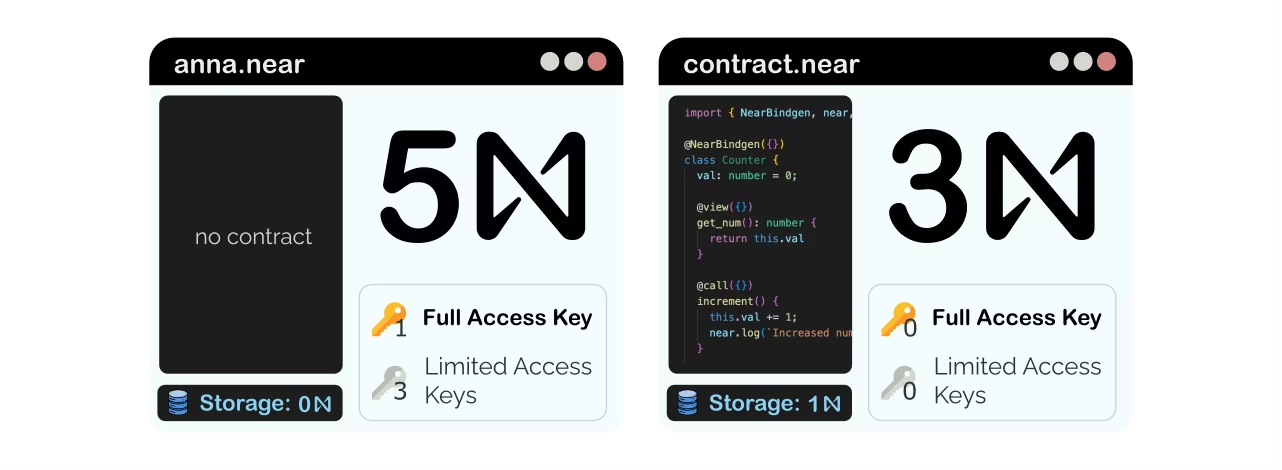
Users participate in the NEAR ecosystem through their NEAR accounts. These accounts are identified by a unique address, can optionally hold a smart contract, and are controlled through Access Keys.
By signing transactions with their account, users can:
- Send and receive digital assets (such as tokens or collectibles)
- Create and interact with on-chain applications known as smart contracts
- Control accounts in other chains (such as Ethereum or Bitcoin) ✨
- Help onboard new users by covering the costs of their transactions (gas fees)
[!TIP]
Want to create an account?
Check out our tutorial on Creating a NEAR Account to get started!
Account Model Overview
Let's take a closer look at the different elements that compose the NEAR account model.
Account ID
NEAR natively implements multiple types of addresses, including:
- Named accounts such as
alice.near, which are simple to remember and share - Implicit accounts such as
fb924c...(64 chars), derived from aned25519private key - Ethereum-like accounts, controlled by Ethereum wallets
- Deterministic accounts such as
0s85f17...(42 chars), derived from their initial code and storage - Universal accounts such as
0u0000...(54 chars), derived from their initial code, storage, and keys
Multiple Keys
NEAR accounts can have multiple keys, each with their own set of permissions:
- You can easily swap keys if one gets compromised
- You can use keys as authorization tokens for third-party applications
Smart Contracts
NEAR accounts can optionally hold an application - known as a smart contract - which can store data and expose functions to interact with it.
Comparison With Ethereum
If you're familiar with development on Ethereum, it's worth making a quick note about how accounts are different. The table below summarizes some key differences:
| Ethereum Account | NEAR Account | |
|---|---|---|
| Account ID | Public Key (0x123...) |
- Native named accounts (alice.near) - Implicit accounts (0x123...) |
| Secret Key | Private Key (0x456...) |
Multiple key-pairs with permissions: - FullAccess key - FunctionCall key |
| Smart Contracts | Synchronous execution | Asynchronous execution |
| Gas Fees | In the order of dollars | In the order of tenths of a cent |
| Block Time | ~12 seconds | ~600 milliseconds |