

HSP-029: Establish a 24-Month Issuance Ramp to a 1.6% Target Rate Of NEAR Token Emissions
- hos_officialOP 7
Frontmatter
HSP: 029
Title: Establish a 24-Month Issuance Ramp to a 1.6% Target Rate Of NEAR Token Emissions
Description: Reduces NEAR's maximum protocol issuance from 2.5% to a target 1.6% target rate on a smooth 24-month per-epoch ramp, retaining the measured 90/10 split.
Author: Sal Ternullo (SVRN), @salternullo
Discussions-to: https://houseofstake.org/proposals/29
Status: Succeeded
Track: Decision
Type: Super Majority
Category: Economic Governance
Stakeholders: Validators, delegators, NEAR token holders, House of Stake
Created: 2026-10-07
Requires: HSP-001
Actionable Insights
This proposal reduces NEAR’s maximum annual issuance from 2.5% to 1.6% on a smooth 24-month per-epoch ramp of roughly 3.75 basis points per month (0.0375%), with the measured 90/10 staker-treasury split retained exactly.
Only one parameter changes. No new emissions mechanism, no redirected validator rewards, no new spending program, no oracle, no administrator. This is the simplest protocol change that delivers a material reduction.
Modeling indicates the ramp avoids 11.8M NEAR of issuance over two years and 66.1M over six years which is a supply 4.36% smaller than the status quo and worth roughly $153M at today’s price, while gross staking yield declines from 4.80% to 3.93% and 3.07% across the first two years.
The cost to a token holder that is staking their assets is small and measurable. A holder staking 1,000 NEAR ends year two with about 20 fewer NEAR than under the 2.5% inflation regime. In this context, NEAR needs to be worth 1.66% more, or 7.9 cents, for that holder to be exactly whole.
Every holder who does not stake, which is currently 57.3% of supply, is better off immediately and with no offset at all.
Impact on validator viability is real and disclosed: on measured ownership, 24 of 405 pools lose economic self-sufficiency at spot at the target rate, however the measured evidence in Section 4 shows issuance was never sustaining the long tail in the first place.
Solana ratified an equivalent change on 28 August 2026 (SGP-0002, 67.001% of stake). NEAR’s proposed path reaches a higher target yield (3.07% vs 2.25%) on a shallower yield cut (36% vs 62%) while delivering a deeper six-year supply reduction (4.36% vs 2.60%).
Every simulation below is measured against NEAR mainnet at block 216,701,043 on 22 September 2026, at a spot price of $4.30 cross-checked across Kraken, Coinbase, and CoinGecko, and reproduces from public endpoints using the method in the Reproducibility section.
Abstract
This proposal reduces NEAR’s maximum annual protocol emissions issuance from 2.5% to 1.6% over 24 months on a smooth per-epoch ramp, retains the measured 90/10 split exactly.
Why this, and why now. On August 20 Illia Polosukhin withdrew the Sovereign Fund proposal and, in doing so, named the problem more precisely than forum discussions previously had. A fund that generates yield needs discretionary management to determine where capital allocation and determination of who receives it; both are judgment calls; and replacing validator rewards that are algorithmic today with an allocation, however well governed, converts security from something the protocol guarantees into something a human process decides. In his words, these are “risks the protocol should not internalize.” He asked that the alternatives raised in that thread be proposed on their own terms. This is one of them.
SVRN engaged in that discussion on August 5 in support of the fund’s direction and proposed a controls framework for it. The feedback that followed from validators, token holders, and finally from Illia persuaded us that the problem was discretion itself, not the controls around it. This proposal is what follows from taking that conclusion seriously and iterating on the idea. In this proposal we suggest a change to one parameter on a published schedule, with no fund, no administrator, no allocation, and nothing left for anyone to decide.
What this proposal does not do. It creates no spending program, no eligibility test, no oracle, and no registry. Earlier drafts paired the ramp with a treasury-funded Node Floor guaranteeing machine-cost coverage for validators; every construction we tested required either a price oracle and an administrator, or a beneficial-ownership registry to resist Sybil farming, which is incompatible with the privacy architecture NEAR is building. The evidence that motivated the floor is retained in Section 4, because it is the reason the ramp is defensible. The mechanism is not.
It does not touch protocol revenue. Intents fee-switch buybacks, and any other revenue removed from circulation, stay removed. Nothing in this proposal creates a path for that NEAR to re-enter the market, and nothing here should be read as reopening that question.
Every simulation below is measured against NEAR mainnet at block 216,701,043 and reproduces from public endpoints using the method in the Reproducibility section.
Context
Three measurements taken directly from mainnet drive this proposal.
First, the issuance split is 90/10. Measured by observing total supply growth against treasury.near inflow over identical block windows of 7, 28, and 92 days: the treasury’s share is 10.13% in every window, and gross realized issuance is 2.45%, slightly below the 2.5% cap because transaction fees are burned. This supersedes the commonly cited 96/4 figure.
Note for implementers: the protocol_reward_rate config field returns 0/1 following the July 2026 network upgrade and must not be used to verify the split. Supply-drift measurement over an identical window is the reliable method.
Second, the long tail of the validator set holds almost no capital of its own. We labeled all 406 active pools by owner identity, delegator count, and owner staked balance. In the 163-pool entry cohort between 30k and 60k of stake, the median operator runs 40,130 NEAR of delegated stake against 19 NEAR of its own, which is 0.05% of the capital. The median owner’s liquid balance is 1.4 NEAR. Across the whole set the median owner self-stake is 128 NEAR.
Third, stake is leaving while the price rises, and that tells us something about what retains it. NEAR has appreciated 86% in the two weeks before this measurement, from $2.31 to $4.30. Over the same fortnight the staking ratio fell from 46.92% to 42.71% as roughly 54.5M NEAR was unstaked, and the active set contracted from 424 validators to 406. Gross staking yield did not fall during that period; it rose, from 4.796% to 5.268%, precisely because the denominator shrank.
This matters for the central question this proposal is asked to answer. If yield were what retains stake, a period of rising yield would retain it. Instead stake left into price strength, and the proposal queue grew from 416 candidates to 459 — more candidates now wait for a seat than hold one. Stake responds to price and to the opportunity cost of liquidity, not principally to the emission rate. The active set stands at 406 validators, 100 block producers and 306 chunk-only.
The network measured on September 22, 2026
Metric Value Measurement block 216,701,043 Total supply 1,306,946,399 NEAR Total staked 558,165,227 NEAR (42.71%) Active validators 406 (100 block producers, 306 chunk-only) Proposal queue 459 candidates Minimum active stake 9,428 NEAR Issuance split 90% to staking participants / 10% treasury (measured 10.13%) Realized gross issuance 2.45% (below the 2.5% cap; fees burned) Distinct pool owners 397; no owner controls more than 3 seats Median owner self-stake 128 NEAR (entry cohort: 19 NEAR) Gross staking yield 5.268% at 2.5%; 3.372% at 1.6% Problem
NEAR emitted roughly $51M more per year than validator economics require, and continues to do so. The bootstrapping job that high issuance performed is largely complete: the network is established, the validator set is oversubscribed, and continued elevated issuance now adds sell pressure without the offsetting distribution benefit it once purchased.
Dilution is a transfer with deadweight loss. Issuance beyond the security threshold transfers value from holders who do not stake to holders who do. Just over half of NEAR supply at 57.3% is not staked and receives nothing in return for that transfer.
Tax drag leaks value out of the network entirely. Staking rewards are ordinary income in many jurisdictions, so a portion is sold to cover tax. At the roughly 17% effective drag estimated in the Solana debate, NEAR leaks about 20M in emissions per year`. This proposal reduces that leak by $8M to $17M annually. That value does not move between NEAR holders, it just gets absorbed by tax authorities.
Persistent issuance distorts the price signal. At 2.5%, NEAR issues about 89,517 new tokens every day. In equity terms this resembles a company consistently selling shares in the open market indefinitely. Most charts and dashboards do not properly adjust for it. At the target rate, daily issuance falls to 57,291.
Approach
The ramp. Maximum annual issuance declines linearly from 2.5% to 1.6% over 24 months, applied per epoch at roughly 3.75 basis points per month, with no step dates to anticipate or defend. The measured 90/10 split is retained exactly. A grace period of 90 days follows before the first basis point comes off, allowing wallets, exchanges, custodians, and staking providers to update disclosures.
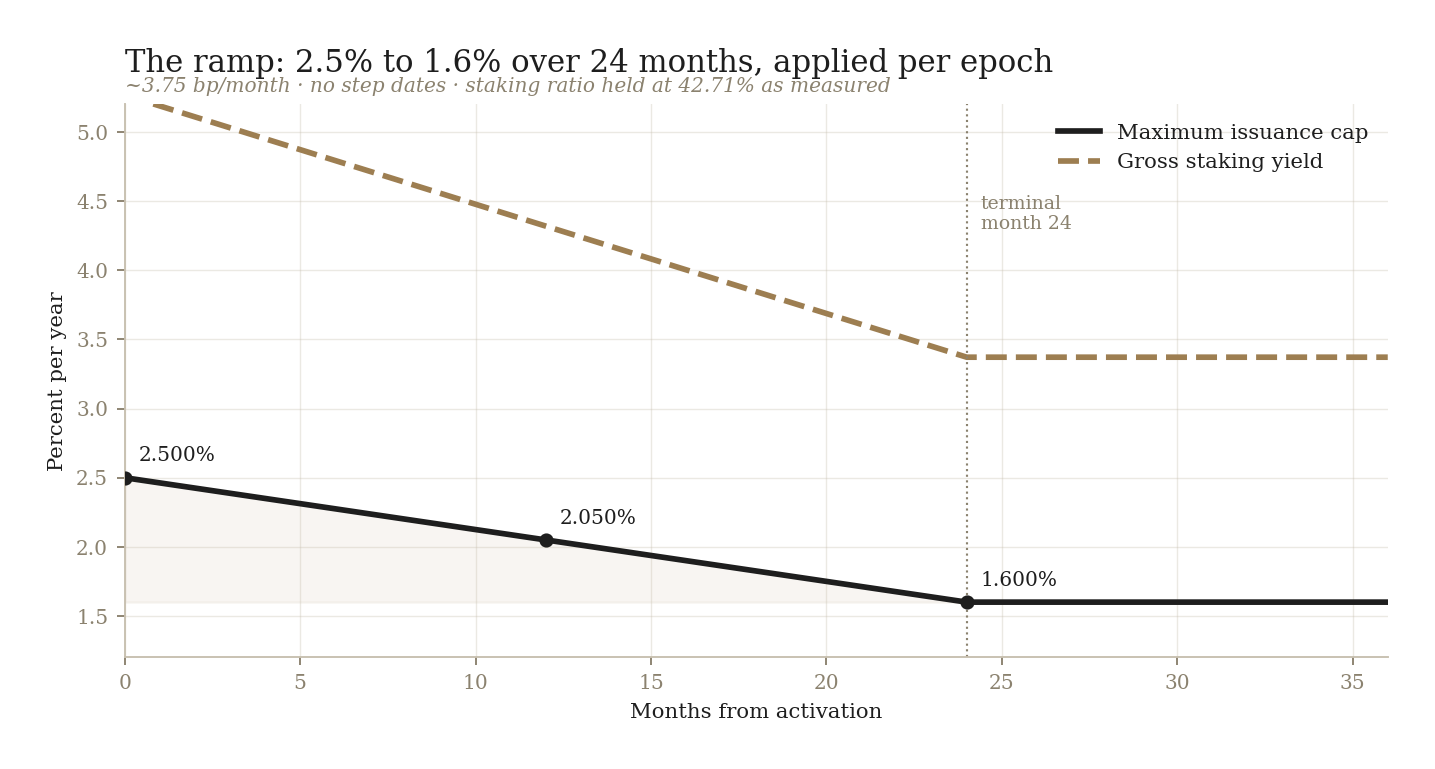
Figure 1. Maximum issuance and gross staking yield under the 24-month per-epoch ramp.
Anchor Issuance cap Gross staking yield Adoption (M0) 2.500% 5.268% Month 6 2.275% 4.622% Month 12 2.050% 4.320% Month 18 1.825% 3.847% Month 24 (target) 1.600% 3.372% Notes: ~3.75 bp/month, no step dates, staking ratio held at 42.71% as measured
What This Means for NEAR Holders
Staking rewards are a transfer from holders who do not stake to holders who do. Cutting issuance shrinks that transfer: a token holder staking receives fewer new tokens, and every holder’s ownership share is diluted more slowly. Both sides are computable.
The breakeven for a token holder who is staking
A token holders count grows at 0.9 × π ÷ staking ratio. Compounding the ramp monthly against the current system in which issuance stays at 2.5% forever:
Horizon Cap Gross yield Shortfall Breakeven price move At $4.30 Today (M0) 2.500% 5.268% - - - Year 1 2.050% 4.320% 0.434% +0.434% +3.9¢ Year 2 (target) 1.600% 3.372% 1.827% +1.827% +16.2¢ Year 3 1.600% 3.372% 3.770% +3.770% +16.2¢ A token holder staking 1,000 NEAR ends year two with about 20 fewer NEAR than under 2.5% forever. NEAR needs to be worth 7.9 cents more for that holder to be exactly whole which is about 1.1% a year over three years.
The breakeven percentage does not depend on price. The cents figure does:
Scenario Price Breakeven price Cents needed Shortfall per 1,000 NEAR staked Bear (half of spot) $2.15 $2.186 +3.9¢ $42.85 Spot $4.30 $4.379 +16.2¢ $85.71 +25% $5.38 $5.473 +9.8¢ $107.13 +50% $6.45 $6.568 +11.8¢ $128.56 +100% $8.60 $8.757 +15.7¢ $171.42 Where the breakeven comes from
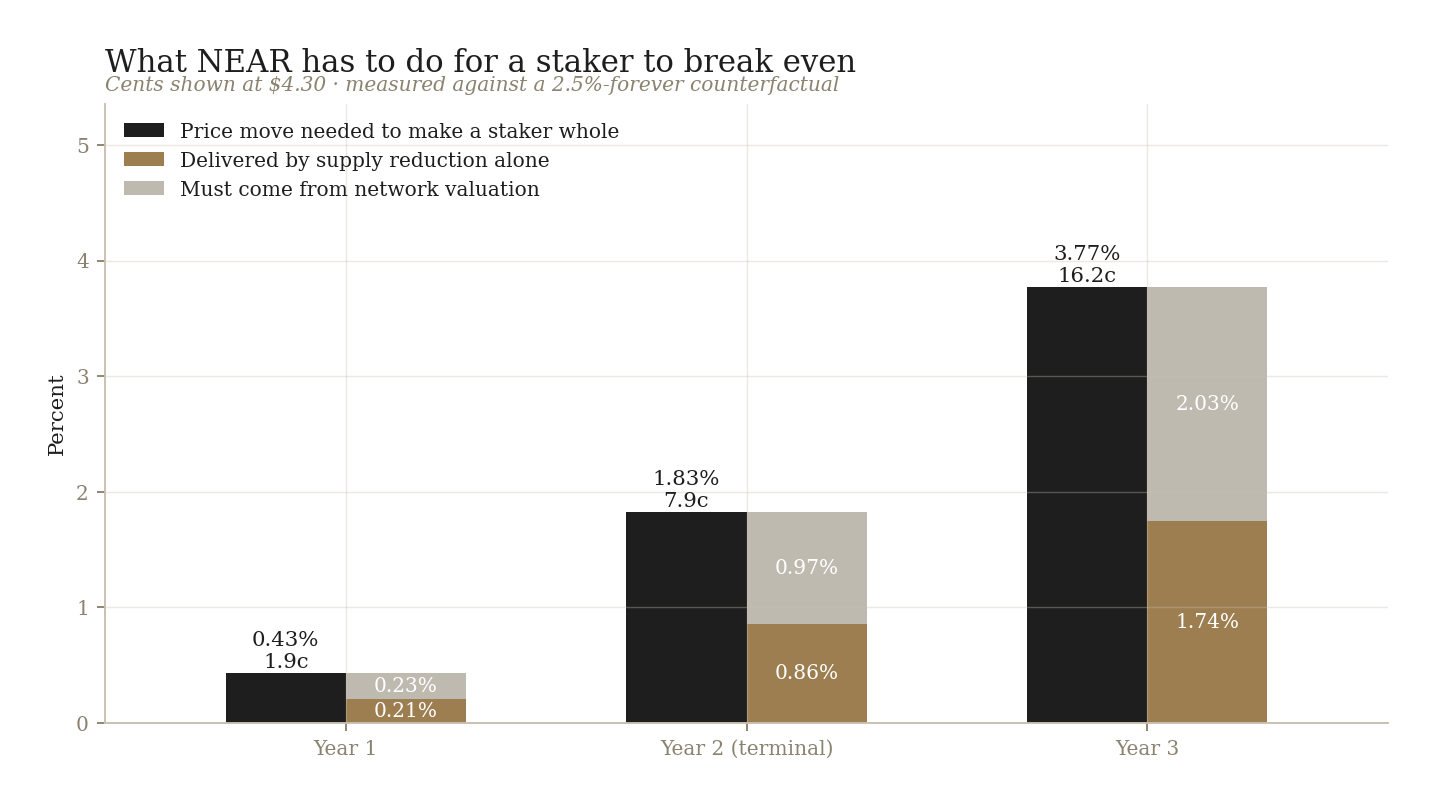
Figure 2. The price move required to make a token holder who is staking whole, and how much of it the supply reduction delivers on its own.\
By month 24 the ramp has issued 11.8M fewer NEAR, a supply 0.857% smaller than the current system. At an unchanged network valuation, a supply 0.857% smaller is a price 0.857% higher. So of the 1.827% a token holder who is staking needs, 0.857% arrives from the supply reduction itself, or a little over half, and the remaining 0.970% must come from the network being valued more highly.
We state that rather than assert that lower issuance pays for itself. Measured against the current state which holds 2.5% indefinitely, it does not quite do so for a token holder who is staking. Two things work in the holder’s favor beyond the table and neither is assumed in it: as yield compresses, some stake unbonds, and a lower staking ratio mechanically raises the yield for everyone who remains; and the current 2.5% rate is not a stable baseline, but a policy under active challenge.
The non-staking holder
For the 57.3% of supply that is not staked there is no offset at all. The full supply reduction accrues as avoided dilution of roughly $86 on a $10,000 position at the target rate with no price change whatsoever.
Cumulative effect
Horizon Issuance avoided Supply reduction Value at spot 2 years 11.8M NEAR 0.86% $51M 3 years 24.5M NEAR 1.74% $106M 6 years 66.1M NEAR 4.36% $284M None of this is spent. It is simply not emitted.
Time is of the essence
The saving is a function of when the ramp starts. Measured over a six-year window:
Ratification delayed by Issuance avoided Forgone vs acting now 0 months 66.1M NEAR - 3 months 62.8M NEAR 3.3M NEAR ($14M) 6 months 59.6M NEAR 6.5M NEAR ($28M) 12 months 53.0M NEAR 13.1M NEAR ($56M) Every month of delay costs roughly $4.7M in emissions that could be saved.
Why the Rate Was Never What Protected the Validator Set
This section is the evidence base for the most common objection to any issuance cut: that it will break small validators.
The table below counts the number of validators whose measured revenue, which is commission on their actual stake plus yield on their actual owner balance, covers machine costs at published benchmarks of $500/month for block producers and $200/month for standard nodes which are deliberately conservative. The finding below holds at any cost assumption we tested, including halving both figures, under which the 300-node level remains unreachable at every rate and every price.
Validator viability against issuance.
The dotted line shows the hypothetical in which every operator self-stakes the stake it actually runs; the gap between it and the solid lines is capital the long tail does not have.
Issuance rate Bear (2.15) Spot(4.30) +50% (6.45) +100%(8.60) 2.5% (today) 133 170 191 209 2.0% 118 159 178 197 ** 1.6% (proposed target) 105 146 169 1.0% 77 118 143 159 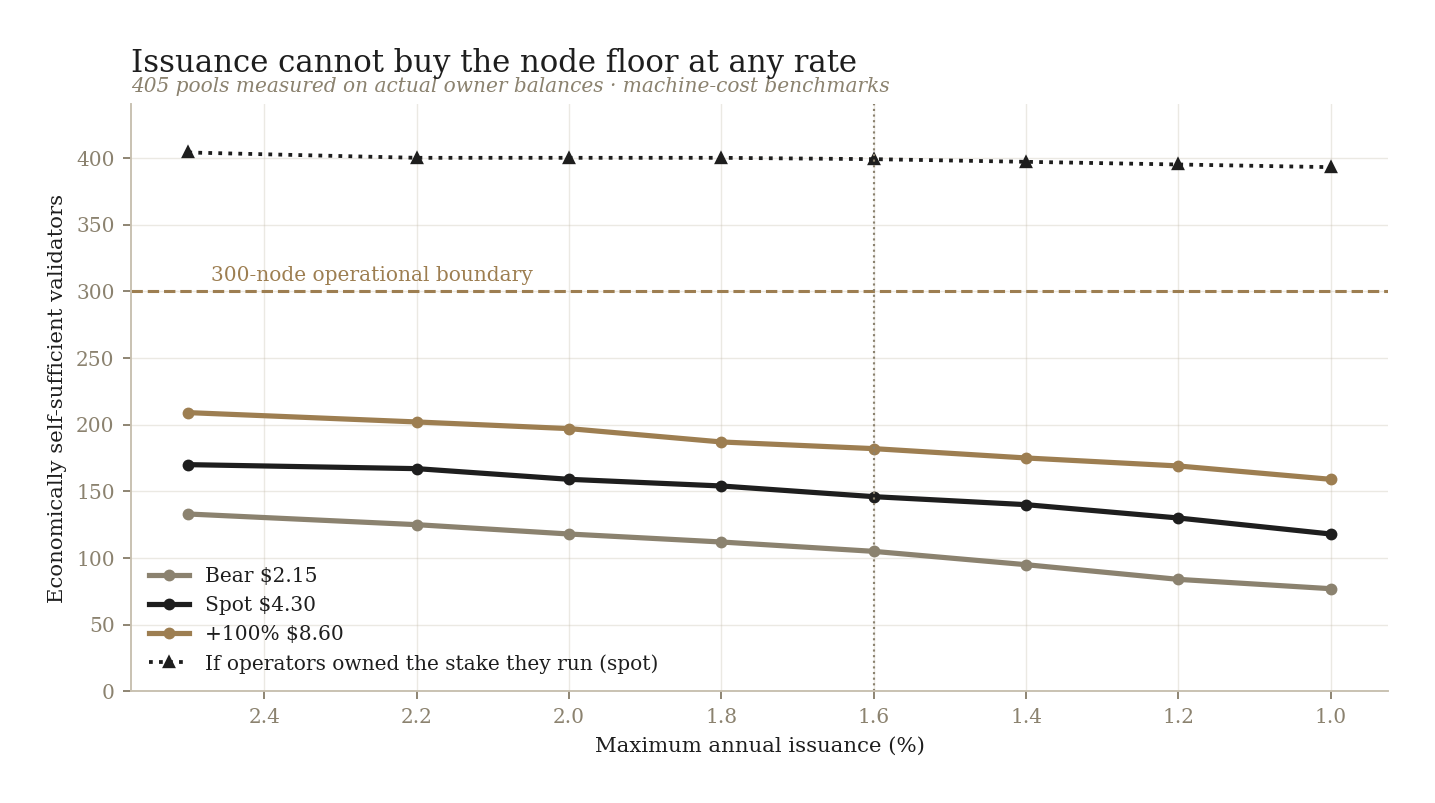
Figure 3. Validator viability against issuance. The dotted line shows the hypothetical in which every operator self-stakes the stake it actually runs; the gap between it and the solid lines is capital the long tail does not have.
Three findings follow, and they are the reason this proposal is a rate change rather than a support program.
No issuance rate at or below 2.5% sustains 300 self-sufficient validators at any price tested, including a doubling of the token. At today’s rate and a doubled price, only 209 of 405 cover their own costs. The 300-node level is not reachable by adjusting the rate in either direction.
The long tail runs on delegation, not issuance against their own stake. The dotted hypothetical reaches roughly 390 viable validators at spot, but only because it assumes operators own the stake they run. They do not, by a factor of about 700 so cutting issuance does not remove protection the tail was receiving, because the tail was not receiving it.
Therefore the inflation rate is the wrong instrument for validator support, in both directions. Raising it would not fix the tail and lowering it does not break the system.
Risks and Limitations
Operators who hold no NEAR have no offset. vadim_hom put this precisely in the Sovereign Fund discussion: a real share of the validator set holds no token at all, and for them an issuance reduction is pure downside; their revenue is being reduced, and they have no upside from price because they never held the asset, which our analysis confirmed. Median owner self-stake in the entry cohort is 19 NEAR. The breakeven analysis above does not apply to these operators; they lose roughly 36% of commission revenue. What we can say is this: their revenue is commission on delegated stake, and delegation follows service quality and fee competition rather than the protocol rate. Any discretionary alternative, i.e. a subsidy program, was rejected by this community and by the fund’s author in writing; Solana accepted equivalent attrition three weeks ago; and an algorithmic support mechanism proposed separately would have our support, if one can be designed without an oracle or a registry.
Validator attrition is real. On measured ownership, self-sufficient validators fall from 170 to 146 at spot and from 133 to 105 at the bear anchor, losses of 24 and 28 respectively. As a share of the set that is comparable to the 30-of-738 attrition Solana accepted in ratifying SGP-0002. The mitigating evidence is Section 4: these operators are largely sustained by delegation rather than by issuance. But this is a cost, and we do not present it as anything else.
Yield compression may reduce the staking ratio. Gross yield falls from 5.268% to 3.372% at today’s participation. The target figure sits above Solana’s ratified 2.25% and in the range of major proof-of-stake alternatives, but the equilibrium staking ratio at that yield is not known with confidence.
Note that the relationship runs the other way as well: a falling staking ratio raises yield, because the same staker share is divided among less stake. At a 30% participation rate the target yield would be 4.80%, above where NEAR sits today. Participation and yield are self-correcting within a wide band.
Constituency risk. The electorate for a stake-weighted vote is composed of the people this compresses. Our answer is the breakeven analysis above, disclosed rather than buried. Two features of the current market make the case easier than it was a fortnight ago: the target yield is now 3.372% rather than 3.069%, because the staking ratio fell, and the breakeven move of 1.827% sits against a token that has just appreciated 86%. The cost is 7.9 cents on a token that moved roughly two dollars in two weeks.
Measurement bounds. Owner balances are measured in the owner account, so operator capital held elsewhere is not counted; the effect is to understate operator capitalization, and the entry-cohort finding is large enough to survive a generous adjustment. Historical validator-set membership is not retrievable from public RPC because epoch information is garbage-collected.
Precedent
Every major proof-of-stake economy has attempted emissions reform. The record is consistent and this proposal is engineered against it.
Network and measure Design Outcome Lesson Cosmos Hub, Prop 848 (Nov 2023) Halve max inflation 20% → 10%, single step Passed 41.1% to 31.9%, 72.7% turnout Breakeven evidence shipped with the proposal Cosmos Hub, Prop 868 (Jan 2024) Push minimum inflation to zero Rejected Communities ratify cuts and refuse zero Solana, SIMD-0228 (Mar 2025) Dynamic market-based emissions targeting stake participation Failed at 37.8% vs 66.67% needed Novel mechanisms and no operator floor lose badly Solana, SIMD-0553 (Aug 2026) Resource-based fee burn Failed to reach supermajority Complexity loses even in a favourable window Solana, SIMD-0550 / SGP-0002 (Aug 2026) Double the disinflation rate; one parameter Passed at 67.001% vs 66.67% needed Simplicity wins The most instructive pair is the last two. SIMD-0550 and SIMD-0553 were proposed by the same team, in the same window, to the same electorate. The change to the single issuance parameter passed and the one that restructured a resource-based fee mechanism did not.
NEAR against the schedule Solana just ratified
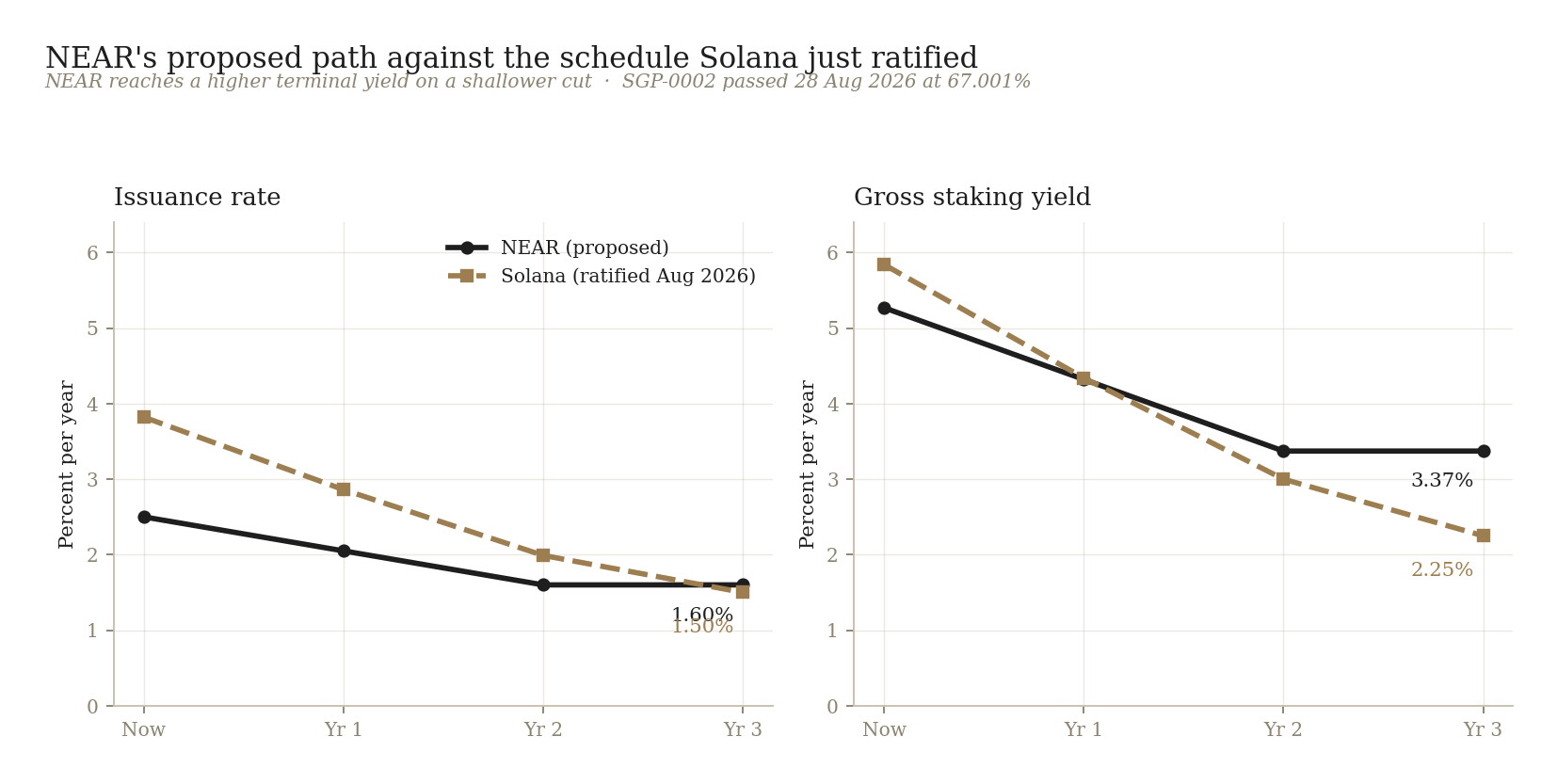
Figure 4. NEAR’s proposed path compared to SGP-0002, ratified 28 August 2026.
Metric NEAR (proposed) Solana (ratified) Start → target rate 2.500% → 1.600% 3.82% → 1.50% Time to target 24 months 2.8 years Parameters changed 1 1 Gross yield today → target 4.80% → 3.07% 5.84% → 2.25% Yield compression 36.0% 61.5% Supply reduction, 6 years 4.36% 2.60% Validators losing viability 24 of 405 (5.9%) 30 of 738 (4.1%) NEAR arrives at a higher target yield on a shallower yield cut while delivering a deeper proportional supply reduction, because NEAR starts from a lower rate with a higher staking ratio. A delegator comparing the two networks after both schedules complete finds NEAR paying more.
End-to-End Value Hypothesis
Objective
Reduce maximum issuance to a 1.6% target on a schedule the market can verify epoch by epoch, and make it the final scheduled change.
Expected outcome
Holders retain 11.8M NEAR over two years and 66.1M over six that would otherwise be emitted; the schedule is predictable and bounded; monetary policy stops being relitigated.
Dependencies
This proposal cannot take effect on a House of Stake vote alone. The issuance cap is a protocol parameter, and changing it requires validator adoption through the standard upgrade process, which is the same path the 2025 halving took, at 68.41% approval. House of Stake ratification is necessary, however validator adoption is ultimately what makes it binding. That two-step structure is deliberate: it means the people who operate the network must independently consent to the change, and it answers directly the concern that House of Stake’s current participation level does not by itself constitute a mandate over protocol economics.
Key Performance Indicators
-
Ramp integrity: realized issuance versus schedule, per epoch.
-
Set health: raw and distress-filtered operator counts, queue depth, staking ratio.
-
Supply outcome: cumulative issuance avoided against the 2.5% current state.
Technical Specification
cap(t) = 2.5% − 0.9% × min(t, 24)/24where t is months elapsed from activation, interpolated per epoch. Activation occurs one full quarter after ratification. The 90/10 split is unchanged.
Treasury
This proposal does not make a claim on the protocol treasury or establish a budget request.
Backwards Compatibility
The ramp is a protocol parameter change requiring validator adoption. No other consensus logic changes, the 90/10 split is unchanged, and no existing contract or staking mechanic is modified. HSP-007 continue under their own terms.
Security Considerations
Reducing issuance reduces the cost of acquiring stake-weighted influence at the margin. At the target rate NEAR’s yield remains above the level Solana has ratified, and the 24-month schedule provides time to respond to any observed decline.
There is no trigger under which emissions increase. The question was asked in the Sovereign Fund discussion whether there should be a security-budget floor at which emissions automatically resume. Our answer is no, and the reason is not indifference to the security budget. An issuance schedule that can rise is a schedule the market cannot underwrite: every institution pricing NEAR would have to price the probability of re-inflation, and every adversary would have an incentive to manufacture the conditions that trigger it. If the network ever concludes that the target rate is too low, the remedy is a proposal clearing the covenant’s thresholds, a deliberate, public decision, not an automatic one.
Implementation Plan and Milestones
-
Grace period of one full quarter after ratification.
-
Activate the ramp; cap moves per epoch thereafter.
-
Quarterly transparency reports: realized versus scheduled issuance, set health metrics.
-
target rate in force at month 24
Budget & Resources
None requested. This proposal changes a protocol parameter and creates no program, no disbursement, and no administrative function.
Stakeholders
-
Validators gross yield compresses from 5.268% to 3.372%.
-
Delegators roughly 5.00% to 3.20% at the median 5% commission fee, remaining above Solana’s ratified target.
-
Non-staking holders- dilution falls; the full supply reduction accrues with no offset.
-
House of Stake- ratifies, then governs the covenant thereafter; cannot bind validators, whose adoption is separately required.
RACI Chart
Activity / Decision Responsible Accountable Consulted Informed Prepare proposal, substantiate modelling, submit for voting Sal Ternullo / SVRN Sal Ternullo, HSP Author Validators, delegators, protocol developers HoS community Finalize technical specification, including grace period and activation conditions Sal Ternullo / SVRN NEAR One Protocol developers; validators HoS community; NEAR ecosystem Implement, test, and release the protocol upgrade NEAR Protocol Working Group — NEAR One — Validators; House of Stake Security Council HoS community; NEAR ecosystem Independently adopt the upgrade through the standard protocol process Validator operators Each validator operator, for its own adoption decision Protocol developers HoS community; NEAR ecosystem Coordinate activation readiness and publish the confirmed schedule NEAR One — NEAR One — Protocol developers; validators Wallets, exchanges, custodians, staking providers, tokenholders Monitor issuance against schedule, validator-set health, and cumulative issuance avoided Sal Ternullo / SVRN — NEAR One — Protocol developers; validators HoS community; NEAR ecosystem Publish quarterly transparency reports and verify completion at the target rate House of Stake team — Sal Ternullo / SVRN — NEAR One, protocol developers, validators HoS community; NEAR ecosystem Reproducibility
Split measurement. Read the chain head and an earlier block from the same node; take total_supply from each header and treasury.near account state at both heights. The treasury share is the ratio of treasury inflow to supply growth over the identical window. We measured over 7-day, 28-day, and 92-day windows and obtained 10.158%, 10.130%, and 10.129%. Do not use protocol_reward_rate.
Validator set and ownership. validators for the active set and proposal queue; per-pool view calls get_reward_fee_fraction, get_owner_id, get_number_of_accounts, and get_account_staked_balance for fees, ownership, delegator counts, and owner self-stake. All 406 active pools were labeled.
Historical staking participation. Epoch validator sets are not retrievable from public RPC, but pool state is: get_total_staked_balance resolves against archival RPC at any height. We summed that call across the 150 largest current pools — 96.5% of stake today — at monthly block heights over twelve months, divided by total_supply from the header at each height, and paired each point with the CoinGecko daily close. Because the sample is defined by today’s composition, it understates the level by roughly 2.2 points at the calibration point (40.55% sampled against 42.71% measured across all 406 pools); the band cited in Clause B is stated on the adjusted basis. The correlation and the direction of the relationship are unaffected by the offset, since it applies uniformly across the series.
Endpoints. rpc.mainnet.near.org and free.rpc.fastnear.com; archival via archival-rpc.mainnet.near.org and archival-rpc.mainnet.fastnear.com. Non-archival endpoints garbage-collect epoch validator information, so historical set membership is not retrievable from them.
Datasets. The full validator dataset and ownership map accompany this proposal.
Conflicts of Interest
Sal Ternullo is CEO of SVRN (OceanPal Inc., NASDAQ: SVRN). SVRN holds approximately 55M NEAR, 90+% of which is staked, composing 8+% of staked supply. SVRN operates NEAR validator infrastructure through third party infrastructure partners. SVRN authored HSP-007, the MPC Node Infrastructure Financing Program, and operates an MPC node that receives payments under that program. SVRN intends to vote in favor of this proposal with these disclosures standing.
What this proposal does and does not touch. It does not alter HSP-007, does not touch the treasury that funds it, and creates no program from which SVRN could receive an allocation. There is no spending, no eligibility, and no administrator anywhere in it. The only thing it changes is a protocol parameter that applies to every token holder who stakes identically.
On SVRN’s position. This proposal reduces the staking yield SVRN earns on its entire staked position from 5.268% to 3.372%, costing roughly 855,000 NEAR per year at the target rate. On the breakeven arithmetic above, SVRN’s position requires the same 1.827% price move as every other token holder who is staking to be made whole, and SVRN is on the losing side of that arithmetic in exact proportion to its size.
On SVRN’s accumulation. It was argued in the Sovereign Fund discussion that SVRN’s stated intent to accumulate a significant share of supply already absorbs several years of issuance at 2.5%, and that no reduction is therefore needed. We would put it the other way around. A public company’s treasury allocation is not monetary policy; it can change at any board meeting and a network should not rely on it as if it were. A network whose new supply is absorbed by a single buyer has concentration risk, not health. And a lower issuance rate means SVRN absorbs less of the float over any horizon, not more, which is the opposite of what a company seeking to maximize its share of the network would propose, and which should reassure precisely the people most concerned about SVRN’s footprint.
Copyright
Copyright and related rights waived via CC0 1.0.
-
- cloudmex-alan 4
Following my previous comments, the numbers do a good job justifying the cut, but not the destination.
What is this meant to support: NEAR Intents, agentic tokenomics, AI, or token sustainability? And beyond Intents buybacks, what drives demand and utility for the token?
The discussion post pointed to a fixed supply, while the formal proposal frames 1.6% as the final change. Those are two different endgames.
So I’m leaning no for now. Not against lower issuance, I’d just like to know where we’re going before choosing the road.
" — Would you tell me, please, which way I ought to go from here? — That depends a good deal on where you want to get to."
- rdp4by
I support this proposal as a holder, but I do not host a node myself. Is there a way to find out my validator’s stance on this proposal in advance? If their choice doesn’t suit me, I would like to transfer my tokens to a validator who supports this update.
- SalTernullo
Hi Alan,
Thanks for the note and comments. The word ‘final’ in the post above was intended to refer to the last step down of this proposal to target 1.6% rather than saying this is the end game, which we described in Phase 2.
Extending your analogy, the direction of travel proposed here is clear which is to advance tokenomics towards a target state where inflation does not erode the ownership of holders who do not participate in staking, the network itself does not overpay for economic security, and fail to achieve an outcome where NEAR is meaningfully more valuable over time.
These objectives require work both on the supply side, with this proposal the second in the journey to evolve, and on the demand side which is best exhibited through the continued growth of Intents, NearAI product verticals and other developers / users transacting on the network and burning NEAR.
Hope this is helpful and happy to discuss next week on the ecosystem call if you are joining.
- SalTernullo 1
Yes you reach out to validator and communicate your stance to express support and in doing so, see where they stand. If they are not in favor to upgrade, and assuming this passes House of Stake, you can unbond and delegate to a validator who is supportive.
- chan42870815
Just do it. Immediately.
- arpoas 5
Introduction
This proposal is in reaction to the following proposals and discussions:
-
HSP-XXX: Establish a 24-Month Issuance Ramp to a 1.6% Target Rate Of NEAR Token Emissions
-
NEAR Governance Discussion: Reducing Issuance to 1.6%, and the Path to a Fixed Supply
-
Gradual Transition From Emission-Funded to Revenue-Funded Network Security
-
NEAR Governance Discussion: Sovereign Fund
I have commented in detail on the Sovereign Fund proposal under username Martin.H (changed username for consistency with other platforms) and I re-use some my comments here.
In general, I am in favor of the direction of all of these proposals. They are all trying to find the best way of ultimately achieving fixed supply and long-term funding of ecosystem development.
I was planning to submit my own proposal, and also comment on the “Gradual Transition From Emission-Funded to Revenue-Funded Network Security” submitted by Ivanov. I have decided to submit my related ideas here, because it is apparent that a meaningful discussion on this subject is taking place here.
Importance of net issuance reduction
There is a sound theoretical basis and empirical data that strongly suggest that reducing net issuance is essential for long-term price appreciation.
As for the theory, there is a basic economic law of supply and demand. One aspect of NEAR is to act as a commodity, a fuel within the NEAR network. So at least partially, price of NEAR is determined by supply and demand laws that affect the commodity markets. As long as “structural supply > structural demand” the price is destined to go down over the long term (I mean years, decades). Structural supply is the issuance and structural demand is the burn plus the part of the fees that does not get dumped back on the market. There is also speculative and investment demand/supply, but these are just waves (sometimes huge waves) on the long-term supply-demand driven curve.
As for the empirical evidence: In February 2025 Solana abandoned burning 50% of priority fees. Looking at the price chart of BNB, TRX and SOL it is clear that the correlation changed since February 2025. In my view Solana is technologically superior network to BNB and TRX, yet since February 2025 the price of SOL started dramatically underperforming both TRX and BNB that consistently maintained deflationary policy. Solana community realized the problem and (fortunately for SOL) passed a proposal reducing issuance and another proposal for introducing and burning resource-based fees which was not passed will be most likely presented for vote again in updated version.
The same dynamics can be observed when Ethereum drastically reduced fees and burn, and became inflationary again. Since 5th August 2021 to 13th March 2024 when Ethereum was deflationary it underperformed TRX and BNB just around 30% for the whole period of almost 3 years. Since it become inflationary it underperformed TRX 400% and BNB 100% in approximately 2 years. The “supply > demand” imbalance is no joke.
Also look at Avalanche which is arguably one of the more interesting projects in the industry with good tech, huge amount of RWA, many real world real deal use cases and used by some big players. Unfortunately for AVAX, they barely charge any fees and just let people create subnets for close to free, so the “supply > demand” imbalance is so huge that AVAX is not even in top 20.
Finally, we can look at NEAR itself. It was suffering for a long time from this same imbalance. But since the issuance reduction and NEAR Intents burn introduction, NEAR became a project with one of the lowest “supply > demand” imbalances in the industry. Not surprisingly, NEAR price started showing some significant strength.
Preserving decentralization
I can not stress enough how important decentralization is, especially in the case of NEAR.
It is a huge unique competitive advantage that NEAR has right now. How many sub-second blockchains with meaningful usage that have more than 400 validators exist at the moment? Solana will become one once it implements Alpenglow. Avalanche is close but the finality is not consistently sub-second. As far as I am aware, that´s basically it. NEAR and Solana. How many sub-second blockchains or L2´s there are with around 100 validators or less? A lot … Would NEAR rather occupy its current unique position or join the “almost decentralized blockchain” crowd? I don´t mean to degrade the successes of the more centralized blockchains, but the difference in security and censorship-resistance should be clearly acknowledged and valued. It is much easier and cheaper to bully, bribe or shut down 20 or 100 validators than a geographically diversified set of 500. I would personally never leave significant funds over which I intend to have sovereign control on a blockchain with just 100 validators.
NEAR positions itself as a pillar of sovereignty for AI, assets, data and agents. From this perspective, decentralization is absolutely critical for NEAR vision.
The problem
Any major change to economics should take the importance of decentralization into account and be supported by objective data and realistic calculations. I admit that I am not a validator, and my data comes from simple Google AI prompts. Reality check from actual validators is welcome:
-
Monthly cost of running block producer on cloud: minimum $240
-
Monthly cost of running chunk producer: minimum $50
These costs can be further reduced by running own server “at home”.
-
Minimum stake 25500 NEAR
-
Current minimum block producer stake 600349 NEAR, source: netblocks
-
I will assume that a validator must earn all income from delegated stake and commission 5%.
-
Suggested terminal issuance is 1.6% leading to estimated yield 3.2%.
Math for smallest block producer: Annual cost is $2880. To earn this at a 5% commission the gross income must be $57600. At 3.2% yield, the value of the stake must be $1800000. With 600349 NEAR staked this gives NEAR break-even price $3.
Math for chunk producer: Annual cost is $600. To earn this at a 5% commission the gross income must be $12000. At 3.2% yield, the value of the stake must be $375000. With 25500 NEAR staked this gives NEAR break-even price $15.69.
Whereas block producers are perfectly fine, there is clearly a problem for chunk producers with small delegated stake.
Solution
How to solve it:
-
Make a minimum mandatory commission 5%. This will deliver several benefits:
-
Prevents large validators from pricing small validators out of the market with zero or close to zero commissions.
-
It may motivate stakers who have significant capital and technical competences to become validators. Now it is possible to just delegate NEAR with 0% commission so why go through all the hassle of setting up a validator? But if the cost becomes 5%, then for some large NEAR holders it becomes more profitable to set up own validator.
-
It will make it possible to calculate adequate staking support for small validators more accurately, because the commission parameter will be known.
-
-
Support small validators from NEAR Intents revenue while making sure it NEVER enters circulation. Stake the revenue algorithmically based on fixed objective criteria such as up-time > 97%, stake size < 100000 NEAR, and commission 5%.
The yield earned on these stakes can initially be sent to equivalent of buyback account, until consensus is reached on how to use it. It is outside the scope of this proposal to suggest which particular entity should manage these funds.
It is essential, that the original amount of NEAR taken out of circulation as a result of NEAR Intents revenues stays staked forever, never enters circulation, and this is programmatically ensured.
The SVRN proposal is to reduce the issuance from 2.5% to 1.6% over the period of two years. Revenues from NEAR Intents taken out of circulation for three months Jul-Sep 2026 were 1274075.98 NEAR. Extrapolating the Jul-Sep 2026 data we can estimate revenues around 10M NEAR for two years. Currently there are around 200 validators with stake below 100000 NEAR. They could be supported by 50000 NEAR stake each from these revenues.
If we run the math for small validator again incorporating these suggestions: Annual operating cost is $600. To earn this at a 5% commission the gross income must be $12000. At 3.2% yield, the value of the stake must be $375000. With 25500 NEAR staked + 50000 NEAR stake from NEAR Intents revenue, this gives NEAR break-even price $4.97.
In my opinion, $4.97 is a reasonable break-even level because it is near the current price and:
-
BTC according to its 4 years cycle should be now bottoming. I would not bet everything on BTC cycle, but definitely BTC, as well as the rest of crypto market, is not in euphoria stage.
-
The reduction of issuance will further support the price, both as a signal to the market that NEAR prioritizes sound economics, and as the inevitable laws of supply and demand shift the market towards more price-supportive state.
Advantage of staking compared to revenue distribution
This solution allows for issuance to be reduced without significant impact on decentralization by disproportionately supporting the validators most affected by the issuance reduction.
If NEAR Intents revenue would be used to offset reduced issuance by distributing it to validators, then, using the same assumption of revenue 5M NEAR p.a and current annual issuance around 32M NEAR, it would enable reduction of issuance to 2.1% The net effect of issuance reduction to 2.1% combined with revenue distribution would be zero on all validators. It would be equivalent to keeping issuance at 2.5% and small chunk producers would need break even price $9.4.
However, if the revenue is algorithmically staked with smallest validators as suggested, then the break even price drops to $4.97 and issuance can be reduced to 1.6%. In the same time, the revenues do not enter circulation, as they would if they were paid as yield to validators to offset issuance reduction. They remain staked forever, effectively out of circulation equivalent to burn, and in the same time continue supporting the ecosystem indefinitely, rater than being spent during the year to cover operating costs.
Effect of higher NEAR price due to reduced net issuance
So far I have focused only on the effects of the yield reduction on the ability of validators to cover their operating costs. While yield is relevant, NEAR price also affect the break-even stake required for a validator to cover his costs. For example, if price of NEAR was $10, then a small validator would need only 37500 NEAR delegated stake to cover his cost at 5% commission and 3.2% yield.
Even more consequential impact of the price trajectory of NEAR is the return on investment on the staked NEAR, which represents the biggest economic investment in NEAR security.
It is true that, if the above solution is implemented, stakers will be getting lower percentage yield. Nevertheless, ultimately stakers will benefit due to the appreciation of their stake relative to the state of higher issuance. Economic theory as well as empirical evidence from crypto space (as discussed above in the section related to issuance reduction) suggest very significant long-term impact of net issuance reduction on asset price. Sooner or later most long-term stakers will realize that it is better to have for example 3.2% p.a. yield on low or zero issuance asset that appreciates 30% p.a., than having 5% yield on asset with systemic over-supply that depreciates 5% p.a.
Off-setting issuance reduction with revenue distribution
There is a proposal “Gradual Transition From Emission-Funded to Revenue-Funded Network Security” which suggest distributing revenues to validators and reducing issuance based on revenues in the weakest month from last observed twelve months.
In principle, I agree with that proposal with slight modification:
-
Initially, do not use revenue to directly off-set issuance. Use it to support small validators as described above. With same amount of revenue it allows greater issuance reduction and in the same time greater small validator support.
This phase would last until there is enough staked NEAR for small validator support. I suggest a simple fixed target 10000000 NEAR which can support 200 smallest validators with 50000 staked NEAR.
-
After break-even for smallest 200 validators is secured, the benefits from further validator support are diminishing, so any further revenue should be used to offset issuance.
Replacing issuance with revenue is the most natural, systematic and clean way to reach zero issuance. If it is technically possible, I would suggest adjusting the issuance dynamically after each epoch, day, week, or whatever period is technically easiest to implement. Revenue would be paid to validators and issuance reduced by the same amount for the next period. If revenue for given period is higher than issuance, then keep the surplus in reserve for future periods. From validator/staker perspective there would be no change in income.
-
Monitor the revenues, and once the average revenue for the period of last 4 years (BTC cycle, FED money printing cycle) is higher than issuance, then stop issuance. Alternatively, instead of stopping issuance immediately, automatically set the nearest rounded number of total NEAR in circulation as a target for stopping issuance (such as 1.4B, 1.5B). This way the NEAR fixed supply would be easy to remember and work with for centuries to come.
Fixed supply rather than infinite burn
The objective of all above mentioned proposals is ultimately to move to a state where there is no issuance, and the security and ecosystem development is financed from revenues. This is inevitable natural direction of long-term economic sustainability, which all surviving blockchains will get to at some point. NEAR is now one of very few blockchains that may be soon able to actually afford it.
Once the state of zero issuance is achieved, we are looking at an asset that is not bound to depreciate over the long term due to systemic oversupply. Consequently, the calculus of intelligent investors changes. It starts to make sense to be looking at “P/E” and yield.
At that point, directing all revenues towards staking yield and ecosystem funding will bring more benefits than burning it and further reducing supply for the following reasons:
-
NEAR will be more transparent and easier to value as an investment instrument with fixed supply. Instead of several moving parts – issuance, revenue, burn – there is just one moving part: revenue. Money likes simplicity.
-
When the asset is not inflationary, then higher yield will motivate all investors to invest and to stake, including professional investors who may have been not motivated by yield during the times of issuance and systemic over-supply.
-
The question “What happens when all NEAR is burned?” does not arise. Fixed supply is intuitively a state sustainable indefinitely compared to infinite burn. It is the neutral and balanced long-term choice where the economic model does not have to be touched ever again.
-
Having a source of infinite ecosystem funding can lead to new projects that will bring asymmetric benefits surpassing potential price increases from further buy-backs.
Proposal summary
My proposal supports the reduction of issuance to 1.6% as suggested by Sal / SVRN and it introduces additional measures to preserve decentralization, ensure long-term ecosystem funding and move smoothly towards fixed supply.
Phase 1: Issuance reduction with decentralization support
-
Reduce issuance gradually to 1.6% as suggested by SVRN.
-
Set minimum validator commission at 5%.
-
Algorithmically stake revenues with up to 200 smallest validators who meet fixed clearly defined criteria: up-time > 97%, stake < 100000, commission 5%.
-
Ensure algorithmically that the original revenue taken out of circulation is NEVER unstaked. Technically, parts can be unstaked and immediately staked again for rebalancing purposes as the list of smallest validators changes. By “NEVER unstaked” I mean never leaving the pool intended for staking with smallest validators, and never entering circulation.
-
Yield from the staked revenues temporarily direct to equivalent of buy-back account until consensus is reached on how to use it.
-
Phase 1 lasts until 10M NEAR from revenue income is staked in support of smallest validators. Then Phase 2 is activated.
Phase 2: Replacing issuance with revenue
-
Start adjusting the issuance dynamically after each epoch, day, week, or whatever period is technically easiest to implement. Revenue is paid automatically to validators and issuance reduced by the same amount for the next period. If revenue for given period is higher than issuance, then the surplus is kept in reserve for future periods.
-
When the revenue for last 4 years is higher than issuance, then automatically set the nearest rounded number of total NEAR in circulation as a target for stopping issuance (such as 1.4B, 1.5B). Once the target circulation is reached, stop issuance and activate Phase 3.
Phase 3: Fixed supply … NEARvana
-
Zero issuance.
-
90% of revenues paid to validators / stakers as yield.
-
10% of revenues to finance ecosystem development.
This phased approach provides economic predictability and minimizes the number of changes to economic model. If implemented in its totality it could actually be the last change to NEAR protocol economics. It accounts for gradual transition towards fixed supply, while adequately supporting most affected validators, and ensuring clear path towards future long-term funding of the ecosystem development.
Support of the SVRN proposal
I don´t see my proposal as competitive or conflicting but rather complementary. The SVRN proposal is “quick simple win” that should be passed and implemented immediately. Mine looks at comprehensive long-term path, and needs careful consideration.
Appendix: Voting and House of Stake
This issue was mentioned several times in the comments in “NEAR Governance Discussion: Reducing Issuance to 1.6%, and the Path to a Fixed Supply”, so although it is outside the scope of this proposal, there is my take on it:
I believe that by initiatives such as “I Am Human” and House of Stake, the leadership is genuinely trying to solve two problems in the context of voting:
-
Reduce influence of short-term speculators
-
Make sure the ultimate beneficiary owners of NEAR tokens vote rather than custodians such as liquid staking protocols, ETF or CEX.
Whereas both these intentions aim to align long-term prosperity of NEAR ecosystem with voting results, for some reason only less than 0.4% of circulation is staked in House of Stake compared to more than 40% in a regular native staking contract (source: AI prompt). May be the low participation is not a problem of the stakers, but the design of House of Stake? I don´t mean to baselessly criticize House of Stake. I am sure it is well-meant initiative. But sometimes it is useful to look at what the market and user data is telling us. And now, after approximately 1 year after launch, the data unfortunately does not point to a meaningful voting participation.
What may be frank and pragmatic reasons for low participation:
-
Extra security / contract risk
-
Need for user education and acquisition for new system
-
Additional user complexity and friction
-
Locking tokens up for future period prior to a significant vote is not fair and is risky for serious investors. If the vote outcome is not what I consider sensible, then I may want to be able to sell the tokens immediately after the vote.
NEAR is experimenting with various concepts to improve governance and I don´t see it as failure. It is research, exploration, evolution.
How to continue this evolution? What are the alternatives?
Enable voting with natively staked NEAR, time-weighted based on period for which the NEAR was staked prior to the vote. Validators vote, but delegators can override the vote for their stake. Preserve the option of delegating voting to white-listed experts.
This has several benefits:
-
No extra security / contract risk. NEAR stays just natively staked. Submitting a vote does not move or lock the token anywhere. It is just a vote transaction enabled by having the stake but not touching the stake.
-
No need for maintaining another staking contracts.
-
Less user friction. Users just hold natively staked NEAR, no lNEAR, veNEAR or any other strange xyzNEAR, and can still vote.
-
Time-weighted stake preserves the benefits of reducing influence of short-term speculators and in the same time removes the uncomfortable and, in my view, unfair future lock-up.
-
Validator is on average more involved community member than holder or passive staker, so it is likely that their voting will be of higher quality and with higher participation. And to prevent validators from having excessive power, any staker can either override the validator vote, or just move the stake to a validator that is in long-term alignment with his conviction.
The trade-off is that liquid staking protocols, ETFs and CEX will be able to vote on behalf of their users without the holders consent. Also, while these entities may be staking NEAR, the holders of ETF, SVRN or users of liquid staking hold liquid immediately tradable instrument. So the vote does not necessarily represent long-term holders.
According to data from Google AI, 75-85% of NEAR is direct native delegation. So the trade-off can be quantified like this: “Is it better to have 0.4% participation, or have potential of 40% participation of which 6-10% may be not direct holders and genuine staking?” (15-25% is not direct native delegation. 15-25% from 40% is 6-10%).
There is also a question whether it is ultimately unhealthy for CEX, ETFs, SVRN and liquid staking protocols to participate in the voting process instead of retail investors who use them or invest in them. They are entities that are important for NEAR token liquidity and investability, and they invested in bringing NEAR to their platforms, so may be they can have a vote? Also if holders are not happy with the way these entities vote, (in ideal world …) they would move their NEAR somewhere else.
If need for more sophistication and complexity arises, further evolutionary step could be to allow all staked NEAR to vote, including custodial, as suggested above, but give more power to direct native delegation. AI agent can identify custodial entities and give them lower weight. If some account is incorrectly flagged by the AI agent as custodian entity, there can be an option to remove the flag by responding to simple gassless cryptographic signature challenge request (this is simple and 100% anonymous) or by using I Am Human (for those who already have it).
-
- vinibarbosa 2
I support this proposal!
Ready to vote FOR it as vinibarbosa.near (300K+ veNEAR).
My support comes both as:
- $NEAR holder
thecoding.pool.nearvalidator operator- Governance delegate & ecosystem contributor
I believe the reduction to the 1.6% target is beneficial in many aspects and a needed direction.
Yes, we might lose some validators and stake percentage (%). These are expected direct negative effects of such a reduction. However, there are many dynamics in play here and the positive aspects could even revert this scenario (as fruit of indirect benefits that reducing emission might cause).
For example, reducing emission reduces holders’ dilution, which encourage more people to hold NEAR for the long run. Holding NEAR for the long run by itself is already net-positive in this scenario, which can compound to staking APY, even when this APY is lower than what it currently is.
Basically:
- Old NEAR holders/stakers may unstake due to the lower APY
- But lower emissions may encourage new holders to come
- Long-term holders can compound the already net-positive holding to staking APY
So, if enough new long-term holders join the ecosystem, this could balance the staking % equation. The same logic applies to departing vs. onboarding validadors.
If the NEAR ecosystem (and tokenomics) is more attractive to a broader audience, we might see new contributors and large stakeholders joining the network and, perhaps, considering being onboarded as node runners and validator operators – building their operations based on the now-approved issuance reduction (1.6% tail emission as a 24-month end goal).
Of course, this is all hypothetical.
Another reason why I support this proposal is because it is well-crafted to work as a solid experiment, with clear guardrails and gradual development, to serve as empirical evidence of whether this proposal is net-positive or net-negative to the ecosystem and NEAR as a whole.
Sal Ternullo (@SalTernullo) and the SVRN team (@SVRN) did a fantastic job here and we have a sound proposal and execution plan to follow.
As a node operator, I will adjust my operations to fit the target rate and I believe it won’t negatively impact them.
My hypothesis is that it may even increase my validator’s long term rewards by NEAR price appreciation and by attracting more contributors, users, services, apps, etc to the ecosystem – all positively compounding for the long run.
As a blockchain researcher, I agree with many other researchers who claim most networks are overpaying for their security, with too high inflation that prevents growth. Nevertheless, I believe this is a thin line to walk over and some issuance is needed for a self-sustainable, decentralized, and permissionless system. I’m against a fixed supply.
The big question lies on: what the right amount (%) is.
I don’t have this answer yet. In the past year (since October 2025, when we reduced emission from 5% to 2.5%), the empirical evidence is that the reduction has had low effects into the staking %, number of validators grew (mostly thanks to delegation cohorts, like MetaPool’s), the ecosystem attracted new contributors/stakeholders, NEAR got broader market attention and the token price benefited from it.
I then support a careful and solid experiment to a 35% reduction (2.5% to 1.6%) to watch will happen then and gather enough data and information to decide whether 1.6% is the right and ideal number, if we can discuss a follow-up reduction, or if reducing was the wrong call and we need to increase it back up.
Overall, I believe it will be highly positive. Hope to be proven right.
- SalTernullo 2
@vinibarbosa thank you, and thanks for putting your perspective in the forum with the different hats you where: holder, operator, and delegate. I think these vantage points give you a unique perspective and I am glad to have your support.
In particular for me, the operator view is critical. The strongest objection to the ramp in both threads is that it pushes small validators out. You run a pool and have looked at the numbers, and its encouraging to know that you will adjust and continue running. That matches what we see in the September validator data and in how the set behaved through the 2025 reduction (342 to 413 validators through a sharper revenue shock than this one). The set has been held up by operators making the same decision you’re making, not by commission margin at the bottom of the distribution.
On the experiment framing, I agree, and it’s why the proposal is built the way it is. Twenty-four months and a linear path provide the basis for us to collect behavioral data over time to inform decisions.
On fixed supply, we may disagree and candidly I will maintain an open-mind to all views, mechanics and prospoals (of which there have been great points raised already in these threads), but ultimately this is not for the current vote. We separated the ramp from the end-state discussion on purpose, so people who want a permanent tail emission and people who want a hard cap can both support the step in front of us. The question of where issuance should ultimately settle and whether some emission is necessary for a permissionless system, deserves its own proposal with its own data and a ton of work across the ecosystem.
Thank you for your engagement, thoughts and support on the current proposal.
-Sal
- SalTernullo 2
@arpoas thanks for this. This is one of the most thorough contributions in either thread, and I want to thank you for time, energy and depth of thought to bring the contribution forward. I had reviewed and contemplated your feedback in previous posts under Martin.H. so I also appreciate you helping me link this. This is long-winded but I wanted to properly respond given the quality of thinking and analysis here and I am open to having a deeper discussion on the matters if you’d like.
I am fully aligned and agree with your sequencing. Candidly the ‘End game’ I framed may have been distracting but it was really intended to solicit. Pass the ramp now and then treat the longer-horizon questions as their own proposals.
On the small validator break-even. Your framing is right, but I’d push on the inputs, because we pulled the full validator set in September and the picture is different from what the back-of-envelope suggests.
-424 active validators, 85 block producers and 339 chunk validators. 211 are under 100k NEAR, so your ~200 is correct.
-At today’s 2.5% and spot price, 269 of those 424 do not cover opex from commission alone. At 1.6% that number is 302. The marginal change from the ramp is 33 pools.
-In 2025 the protocol took a much sharper revenue shock than this ramp and the validator set grew from 342 to 413.My point isn’t that small validators don’t matter it’s just that the set is not held up by commission math on marginal pools. Most small operators run for yield on their own stake, for ecosystem reasons, or as a cost center of a larger business. The ramp doesn’t change that calculus which is a major factor for why the 2025 data looks the way it does, as well as the positive impact of MetaPool’s node studio.
On directing Intents revenue to the smallest validators. We modeled a very similar mechanism (we called it the Node Floor) and removed it before posting because it failed Sybil attack modeling. If the protocol stakes 50k NEAR with any pool under 100k that holds 97% uptime, the rational move is to split one operation into five pools and collect five stipends. Uptime is cheap to fake at that scale and stake size is trivially gameable. Every version we tried either needed an identity layer (which brings back the custodian and verification problems you describe in your appendix) or ended up subsidizing the operators who needed it least. I’d rather see that NEAR accumulate in the protocol treasury as a counter-cyclical security budget, which is where the current draft lands, than build a targeting mechanism we know is exploitable.
On the 5% minimum commission I think this is worth its own thread and discussion. Commission is a staking pool contract parameter, not a consensus parameter, so this is a change to the whitelisted pool contracts rather than a protocol economics vote. It’s also a price floor set by governance, and the pools running at 0-1% today are mostly large commercial operators competing on price in a way delegators benefit from. I’m not against discussing it and building solutions around this, but I do think it shouldn’t be bundled with issuance.
Where we agree completely is the end state. Fixed supply, revenue displacing issuance as the funding mechanism, and a cap at a round number people can remember. We envision 1,432,700,000 ;).
Your Phase 2 (revenue offsets issuance period by period, surplus held in reserve) is close to how we think the transition should work mechanically, and the ERSF framework draft from House of Stake is the institutional complement to it. Once the ramp is ratified I think that’s the conversation to have next, and I’d welcome you building it out as a standalone proposal and supporting you on it.
- Polkachu 4
Polkachu supports the proposed gradual reduction in NEAR emissions from 2.5% to 1.6%. We will support by adopting the corresponding protocol upgrade as a validator.
Thanks for the thorough write-up of this proposal.
- Edouard_StakinTheTie 3
Interesting proposal, thank you for putting it together. As a validator and operator, we see the importance of this discussion and its implications for the long-term sustainability of the network. We also see similar trends and initiatives across other networks. We’ll seek feedback from our delegators and invite them to also contribute to the discussion.
- Axia 5
Thank you for the detailed proposal and for being direct about the trade-offs.
Disclosure: Axia operates a node through Meta Pool’s Node Studio program. That gives Axia practical exposure to validator economics and delegation dynamics, while also creating a potential economic interest. I will assess this proposal independently.
I see the case for reducing persistent dilution and appreciates the proposal’s simplicity: a gradual 24-month schedule, no new discretionary spending mechanism, and quarterly reporting. However, the key decentralization question is not yet fully resolved.
The analysis usefully models the impact of the target rate on validators under measured ownership. It also shows that many smaller validators rely on delegated stake, rather than self-stake, to retain an active seat. But it does not appear to separately assess how the ramp affects validators whose active seats depend on delegation from validator-support programs.
Before taking a final position, Axia would welcome analysis covering:
- the current share of active stake and validator seats supported by validator-support programs;
- active validator count, stake concentration, and Nakamoto coefficient if delegation from validator-support programs changes materially;
- how those outcomes change at the start, midpoint, and target rate of the issuance ramp;
- the specific set-health thresholds House of Stake will monitor, and the governance response if validator exits or concentration exceed those bounds.
I would also particularly welcome input from @Meta_Pool, as well as validators. Ultimately, validators must adopt and implement the protocol change, and their practical view on validator economics, delegation dependence, and the viability of the transition should be part of this discussion before governance reaches a decision.
- arpoas 2
Thank you Sal for the feedback and for all the hard a professional work you are putting in.
Regarding the validator support:
I think we have approximately the same data for number of validators and their stakes. Our data differ mainly in the estimated operating costs and that leads to different conclusions. It would be interesting to know if there is some small chunk-producer who actually operates at $50 per month, as the AI told me?
In my calculation I assume all managed stake is delegated, because even if it is my own stake I still have the extra cost of running a validator, compared to delegating it. The only way for me running a validator to be profitable compared to delegating my stake, is if income from the stake delegated to me covers the cost. This is based on purely economic consideration. As you say, there are probably validators running “non-profit” nodes for other reasons.
The concern that the support may be hijacked by big validators splitting into several nodes is legitimate. I wonder whether Meta Pool that is doing something very similar has some empirical data on this issue? There is an inevitable marginal cost of running a new node so unless the income from the subsidised stake is not higher than this marginal cost, direct economic incentive for node splitting is missing. Other thing to consider is the value at risk as a result of implementing the validator support. Let´s assume all 10M NEAR that I propose to use for small validator support is hijacked by big bad guys splitting nodes. If the yield is 3.2% p.a. and they get 5% commission from this yield, then 16000 NEAR would annually go to these bad players. So the maximum value at risk from implementing the 10M NEAR support program is 16000 NEAR p.a. (0.16%). In the same time, protocol treasury would be receiving 304000 NEAR p.a. from the stakes, that could be used for ecosystem development.
I have bundled the minimum 5% commission with my proposal, because the small validator support would be far less effective without it. Let´s assume the support works and several small validators start operating as a result of it. But if large validators charge 0% commission, the new validators will never be able to meaningfully grow stake, will forever operate at near break-even level dependent on validator support, and stake will be increasingly concentrated with the low to zero commission huge validators. I agree that it is not something to vote on as part of the 2.5>1.6% issuance reduction. It falls more in what you refer to as Part 2 in the discussion preceding this your proposal. But if my validator support proposal was implemented without the 5% commission floor, it might solve the number of validators question but not the concentration question, which is why it would not make sense to implement it at all.
I personally think the validator income will be actually higher after the issuance reduction than what it would be if left at 2.5%. While the percentage yield will be lower, the absolute USD income will be probably higher due to higher NEAR price relative to what the price would be at higher issuance. So from my perspective, I think the validators will be better off anyway, and the proposed small validator support is more of a risk-management measure because I don´t have mathematical model predicting the exact impact of issuance reduction on price. It is also a market signalling measure, making a clear statement that NEAR protocol prioritizes decentralization and will remain decentralized at least at the same level as it is now.
Let´s get the 2.5% → 1.6% reduction implemented and continue the discussion, perhaps also in separate threads as you suggested.
- awstian 4
Every time NEAR gets a little price momentum, we seem to develop the same anxiety: how do we make the token more attractive to the next investor, the next fund, the next institution, the next speculator?
And every time, the people already here are asked to pay for it.
I am tired of this mercenary approach to tokenomics. NEAR has spent years trying to become more attractive to capital that has not committed to this ecosystem while progressively reducing the economic reasons for the people who actually did commit to stay.
So I will be direct…
TLDR: I think this is a shit proposal.
Not because reducing issuance is inherently wrong. Eventually it probably makes sense. It is a shit proposal because it once again starts from the interests of the future buyer and works backwards, instead of asking what economic contract NEAR should maintain with the people who got it here.
We already ran a version of this experiment.
In 2025, maximum issuance was cut from 5% to 2.5%. Staking APY fell from roughly 8–9% to the 4–5% range. The sales pitch was remarkably similar to what we are hearing now: “lower inflation = less dilution; less dilution = stronger NEAR.”
The proposal even talked about duration-based staking between roughly 4.5% and 11% and explicitly promised that “long-term stakers win.”
What happened next matters.
The halving went live around October 30, 2025. NEAR closed that day around $2.10. By the end of November it was around $1.81, and by December 31 around $1.51. That is roughly a 28% decline from the halving date to year-end. The broader crypto market was weak too, so I am not claiming the halving caused that decline. That would be intellectually dishonest. What I am saying is that the promised relationship between lower issuance and a stronger token clearly did not work mechanically either. Scarcity did not protect the price.
That distinction is important. If we are not allowed to blame lower issuance when price falls, then we should also stop selling lower issuance as though price appreciation naturally follows from it.
Price is ultimately a demand problem.
And loyalty is a demand problem too.
The most revealing part of the 2025 halving is what NEAR had to do around it. The ecosystem immediately created complementary programs because everyone understood that cutting rewards by roughly 50% had consequences. HSP-002 subsidized smaller validators. HSP-003 attempted to create additional incentives for governance-locked NEAR. The official 2.9.0 announcement itself presented these programs as necessary to “support this transition.”
Then we got actual data.
HSP-002 paid rewards to 32 small validators. Every one of those 32 remained an active validator afterward. Among a comparable group of 29 small validators that did not qualify for those rewards, nine were no longer active: a 31% churn rate. There are selection effects here, the rewarded group also met uptime requirements, so nobody should pretend this is a randomized experiment. But the difference is large enough that dismissing incentives as irrelevant would be absurd.
During the same period, the number of small validators grew from 110 to 174, up 58%, and their combined stake increased from 8.3M to 12.2M NEAR, up 47%. Total active validators increased from 296 on October 1 to 396 by the end of Q4 2025. Gauntlet itself concluded that the program was effective at maintaining and growing small validators, while correctly acknowledging that the design was not sustainable forever.
That is exactly the lesson we should have learned: incentives work, but they have to be designed properly.
HSP-003 actually gives us the other half of the lesson. Its veNEAR incentives did not independently produce convincing additional locking. Around 83% of locked NEAR came from only 15 large locking events, mostly around active proposals, and Gauntlet ultimately recommended ending the program in its existing form.
Good. That is useful data.
It tells us that simply throwing rewards at people is not enough. Incentives need to reward the behavior we actually value: duration, participation, contribution and loyalty.
What it does not tell us is that incentives do not matter.
Yet the new proposal wants to take issuance from 2.5% to 1.6%, reducing modeled gross staking yield from 5.268% to 3.372%, without replacing the lost incentive.
And one of the statistical arguments used to justify that deserves much more scrutiny.
The proposal points out that during a two-week period NEAR rallied approximately 86%, from $2.31 to $4.30, while the staking ratio fell from 46.92% to 42.71%. Roughly 54.5M NEAR left staking and the active validator set fell from 424 to 406. Meanwhile staking yield rose from 4.796% to 5.268%.
The author conclude that if yield retained stake, rising yield should have prevented stake from leaving.
I do not think that inference holds.
The yield rose partly because stake left.
When fewer tokens are staking against a given reward pool, APY mechanically rises. In other words, the proposal is treating an endogenous response to unstaking as evidence that yield does not influence staking.
That is backwards.
And an 86% price increase over fourteen days is a terrible window from which to infer the long-term elasticity of staking anyway. People unstake during explosive rallies to take profits, move into DeFi, rebalance, provide liquidity or simply regain optionality.
Fourteen days of price euphoria tell us very little about whether somebody who has supported NEAR for five years will accept another permanent reduction in the economics of staying.
Those are two completely different populations.
This is why my objection is much broader than validator decentralization.
I care about validators, but I also care about the ecosystem that grew around NEAR: liquid staking protocols, founders, developers, delegates, regional communities, governance participants and people who chose to build their businesses around this network when there was no ETF waiting to make NEAR respectable.
These people took duration risk.They took ecosystem risk, provided liquidity, built products, educated users and stayed through multiple cycles.
And every time NEAR begins attracting outside attention, somebody seems to discover a new reason why the economics of those people should be reduced for the benefit of the next buyer.
This is becoming a pattern.
In 2025 it was staking rewards.
In 2026, HSP-027 proposed removing the 30% developer gas rebate entirely and redirecting that value to protocol-level burn. Different mechanism, same instinct, improve token value accrual by taking an incentive that currently flows to an active ecosystem participant and redirecting it toward the asset.
At some point we need to ask what kind of ecosystem we are designing.
Because the most scarce resource NEAR has is not NEAR.
It is people willing to spend five years building around NEAR.
And those people are much harder to replace than tokens are to burn.
Even the ecosystem’s own survey points in this direction. In the Network Economics & Security Working Group survey, most of the 58 respondents had been involved with NEAR for more than two years. Their median preferred inflation rate was around 3%, so these were not people demanding infinite emissions. But they preferred staking APY around 6–7%. When asked what should replace reduced staking rewards, common answers included gas-fee reallocation, validator subsidies, treasury funding and longer lockups.
That is a much more sophisticated position than “issuance bad.”
Reduce monetary expansion, but preserve the premium for commitment.
And there is now another reason this matters: ETFs.
The Bitwise NEAR ETF launched in the United States on September 29. Bitwise explicitly markets staking as part of the product and says it intends to stake the fund’s NEAR, targeting participation in the network’s roughly 5% staking rewards. The fund already charges a 0.75% management fee.
So I do not understand how reducing staking yield toward 3.37% is supposed to be obviously friendly to institutional holders either.
You are removing part of the carry from one of the exact features being used to market institutional NEAR exposure.
Yes, ETF holders benefit from lower dilution but they also lose yield, again there are two sides to the equation.
More importantly, institutional capital does not deserve better economics simply because it arrived later with a cleaner wrapper.
An ETF can sell, a fund can rebalance.A speculator can rotate into another L1 tomorrow. Someone who spent five years building a validator, protocol, company or community around NEAR has made a much deeper economic commitment.
Tokenomics should recognize that difference.
The other argument I do not buy is that NEAR has already reached the stage where real economic activity makes these rewards increasingly unnecessary.
The progress of Intents is real and worth celebrating. But look at the scale.
In Q3 2026, NEAR Intents generated approximately $14.43M in gross swap fees. After roughly $11.37M was paid to solvers and distribution channels, NEAR captured about $3.07M in net revenue, which DefiLlama tracks as NEAR buybacks.
The current issuance regime creates roughly 89,500 NEAR per day. At the proposal’s own $4.30 reference price, that is about $140M of annual gross issuance, with roughly 90% directed toward staking participants. The Q3 buyback run rate annualizes to only around $12M.
That is progress.
It is not yet a replacement security economy.
There is already an alternative framework on this forum that asks what I think is the more important question: instead of choosing the desired issuance rate first, how much issuance has real protocol revenue actually demonstrated that it can safely replace?
That proposal (Gradual Transition From Emission-Funded to Revenue-Funded Network Securit) suggests supplementing staking rewards with protocol revenue, observing the system for 12 months, using the weakest revenue month with a 2× safety margin, and only then considering an issuance reduction. Security metrics can still override the formula. In other words, revenue determines what NEAR can afford to remove; security determines what NEAR should remove.
That is the conversation NEAR should be having.
I am not defending 2.5% forever. I am defending an economic principle.
If NEAR wants to reduce issuance, fine.
First build the replacement.
Reward duration. Give somebody staking for five years better economics than somebody staking for five weeks. Use real protocol revenue as it grows. Explore fee redistribution. Design mechanisms for builders and validators whose commitment compounds with the network. Make the opportunity cost of leaving larger because staying is valuable, not because leaving is punished.
That is how you turn loyalty into scarcity.
And ironically, that may be far more effective than simply cutting emissions. A NEAR token locked for years by someone who genuinely wants to remain in the ecosystem is more economically scarce than a liquid token sitting inside a fund that can rebalance next quarter.
NEAR does not need more mercenaries.
Crypto already has enough of them.
It needs builders, stakers and holders who believe that staying longer will make them better off, not people constantly calculating when the next governance proposal will take another piece of their economics away.
The goal of tokenomics should not be minimum issuance.
It should be maximum long-term value per committed participant.
So before taking staking yield from roughly 5.27% toward 3.37%, answer a much simpler question:
What are you giving the people who stay?
If the answer is simply “less dilution,” then this proposal has learned remarkably little from the last one.
Stop optimizing NEAR for people who are not here yet.
Take care of the people who never left.
They are not a cost to optimize away.
They are the moat.
- arpoas 4
In reply to awstian comment:
I agree with optimizing NEAR for people involved long-term, and respect your view and the passion for NEAR community that is felt from it.
My view on the effect of issuance reduction on long-term holders is different:
I would argue that the halving “experiment”, as you call it, actually worked. NEAR Protocol (NEAR) has drastically outperformed the broad cryptocurrency market since October 30, 2025. NEAR Protocol Return: +139.1% compared to Total Crypto Market Cap: -31.5%. Coincidence?
The changes affecting supply/demand dynamics are long-term structural changes that take years to manifest. In short-term, narratives and market moods have stronger effect. When you measure the effect after two months as you did, you are more likely to see the “sell the news” effect rather than the actual supply-demand re-adjustment.
Price is not ultimately a demand problem. It is a demand AND supply problem. If there are 1000000 apples and 100 people, the price will be different than when there is just 1 apple and 100 people. After approximately one year since the „halving“ the same mechanics can be observed on the NEAR price.
It is fair to point out that the dramatic out-performace does not come from the halving alone. NEAR Intents buybacks are also a decisive factor, not just because they also reduce supply, but because they provide “light at the end of the tunnel” hope for long-term economic sustainability.
If you look at AVAX and NEAR charts with monthly candles, you will see that the charts look strikingly similar until the recent economic changes on NEAR. Since the economy changed, the divergence is mind-blowing. It is not because Avalanche is a sleeping project. They have advanced tech and are closing some major deals. But the over-supply is killing their token just as NEAR was being killed prior to the economic changes. Without these changes I am convinced NEAR would keep following the AVAX price path. (I don´t mean to bash AVAX. It just fits my example because it is a legit project with oversupply and the charts were similar).
Frankly, I don´t understand why people involved long-term with the eco-system and holding the tokens many years would not welcome these changes and their results?
I actually believe that SVRN proposal is not a self-serving mercenary temporary token pumping attempt, and I would oppose any such proposal. At the end of the day, SVRN stakes > 50M NEAR, so even purely from their self-intenrest point of view, they must have a long-term perspective. I believe this proposal, as well as all the recent economics related proposals, aim to fix the over-supply problem, that would basically push the NEAR market cap and consequently the NEAR project into irrelevance.
Although I am convinced that this particular issuance reduction proposal will ultimately benefit long-term holders even in its current form, I agree in principle, that issuance reduction ideally should be accompanied with appropriate balancing incentives or subsidies. I have suggested above a mechanism that would support the most affected validators. What would be your suggestion?
I agree that the proposal “Gradual Transition From Emission-Funded to Revenue-Funded Network Security” is interesting, and above I have suggested slight modification of it. From Sal´s reply to my proposal, I got the impression that SVRN is also working on something similar as Phase 2.
- rdp4by 1
 arpoas:
Frankly, I don´t understand why people involved long-term with the eco-system and holding the tokens many years would not welcome these changes and their results?
Information asymmetry. Varying levels of education, different prospects, access to data, and the ability to interpret data. Most of the people preaching about decentralization here are likely small, subsidized validators and their alt accounts.
You have written some excellent posts in this thread. I agree with everything except the idea of sponsoring individual validators. That is the wrong approach. It is sufficient to create conditions where large holders have an economic incentive to set up their own nodes. The minimum validator commission percentage you proposed provides exactly those conditions.
It is even possible that the reduction in emissions in this specific proposal is too slow and weak. We need to aim for zero emissions as soon as possible. - arpoas 2
Thanks. I agree that the minimum commission is more important. Minimum commission without subsidies on its own will reduce concentration. Subsidies without minimum commission will not.
As long as there is 0% commission, there is no economic incentives for large staker to set-up own validator.
Commission floor would make the staking business economically viable and more predictable for new entrants in general.
As long as there is 0% commission, random stakers have direct economic dis-incentives to consider smaller validator charging a commission. If the small validators and large validators charge the same commission, then a random rational staker has a slight incentive to stake with the smaller validator as it helps to decentralize the network where his assets are staked.
Regarding staking support … I think the revenues should be staked somewhere to fund ecosystem from the yield, so why not stake it with the smallest validators?
Regarding zero emissions ASAP … absolutely yes, but yield is also necessary. No yield => no staking. So the revenues must compensate for the issuance first. I think, subjectively, going to issuance 1.6% (may be 1.5%) and yield 3.2% is probably at the limit of acceptability without replacing the issuance with revenue. At yield 3.2% NEAR has better yield than ETH, SUI, APT and probably SOL when SOL reaches its terminal issuance. FED funds rate is now 3.88% and was between 0 - 5% since 2000. So yield around 3.2% kind of works even from a simplistic market yield comparison perspective, leaving aside the supply-demand mechanics that may be difficult to grasp for part of the market. But I may be wrong on this one. Let´s observe the data once the 2.5% > 1.6% is implemented.
- rdp4by arpoas:
Regarding staking support … I think the revenues should be staked somewhere to fund ecosystem from the yield, so why not stake it with the smallest validators?
That is where politics comes into play. The very existence of ecosystem funding is controversial. NEAR has a long history of irresponsible, poor-quality, and malicious ecosystem funding. Funding that, for the most part, ended up benefiting the very people responsible for allocating the capital. This is not just a NEAR problem. It is a problem for any organization that allocates other people’s funds, literally any state on this planet. That is precisely why token burning is a brilliant idea. It represents a direct transfer of value to token holders. As for the ecosystem, developers must fund their projects themselves or seek external financing. Only in such an environment can high-quality projects emerge.
- rdp4by 1 arpoas:
At yield 3.2% NEAR has better yield than ETH, SUI, APT and probably SOL
It’s not about the token yield, but the yield in dollars. No one would want a 100% return in tokens if their dollar price were to drop by half by the end of the year. Conversely, investors will gladly buy and stake an asset with no to very little yield, provided its price rises.
- awstian
I think the timeline makes my concern stronger.
I agree that NEAR has massively outperformed the broader market since October 30, 2025. I also agree that price depends on both supply and demand. Where I disagree is using that outperformance as proof that the halving itself “worked” and therefore another cut is validated.
The issuance reduction went live with NEAR around $2.10. NEAR then fell below $0.90 in February 2026, almost 60% lower. Only after that came the major recovery. Even now, around $5, NEAR remains roughly 75% below its $20.44 ATH.
That matters because the full path was not: halving then stronger NEAR. It was halving then major drawdown then Intents scaled then protocol revenue became meaningful then buybacks began then external demand increased and finally then NEAR repriced.
Intents is not a minor variable here. In Q3 2025 it generated roughly $1.35M in gross fees. By Q3 2026 it was generating about $14.43M, with roughly $3.07M captured as net revenue and directed toward NEAR buybacks. That is a completely different economic engine.
The September rally makes this even clearer. During one of NEAR’s strongest moves, NEAR rose roughly 23% while Bitcoin moved less than 1%. At the same time, daily ZEC volume routed through NEAR Intents had increased roughly 6x in one week. Users came because they wanted ZEC, privacy and cross-chain execution. Many did not even need to become traditional NEAR users. Intents let NEAR monetize demand coming from outside the ecosystem.
That looks much more like product-market fit than an eleven-month-delayed reaction to lower issuance.
The AVAX comparison also proves less than you suggest. Similar charts are not a counterfactual. Avalanche has businesses, institutional deals and products NEAR does not have. NEAR now has Intents, which Avalanche does not have in the same form. Different economic engines can produce different token outcomes.
And supply itself needs more nuance. Total supply is not the same as liquid supply. If the objective is reducing sell pressure, there are other tools: longer lockups, duration-based rewards, treasury locks, escrow-style programs and performance-linked issuance reductions.
What matters is how much supply is actually liquid, how quickly new supply reaches the market and what economic behavior that issuance is buying.
That is why I prefer a performance-based transition. If protocol revenue can safely replace 10% of the security budget, reduce issuance accordingly. If it later replaces 30%, reduce more. If validator economics remain healthy, staking participation stays resilient and concentration does not worsen, continue.
Do not choose 1.6% first and then ask the ecosystem to absorb the consequences.
The previous validator support program is relevant here. HSP-002 was created after the 2025 reduction to offset infrastructure costs for smaller validators. All 32 validators that received rewards remained active.
It shows the transition already required compensating mechanisms.
So if issuance is reduced again, the replacement architecture should exist before the cut, not after we discover who can no longer make the economics work.
Maybe the halving helped NEAR’s supply dynamics. I think it probably did.
But the strongest lesson from the last year is not “cut issuance again.”
It is that NEAR finally created real external demand through Intents, revenue and buybacks.
Monetary policy should follow that success, not run ahead of it.
- JoeSixpack 1
I agree with very little in this thread but a commission floor to mitigate the race to the bottom in validator fees (necessary to remain eligible for delegated stake) and that real demand is what drives token price, not higher or lower emissions. Its far too easy to propose another cut in the emissions now after the earlier participants benefited massively from relatively higher staking yields and/or NEAR Foundation’s corruption/incompetence. The 100K validator target is never going to be achieved with a lower and lower and lower and lower emission rate that just doesn’t cover node operational costs. Yet, emissions are supposed to be a temporary subsidy to bootstrap the network in the early years. Fine, replace it with revenues now that NEAR appears to have finally achieved product-market fit and is no longer a useless ghostchain. Shall I hold my breath?
- satojandro 4
- This proposal is extremely long. Assume very few people are reading it. Understanding beyond ‘reduction from X to Y’ will be limited.
- There are several things in this proposal that seem misleading or incorrect:
- All the figures calculate the reduction from 2.5% to 1.6% and ignores the reality that WE ALREADY REDUCED BY HALF not that long ago. Please adjust all the metrics to reflect the aggregate, ongoing reductions.
- Complete ignorance of validator set. Most of the delegation of most validators come from Liquid Staking (Meta Pool, directly supported by NEAR Foundation who did not increase their delegation after 50% inflation reduction).
- Liquid Staking providers themselves are under stress. Protocols are barely sustainable, mpDAO has already been priced to zero. As Liquid Staking goes, so does more than half the validator set.
- Inflation does not have meaningful impact on price. We tanked to $1 after halving, now we are climbing without any further reduction. It is the sentiment around BUILDERS that matters.
- This proposal is coming from a purely financial perspective. Zero mention of how any stakeholder benefits beyond price? Alleged price. We know we can’t control the free market. Yet zero is being done to actually support validators, or builders, etc.
- NEAR blockchain is decentralised, but the token ownership is not. I see inflation as a feature, not a bug. Most likely the few large token holders also stake, but in other ways it is a direct transfer of value from old money to new stakers.
- We should build our way out of inflation. Tokenomics is the last resort when you are desperate and nothing else works
- There is a lot of ambiguity as to what happens to the NEAR ‘that goes out of circulation’ (that you control). That ‘won’t enter circulation’ (but you control into infinity)?
- nearforce 4
Speaking as a mid-table validator (currently around rank #120), I support this proposal 1000%. Honestly, I would go even further: cut issuance to 1% immediately, then cap the max supply as soon as possible.
I know this hurts operators like me, and I’m still in favor of it, for three reasons.
1. Dilution is NEAR’s biggest weakness in the market. It’s the criticism I hear most often about NEAR: the supply keeps growing and nothing on the other side offsets it. The previous reduction was a step in the right direction, but it’s not enough. NEAR needs to become net deflationary as fast as possible. Think about it: roughly 50,000 new NEAR every single day. That’s an ocean of tokens constantly diluting holders’ value. It has to stop.
2. Competition among L1s is only getting fiercer. Other chains are fighting hard for the same users, developers and capital. In that environment, I don’t think NEAR has a choice: lower issuance and a hard supply cap are what investors expect from a serious L1 today.
3. Validators should be partly compensated through fees, not inflation. To soften the impact on validator economics, I’d suggest redirecting a portion of transaction fees to validators. Solana went this way with priority fees, although Solana’s ecosystem is far more active and generates much more fee revenue than NEAR today. So this won’t fully replace lost rewards, but it ties validator income to real network usage instead of dilution, which is a much healthier model long term.
To those concerned about validator sustainability (a fair point raised above): I share the concern, but I don’t think the answer is to keep printing tokens. A token that keeps losing value hurts validators too, since our rewards are paid in that token. A scarcer NEAR plus a fee-sharing mechanism is a better deal for everyone, validators included.
- rdp4by 3
It seems to me that after this proposal, we will need to open a new topic and discuss the steps required to encourage large holders to launch their own nodes. This seems to be the only sustainable solution. Subsidizing nodes that do not have “skin in the game” doesn’t appear healthy, as they will inevitably suffer as competition increases and issuance decreases.
Furthermore, it would be interesting to see a map of the nodes. We need to know not just the total count, but also their distribution across various cloud providers. It would be disappointing to see a situation where the majority of nodes are hosted by a single provider. - arpoas 2
I have it on my todo list to suggest the 5% commission floor. I am just little stuck for next 2 weeks. If you or whoever else opens it before I get to it, I will definitely support it.
- arpoas 1
I appreciate the in-depth discussion. My impression is that, except for the question of the effect of issuance reduction on price and the community, our views are not that different.
Agree that Intents Revenue is a major factor in the last year´s price development.
Still see issuance as a significant factor. Not only based on AVAX charts, but a number of charts. Even the whole BTC cycle theory is based on reduced issuance. AVAX is different business than NEAR but from demand/supply perspective they were very similar: almost zero income + oversupply. They got there differently, but the supply/demand situation was similar => chart was similar. That is why NEAR went from the euphoric ATH $20.44 to below $1. When supply was reduced and income increased, the chart changed.
I would go as far as saying:
It is close to impossible for price in unregulated free market not to be affected by supply.
The latest Claude model estimates medium value for staking rewards sold:
-
17% immediately
-
33% within year 1
-
46% within year 2
-
55% within year 3
-
63% within year 4
-
69% within year 5
Gemini puts the rewards sold within one year at 15-20% and 35-45% within two years.
I acknowledge that these are just estimates based on validator operating cost, staker behavior, tax implications etc. So if we prudently take the lowest estimates, at 2.5% issuance it is approximately average 13400 NEAR sold daily within a year, and average 31200 NEAR sold daily within 2 years. NEAR Intents takes out of circulation approximately 18400 NEAR daily based on last 4 weeks data from DeFiLLama. So purely from supply reduction perspective in short-term NEAR Intents have slightly greater impact, and over longer term the 2.5% issuance reduction has significantly higher impact. Of course we all hope the NEAR Intents revenue will continue growing and so will its impact on supply reduction. Also I realize that the impact of NEAR Intents on investment demand may be greater than the impact of issuance reduction, because market sees is it as potential engine for long-term economic sustainability. Nevertheless, discarding the issuance reduction as insignificant, considering the above data, would be in my view a mistake.
Agree that reducing velocity (duration incentives, lock-ups) etc. also reduces sell pressure. Issuance reduction is not mutually exclusive with these initiatives.
Performance-linked issuance reduction is ideal. Also I would not be opposed to validator support if some effective functional permanent solution can be found. I have actually proposed both these things in this thread.
Nevertheless, I still support standalone gradual reduction to yield around 3.2% because
-
I sincerely believe based on available data, that the annual price increase due to supply reduction will be much higher than the 1.8% reduction of yield from 5% to 3.2%. And if, as a result of reduced supply, price increases more than 1.8% p.a. than every holder, staker and validator will be better off. The only exception are validators with zero own stake. For them the increase must be > 36%. It is questionable how long-term perspective these validators have? How many of them are “mercenary validators” not tied to any particular ecosystem, just invested in general-purpose hardware and switching to whatever blockchain gives more yield at any given moment? In comparison with those who take the risk of holding NEAR, they risk only monthly operating cost of running a node. The bigger the financial risk taken by staking own NEAR, the smaller price increase resulting from issuance reduction is necessary to compensate for yield reduction. Seems like a fair incentive aligned with long-term conviction.
-
It is still a competitive yield relative to the rest of the market even just looking at the yield alone. I would probably be hesitant supporting a greater cut without off-setting it by revenue distribution. Although I believe all holders would benefit from even higher cut, there is a risk that the differences in perspective on the yield / issuance issue may lead to larger unstaking if yield was cut too dramatically, too fast, and significantly below market-competitive level.
-
- rdp4by 1 arpoas:
Agree that reducing velocity (duration incentives, lock-ups) etc. also reduces sell pressure
Although I believe all holders would benefit even from higher cutIt’s not. This simply shifts sales to a different date. Any minted token, no matter when it is issued and no matter what market conditions, is pure pressure on the price. Sometimes this leads to a drop in price, sometimes to a slowdown in growth. But it never exerts upward pressure.
Actually, not everyone. Those who don’t have “skin in the game” will lose—specifically, the sponsored validators who don’t stake (hold) their own tokens. This is the only group that will protest, which makes sense. Essentially, having set up the server once, they secured a lifetime income stream and now don’t want to lose it.
If I could choose where to direct the treasury stake, I would not choose the poorest validators, but rather those with the highest personal stakes, distributing the treasury among them proportionally. - beek520 1
I appreciate the amount of effort and clarity on this proposal. Kudos to @SalTernullo
I post my stance on this Article.
x.com
simonbebek
- RecklessReef-ai 2
Hey Team, as a representative of ChicagoCityNode. We support this proposal.
- Mariette 1
For sure, because Chicago city node funded by near foundation. As well as SVRN. Decentralized governance in action.
- beek520 1
FYI, City Nodes could have diverse opinions and vote; each one is unique and has different takes about any proposal.
I
- RecklessReef-ai 2
I appreciate you pushing back for the sake of decentralization. Chicago had crypto groups before this node existed, and it will continue to have them whether we exist or not.
I am comfortable saying no if it comes down to it. Based on your response, I expect you to oppose this proposal. If so, what is your counterargument? I am more than willing to listen.
- WinVerse_DAOplomats
Hey gm SalTernullo!
Thanks for bringing this proposal.In the first cut, we saw a clear reason to trim emissions: sharding made fees cheap, so burn was nominal (0.1%), with inflation sitting at the other end at 5%. Made total sense.
Trimming this further, just a little over 12 months later, we are not as convinced.However, we have been examining two separate questions behind the proposal:
- whether NEAR is overpaying for economic security, and
- whether recurring revenue could offset dilution while preserving the current issuance budget.
On the first, the approximately $51 million figure closely matches the annualized value of the difference between the current and proposed issuance rates at the proposal’s reference snapshot. Approximately $45.5 million relates to staking participants and $5.1 million to the treasury.
That establishes the value of avoided issuance. I would like to understand the independent calculation establishing that this amount exceeds what validator economics require. Operator expenses, the return needed to retain staked capital, and resilience against concentrated control are different requirements; comparing rewards with infrastructure costs alone does not resolve them.
There is evidence supporting optimization: the previous reduction was absorbed, and raw validator count is an incomplete measure of stake-weighted security. However, delegation support complicates the historical comparison, and the participation response to another reduction remains uncertain.
On the alternative, revenue-funded burns can offset dilution mechanically, but the verified revenue does not yet demonstrate a complete replacement. DefiLlama reports approximately $3.07 million of captured Intents revenue in Q3, while the stronger latest 30-day figure annualizes to roughly $27.4 million. Matching the endpoint issuance difference would require approximately $50.6 million annually at the reference price. These revenue annualizations are not forecasts or estimates of unrestricted cash available for burns.
Existing Intents buybacks also need to be distinguished from permanent burns. Retaining purchased tokens can reduce market float, but it does not cancel total-supply dilution. Converting those purchases into burns would be a separate policy decision.
This leaves two distinct uncertainties:
- the cut’s appropriate security floor, and
- the alternative’s recurring funding capacity.
@SalTernullo can you publish the calculation that independently derives the $51 million excess—separating the treasury allocation from security payments—and identifies the minimum stake and concentration thresholds that 1.6% is expected to preserve under a downside-price scenario?
That would help establish whether the proposed endpoint is supported by a security requirement, and allow revenue-funded alternatives to be compared against the same requirement.
On a separate note, there have been really valuable discussions in this thread; it would be great to hear from other participants from last year’s issuance discussion.
Finally, please help verify this
 hos_official:
NEAR leaks about 20M in emissions per year. This proposal reduces that leak by $8M to $17M annually
Do you mean 8 to 12 or 3 to 17?
- Mariette
 beek520:
City Nodes could have diverse opinions and vote; each one is unique and has different takes about any proposal.
Good joke brother. Ones you voted against nf / NF affiliated proposal, NF withdrew city node delegation.
- SalTernullo
Thank you for the feedback and glad to see you are supporting the proposal.
- SalTernullo 1
Thank you Edouard appreciate your feedback and similarly glad you are supportive. We look forward to having The Tie participate in the House of Stake vote as well!
- SalTernullo 3
@Axia thanks, and thanks for the disclosure and your participation in HoS governance. I pulled the delegation data at the same block the proposal uses and ran analysis with some comments below that I hope are helpful.
Validator delegation from Meta Pool. Meta Pool’s liquid staking contract holds 24.8M NEAR, 4.4% of total stake, but it is the majority delegator in 186 of 406 active pools. Without it, 162 of those pools would fall below the 9,428 NEAR seat price. In the 163-pool entry cohort, 158 pools are majority Meta Pool, and the median pool is 99.8% Meta Pool stake. LiNEAR adds another 23.7M NEAR; remove both and 195 pools lose their seats.
Concentration barely moves either way. By owner account, with SVRN’s five pools merged into one, 7 owners hold a third of stake today. If Meta Pool delegation went to zero, it would be 6. Most stake sits in large pools, so the long tail decides the seat count, not the Nakamoto coefficient.
Across the ramp, counting validators whose commission plus yield on their own stake covers machine costs:
Of the 186 Meta Pool-dependent pools, 20 cover their machine costs today and 18 would at the target. Those seats never ran on issuance income and they have always run based on Meta Pool continuing to delegate. @Meta_Pool is the right party to answer that, and I’d like to hear from them in the forum before the vote.
Thresholds and the response. As I worked on drafting this prior versions had contemplated gaurdrails but introduced significant technical complexity. All of these were not included in the proposal so the proposal proposes a change to only one parameter. If set health deteriorates during the ramp, then best remedy in my view is to form a new proposal. The information to inform this will be public across the node population using similar analysis to what is included in this proposal today.
If Meta Pool pulled back, the active set would fall to about 244 and that would show up in public data immediately, but I expect this is not what they would do given their own protocol economics are tied to NEAR emissions.
- Iryna_Everstake 1
We appreciate the proposal’s transparency, but would like to see additional information and analysis before making a final decision.
What we see at this stage:
- All figures are modeled on the maximum issuance cap rather than actual net issuance after fee burn and Intents buybacks.
- The yield estimates assume the staking ratio stays at 42.71% throughout the ramp.
- The price upside assumes a constant network valuation.
- Treasury inflows also fall by ~36%. The proposal does not assess the impact on treasury-funded programs.
- There is no pause mechanism or set-health safeguard. Once the ramp starts, any correction requires a new proposal.
- The stated long-term direction toward zero issuance does not yet answer who pays for network security.
- The 2025 precedent does not clearly support the case. NEAR fell from ~$2.10 at the halving to below $0.90 in February 2026, so dollar revenue per staked NEAR dropped sharply after the cut. The subsequent recovery coincided with the growth of NEAR Intents, which makes it difficult to attribute to issuance policy.
What would help us reach a decision:
- Analytical justification of the expected price impact of lower issuance, including evidence from comparable PoS networks and separation of the issuance effect from demand-side drivers such as NEAR Intents.
- Modeling based on net issuance, with staking-ratio sensitivity
- An assessment of the treasury inflow reduction and its effect on treasury-funded programs.
- Explicit set-health thresholds (active validators, Nakamoto coefficient, staking ratio) with a defined pause mechanism.
- Analysis of how the ramp affects validators that depend on liquid staking and validator-support delegation.
- A dated path for the revenue-funded security discussion.
Thank you!
- SalTernullo 1
@awstian thanks for writing this. It’s the strongest case against the proposal in either thread and you made to comments in particular that I think can optimize how we present this. While we differ in perspective and approach, I appreciate your thoughts and hope this response is helpful for you and others.
On the point regarding the inference on stake and yield I think you are completely correct. Yield rose over those two weeks because people unbonded, so I think it fair and accurate to say that the time window analyzed can’t tell us conclusively whether or not yield retains stake. I do think that it shows us that a sharp rally in price, where liquidity is expanding, is a natural and organic moment where long-term holders realize gains or exits. 100% agree that fourteen days does not say anything about how someone staking for five years responds to an emissions cut.
HSP-002. The 32 rewarded validators staying active against 31% churn in the comparison group is the best evidence anyone has posted in this thread and it show that these incentives did in fact help to retain nodes. The September data says the same thing another way. Meta Pool is the majority delegator in 186 of 406 active pools, and 162 of them would lose their seats without it. I just comment on Axia’s post to this point with some data. At $4.30, the median entry pool’s commission falls from about $53 to $34 a month under the cut and losing its Meta Pool delegation would make it no economically viable. It is important for the system and ecosystem that Meta Pool’s architecture be preserved to support tail-end nodes.
Where I disagree with you is that trying to build replacement mechanism as precondition is certain to prolong deliberation and likely fail. We spent a lot of time trying to desig and model for a gaurdrail on a Node Floor, and every version either failed Sybil testing or needed a validator ownership registry which feels completely misaligned to privacy and sovereignty of operators.
I said to Arpos that I fully agree with researching in this direction and we can solve for these points I would welcome a solution.
The proposal doesn’t claim lower issuance pays for itself, and for a staker the post says it does not. Over two years a staker needs NEAR about 1.8% higher to be whole, and a little over half of that comes from the smaller supply alone. I’m not selling a price outcome. The argument is narrower: 57% of NEAR isn’t staked, and it pays for issuance with nothing in return. In this analysis, I think you can understand that I genuinely believe building towards sound supply and demand economics are the foundation of building a valuable token, and this proposal is solely focused on the supply side. I think ultimately the impact we can have by scaling the demand side is FAR greater than the supply side and this where we are focusing our time at SVRN.
I agree revenue should take over from issuance and I tabled this to a discussion in Phase 2. In your framing I think the weakest part is defining a trigger where we gate each cut on the the weakest revenue month and then we end up waiting through bouts of volatility which we obviously have often. Q3 captured revenue was $3.07M, while the last 30 days annualize to about $27M. If we implemented a rule that triggered based on the low end then we could hold 2.5% emissions for years.
Agreed that duration of delegation and ‘loyalty’ to the system are valuable long term focused behvaiors. There are other cryptoeconomic systems that have perofrmed well doing this and HoS voting power reflects a similar design. I think we discuss in the Phase 2 research and design process if this passes I think that I would be supportive of the idea if does not depend on identity or a registry, and does not introduce technical complexity and risk that exceed the value. Honestly these were the hardest constraints and why the proposal is simple focusing
For a holder who doesn’t stake we are giving them smaller dilution and debasement every year. For a staker, about 20 fewer NEAR per 1,000 over two years, against a supply growing more slowly, and a personal view that this has a positive impact on price through reduced selling pressure to meet tax obligations or operating expenses.
I know this is long winded but I wanted to properly respond given your depth of thought here.
- SalTernullo 2
gm, and thanks. Both questions are fair, and the first needs to be corrected before we go to a vote.
You are right on the $51M point the updated figure is below which is actually $400k less. It’s the endpoint issuance gap of 11.76M NEAR per year calculated at $4.30.
$45.5M to stakers and operators and $5.1M to the treasury. Here is the split
Twenty-nine pools charge 50% or more and they are self-capital pools which includes ours so their rewards count as capital rather than operator income.
I think this impacts the questions to some extent but you can let me know. The actual infrastructure for the full 406-node set costs about $1.33M a year at our benchmarks (which we modeled extremely conservatively in terms of cost likely 3-4x over the avearge) and almost none of the cut comes from what operators get paid; about 85% of it is a cut to the return on staked capital. So the real question is whether 3.37% gross, about 3.18% net at the stake-weighted fee continue to keep capital staked. My view is that it will and gradual expansions in valuation from a more balanced economy will enhance it.
Based on price at the same block 216,701,043 here is the math:
On an aggregate basis the operator commissions cover machine costs down to about $1.41 at 1.6%, against about $0.90 at 2.5%. The weak point is distribution, not the aggregate, which is why I think the self-sufficient count is actually the number that matters for monitoring.
The posted version doesn’t specify thresholds which I’ve explained the logic for in other response and my view is that the forum is always open for proposals and if there is a negative impact we can run a fast track proposal to freeze the emissions change, but I think this is a very unlikely scenario.
On the revenue side I am aligned with the math as compared to gross data but what actualy matters is net retained NEAR for the protocol terasury. I also agree on buybacks versus burns too. Retained tokens reduce the float but do not change supply. This is a longer discussion that is more theoretical at this stage and no protocol has empirical data on 5-7 year horizon to prove one way or another. Right now its really just different design choices and the jury is out to see what creates the most enduring value for a token.
On the HoS figures point, I think my sentence lost its second half so here is the framing. At 17% tax drag, NEAR leaks about $21M a year and the cut reduces that by about $8M. At 37%, the leak is about $47M and the reduction about $17M. So $8M to $17M is right and we will correct the post before it goes to vote.
- SalTernullo 3
I’ve tried to be comprehensive in responding and contributing to the dialogue and discussion here. There are multiple tweaks to the proposal that have come from this discussion thus far and I look forward to speaking tomorrow with everyone on the Ecosystem call.
Thanks to everyone for your time and contributions so far. Absent anything material in the next few days, we are planning to post this for the voting process (with the tweaks promised in replies) on Monday of next week.
In the meantime, I hope everyone locks their NEAR in HoS so we have good participation in the vote.
-Sal
- fiatisabubble 2
Tomorrow’s HoS GM Call will include a breakdown of this proposal, followed by a Q&A with its proposal author. Consider joining if you prefer a video call setting to ask questions and share feedback. Details below

 Join us for our next GM Community Call tomorrow. We’ll be covering governance updates as well as have Sal Ternullo from SVRN present his proposal for a gradual reduction to NEAR’s token emissions, including a Q&A session.
 Join us tomorrow October 15 4:30PM UTC
 Link to the Google Meet
- arpoas 2 arpoas:
I have it on my todo list to suggest the 5% commission floor. I am just little stuck for next 2 weeks. If you or whoever else opens it before I get to it, I will definitely support it.
 rdp4by:
It seems to me that after this proposal, we will need to open a new topic and discuss the steps required to encourage large holders to launch their own nodes. This seems to be the only sustainable solution. Subsidizing nodes that do not have “skin in the game” doesn’t appear healthy, as they will inevitably suffer as competition increases and issuance decreases.
 JoeSixpack:
I agree with very little in this thread but a commission floor to mitigate the race to the bottom in validator fees (necessary to remain eligible for delegated stake)
 SalTernullo:
On the 5% minimum commission I think this is worth its own thread and discussion.
Setting a commission floor was mentioned several times in this thread. I have proposed 5% floor as a possible solution to improve small validator economics, and I wrote that I am planning to open a new topic for discussion about it.
I have started looking into it, and although I realize it is out of the scope of this thread, I feel obliged to reconcile my previous suggestion of 5% that was based on validator break-even economics, with the data below that focus on the potential impact of commission floor on stake concentration. Data are generated by Gemini AI based on the validator set on 18th October 2026.
My conclusions from the above data:
-
Most validators already charge at least 5% commission.
-
Setting a minimum commission 2% would affect around 30% of stake. Setting it higher than 2% would have marginal impact and is probably not worth the risk of reducing max available staking yield further.
-
If minimum commission is set to 2%, then approximately 88% small validators with uptime ≥ 99% and stake < 100,000 NEAR would be able to charge higher commission than they are charging now.
-
Approximately 20% of total stake is staked with large validators who have > 1000000 stake and charge commission 0% or 1%. Other large validators already charge higher commission. To make an assumption that even half of these 20% would be unstaked by very conscious stakers and moved at same commission to smaller stakers is very optimistic if not naive. But let´s assume for the sake of the argument, that 10% of total stake could be “de-concentrated” as a result of setting a minimum commission 2%. Is it worth the effort and risk? May be not purely from de-concentration perspective, but it would also improve economics for 88% small validators.
Based on this data I will most likely not be opening a thread about 5% commission floor. Reducing maximum available yield to stakers without meaningful potential effect on stake concentration would be in my opinion contra-productive.
However, I still see a general discussion on this topic as potentially useful. I would be hesitant to put a specific floor number suggestion out at this moment without further analysis. Preliminarily 2% seems a good impact / risk trade off based on the above data.
For eventual further discussion about this subject, let´s do it in another thread.
-
- rdp4by
Thank you for the analysis. I agree that expecting delegators to migrate en masse from large pools to smaller ones after commissions are equalized would be overly optimistic.
However, I would consider another potential mechanism for reducing concentration: large holders who currently delegate their tokens launching their own validators. Advances in AI and automation could reduce the operational burden, although infrastructure costs would remain.
The economic incentive arises when two conditions are met:
S ≥ S_min(t)
S × r × c × P > C_nodeWhere:
- S — the holder’s own stake in NEAR;
- S_min(t) — the current minimum stake required to participate in the active validator set;
- r — annual staking yield before commission;
- c — commission paid when delegating, expressed as a fraction of rewards;
- P — the price of NEAR;
- C_node — the total annual cost of running a validator, including hosting and the operator’s time, expressed in the same currency as P.
All else being equal, a 2% commission requires 2.5 times as much stake to cover the cost of running an independent validator as a 5% commission. This comparison assumes comparable validator performance and applies to the economic break-even threshold; the minimum stake requirement must also be met.
Therefore, limited potential for migration between existing pools does not necessarily capture the full effect of a commission floor.
To assess this mechanism, we would need to examine the distribution of individual delegators by stake size, rather than just validator pool sizes. How many independent holders could—and would—launch their own validators at each commission level?
This does not establish that 5% is better than 2%, but it adds a potential mechanism that these tables do not evaluate. Additional nodes would improve decentralization only if they were operated by independent participants.
- KamBenbrik 2
Hello team, this is Kam from Bitwise. Thank you Sal and the SVRN team for the work on this proposal. Great to see an engaging discussion with the community on this forum.
What I like about this proposal is its simplicity: it changes one parameter and this change doesn’t happen overnight: it’s a gradual decrease over 24 months which gives everyone (especially validators) time to adapt.
When there is a discussion about inflation reduction, I think it’s always important to take a step back and look at the bigger picture. Reducing inflation addresses supply, but we also need to give people more reasons to acquire, hold and use the token. It’s important that these two work in tandem and we’ve seen a lot of great work happening on the demand side for NEAR as well.We’ve seen the success of Near Intents in connecting different ecosystems and offering one of the best cross-chain experiences alongside the work on Confidential Intents and the amazing work currently being done with Near AI. Improving the supply side makes sense when there is constant work to grow demand, bring in users and build products that people want to use. This is exactly what the team is doing with such great execution.
We’re following the different discussions, listening to the community and gathering feedback. We’re approaching this with an open mind and want to make Near one of the best ecosystems in the space. Great to see the engagement on this discussion!
- rdp4by
@arpoas, your figures appear inaccurate compared with an on-chain check on October 19:
- 22 active validators charge exactly 1%, rather than 140–160.
- A 2% floor affects 18.24% of stake; a 5% floor affects 28.08%.
- Among 205 pools with less than 100,000 NEAR, only 5 charge below 2%, and 12 below 5%.
- The 88.1% in your table represents the segment’s stake share, not its validator count.
Our snapshots are one day apart, so access to your underlying dataset would help reconcile these differences.
I agree that expecting substantial migration from large pools to smaller ones is optimistic. Another potential effect is encouraging existing delegators to launch their own validators.
For stake delegated at a single commission rate, the conditions are:
S ≥ S_min(t)
S × r × c × P > C_yearWhere:
- S — own stake in NEAR;
- S_min(t) — minimum stake required to participate;
- r — annual staking yield before commission;
- c — commission charged by the delegation alternative being compared;
- P — NEAR price;
- C_year — annual operating costs.
The relevant benefit is the commission saved, since delegating already earns staking rewards.
A 0% minimum commission does not mean all delegators currently pay 0%. Many use pools charging 5%, 10%, or more. However, if a comparable 0% pool is available, running a node cannot beat that alternative through commission savings alone: there is no commission to save, while operating costs remain.
Assuming NEAR = $5, 1.6% issuance, a 90/10 reward split, and an unchanged staking ratio, modeled gross annual yield is 3.144%:
Monthly operating cost Break-even stake at 2% commission At 5% At 10% $50 — hypothetical minimum 190,821 NEAR 76,329 NEAR 38,164 NEAR $100 — budget 381,643 NEAR 152,657 NEAR 76,329 NEAR $200 — base assumption 763,285 NEAR 305,314 NEAR 152,657 NEAR $320 — high-cost 1,221,256 NEAR 488,503 NEAR 244,251 NEAR These are illustrative cost scenarios. All economic thresholds exceed the smallest observed active stake of approximately 9,826 NEAR, which is not a guaranteed future admission threshold.
I also counted candidate addresses across all 399 active pools, covering 212,138 unique addresses with positive staked balances at block 220632378. Balances belonging to the same address were aggregated across pools.
The following table compares operating a node with each address’s current delegation portfolio. It does not assume delegators switch to the cheapest available pool.
Monthly cost Viable vs current fees Total at 2% floor New at 2% Total at 5% floor New at 5% Total at 10% floor New at 10% $50 — hypothetical minimum 512 550 38 674 162 885 373 $100 — budget 385 407 22 481 96 636 251 $200 — base assumption 250 274 24 308 58 423 173 $320 — high-cost 177 183 6 237 60 304 127 Viable vs current fees means that, under the modeled yield and costs, operating a node would outperform the address’s current delegation portfolio. It does not mean it would outperform delegation to an available 0% pool.
Total includes these addresses plus New candidates crossing break-even because of the floor, assuming they remain with their current pools. Existing commissions above the floor remain unchanged.
For each address:
Savings before = P × r × Σ(S_i × c_i)
Savings after = P × r × Σ(S_i × max(c_i, floor))An address qualifies when savings exceed operating costs—even slightly—and its combined stake meets the participation threshold used in the model. No additional profit margin is required. Comparable validator performance is assumed.
Known pool-owner and liquid-staking protocol addresses are excluded from candidate counts. For lst-pool.near, token balances were converted to NEAR using its on-chain exchange rate.
These are candidate addresses, not a forecast of independent operators. Common ownership, custodial or lockup restrictions, and additional incentives are not modeled. Balances in inactive pools are outside the dataset.
At $200/month, a 5% floor creates 58 additional candidates relative to their current portfolios, bringing the total to 308. The other 250 already pass this comparison because they currently pay sufficient commission.
A different comparison would assume everyone can delegate at the lowest available rate: 0% today and exactly the floor after its introduction. Under that assumption, no address benefits from running a node through commission savings before the floor. Afterward, eligibility depends on total stake exceeding the thresholds in the first table. Those address counts require a separate calculation; the portfolio-based counts above should not be interpreted that way.
- Yuen 1
I will be voting IN FAVOUR of reducing NEAR token emissions to 1.6%.
I would like to see $NEAR become increasingly scarce over time, with lower emissions bringing us closer to a potentially deflationary token economy.
However, this raises an important question: What comes next?
If NEAR emissions are reduced to 1.6%, could we eventually move towards 0%? And if so, how do we ensure validators remain sustainable without relying heavily on newly issued tokens? Should we explore alternative economic or security models, or rethink how validators are incentivized?
During Q4, I would like to initiate deeper discussions with industry experts, tokenomics specialists, and validators, together with Sal, to explore the long-term sustainability of NEAR’s economic model.
Reducing inflation is a step forward, but ensuring validators remain profitable, decentralization stays strong, and network security is maintained is equally important.
The goal isn’t just be to make $NEAR scarcer. It should be to build a sustainable economic model that supports the network for decades to come.
- nearforce
Is this proposal in vote or not @SalTernullo ? why is it still not proposed to vote ? Are there any issues with big nodes?
- rdp4by
 Yuen:
Should we explore alternative economic or security models, or rethink how validators are incentivized?
We need to motivate big holders to run their own validators. Assuming NEAR = $5, 1.6% issuance, a 90/10 reward split, and an unchanged staking ratio, modeled gross annual yield is 3.144% . If we put a 5% fee floor, we will have a 308+ potential validators with own stake. Their operating costs will be lower than a 5% fee they would pay to other validators as a fee.
- nearforce
Why linear unstaked big chunks on many validators last days ? any one has an idea?
- rdp4by
I don’t but perhamps their stakers unstake? Last days total staked amount is grow tho.
- SalTernullo 1
Yes its live and being voted on now https://gov.houseofstake.org/proposals/29
- nearforce
they unstaked huge amount from numerous mid nodes lowering their stake to dust …
- arpoas 1 rdp4by:
@arpoas, your figures appear inaccurate compared with an on-chain check on October 19:
Yes, my data may not be exact. As mentioned in my comment, it is AI generated data. I did not manually go through the validator set to verify it. I posted it to show one way of approaching the analysis rather than as a definite proposal. Your analysis is also interesting. Let´s discuss it in another thread.
rdp4by:- The 88.1% in your table represents the segment’s stake share, not its validator count.
Yes. Thanks for pointing this out. It is share of stake and my statement that economics of 88% small validators could be improved is inaccurate. Using the validator count generated by the AI (may not be accurate), it is 82.5-86.6% of validators in that segment.
I was surprised by the relatively small portion of stakers motivated by purely economic reasons (those who are staking with 0-1% commission and good uptime). It is only part of this small segment that could be motivated by minimum commission to set up their own validator so I have decided to water down my 5% commission suggestion. I don´t discard it, but it needs thorough analysis from various angles and based on exact data.
- Chip_at_Twinstake 1
I think there is a small discrepancy on the ramp table.
The 6th Month gross staking yield is listed as 4.622%, but using the table’s assumptions (90% to stakers, staking ratio held at 42.71%) it comes out to: 0.9 × 2.275% ÷ 0.4271 = 4.794%. The other rows check out (5.268 / 4.320 / 3.372), and Figure 1 does plot it at ~4.79% at month 6, so it looks like a typo only in the table.
Let me know if I’m missing something

- DDeAlmeida 3
Correct LiNear is removing all staking.
Meta Pool is removing NodeStudio Program 1 staking too.
Node Studio 2 is ending on November So another wave in november/december - JoeSixpack 1
I should point out that relying on these iffy third-party liquid staking protocols makes charging more than a 1% fee that the fat cat validators do very problematic if you want to stay in the active validator set. We need a comprehensive and continuous delegation solution coming from NEAR Foundation, that isn’t going to prioritize the lowest fee in lieu of decentralization and other variables. Enough of this one-off B.S..
- rdp4by
Can we run a program incentivizing large holders to launch their own nodes? It’s like a set of instructions for their agent—they simply pass it on to him, and the only thing they’ll need to do is pay the rent and move their stake to their own node.
- nearforce
Why LiNear is removing all the stakes ? you mean they will unstake all their stakings?
This will harm a lot of mid tier nodes…in the same time we see many big pools applying 100% fees , like svrn, meta..everyone is selfish now that the price is growing..
- DDeAlmeida 1
Don’t know why.
Today 370 Validators active.


