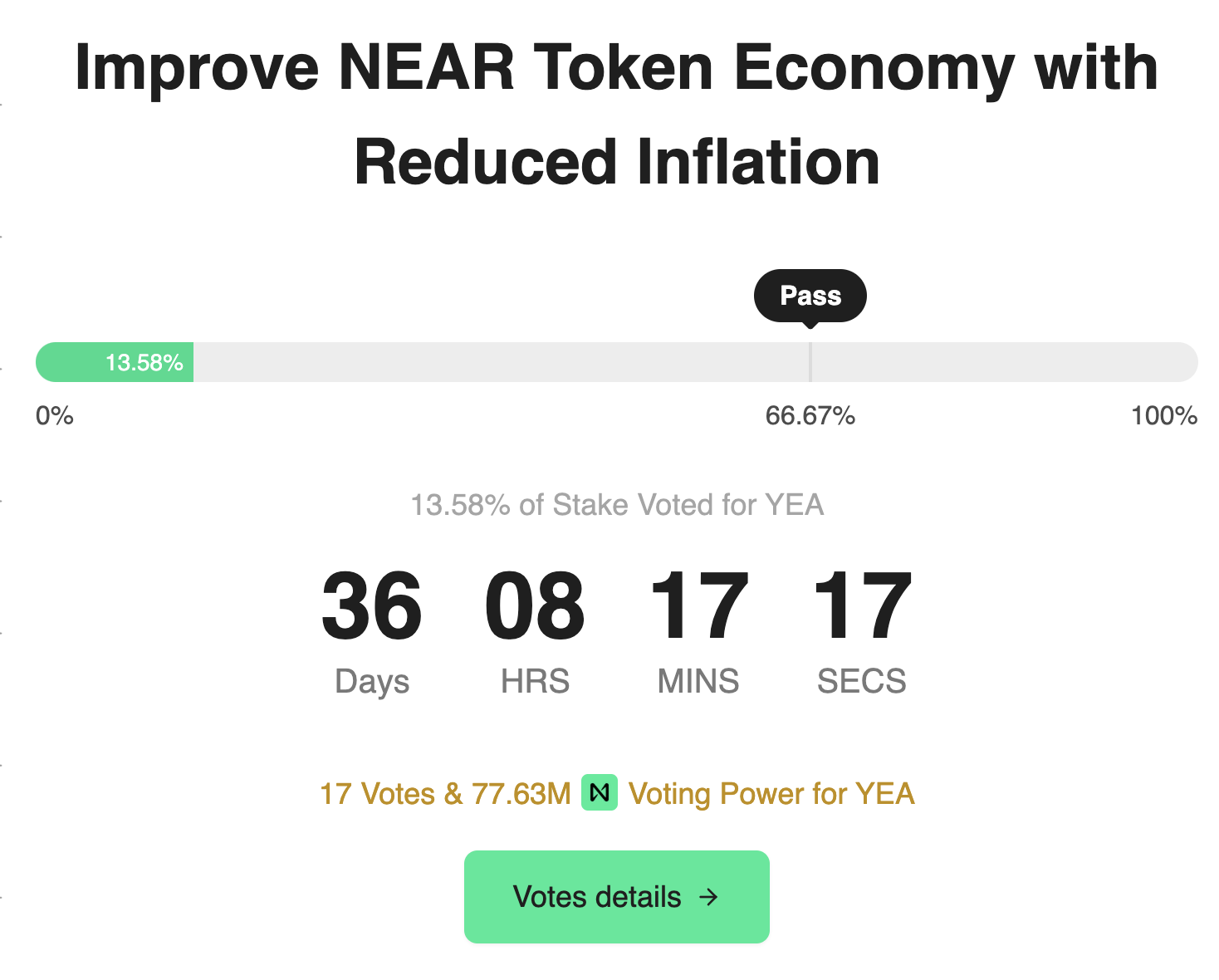
Reduce Inflation for NEAR Protocol
- HOT_DAOOP 18
 Context: NEAR’s Current Inflation and Drawbacks
 Voting link: https://vote.linearprotocol.org/
NEAR’s token economics currently rely on a fixed 5% annual inflation rate on the total token supply. This rate was set at mainnet launch with the expectation that high network usage (and fee burns) would bring net inflation down to ~2-3%. In reality, fee burns have been minimal (only ~0.1% of supply burned over the past year), so nearly the full 5% inflation is hitting the supply. This translates to over 60 million new NEAR tokens minted each year, significantly expanding the supply. Such excess inflation dilutes existing holders and gradually devalues the NEAR token price.
Key issues with the status quo include:
• Excessive Net Inflation: With low fees burned, net inflation remains ~4.9% (out of 5%), far above the intended 2-3% range. This adds tens of millions of NEAR to circulation yearly, outpacing network growth.
• Token Dilution: Continual 5% supply growth (vs. only 0.1% burned) means holders’ proportional ownership is diluted over time, potentially putting downward pressure on the token’s value.
• Uncompetitive Tokenomics: Other proof-of-stake chains (e.g. Polkadot, Solana, Aptos) have recently recognized similar issues and proposed inflation reductions. NEAR risks lagging behind if we don’t adjust our inflation model to align with industry best practices.
In summary, the current 5% fixed inflation is too high relative to usage, causing unnecessary token supply growth and dilution. The NEAR community needs a more sustainable inflation model that curbs inflation while still rewarding stakers and securing the network.
Proposed Inflation Change
Proposal Summary: Change NEAR’s maximum inflation from 5% to 2.5% Rationale: With ~0.1% of total supply burnt in transaction fees every year, 2.5% maximum inflation would result in an actual inflation of 2.4%, which is much healthier than the 4.9% we have today and make the economics of the protocol more sustainable. In addition, the current ~9% staking yield makes it unattractive for token holders to use NEAR Defi.
Maintaining a fixed maximum inflation rate makes it easy for the community to understand how tokenomics works and adjustment can be done on a regular basis through voting when the House of Stake is properly set up.
Inflation Impact: Inflation will be reduced to roughly 2.4%. Staking yield will be reduced to 4.5% assuming 50% of the total supply is staked. If some stakers decide to withdraw their stake due to lower yield, the staking yield will increase accordingly. There will be a much stronger incentive for NEAR token holders to put $NEAR into Defi.
Urgency and Path to Execution
Why Now? Reducing NEAR’s inflation is an urgent priority. Every additional month of the status quo means millions of new NEAR entering circulation, which is not only dilutive but also unnecessary given the low fee burn. High inflation without high usage is unsustainable. Furthermore, with multiple other networks already taking action to lower inflation, it’s crucial for NEAR to move quickly or risk having a less attractive token economy for investors and users. This proposal addresses a core economic concern and aligns NEAR with a healthier, leaner inflation level sooner rather than later.
Governance Process: To enact this change, the proposal will proceed through NEAR’s governance framework, albeit with some adaptations given current limitations:• Community-Driven Initiative: This idea originates from community and ecosystem discussions about improving NEAR’s economics. We encourage well-known ecosystem participants (major validators, projects, or investors) to sponsor and champion the proposal when it goes up for a vote, demonstrating broad support.
• Validator Vote: Because NEAR’s on-chain governance (e.g. the House of Stake framework) is still in development and won’t be fully operational for ~6 months, we will use an interim voting mechanism for this decision. We have worked with the Linear team to implement a special smart contract for delegated voting by validators . In practice, each validator (and by extension their delegators) can cast a vote on the proposal through this contract, weighted by stake. There will be a simple web frontend provided to track votes and validators will vote through near-cli . This method leverages our validator community’s consensus as the decision-making process, until formal governance is available. After the House of Stake is properly set up, it will conduct review and voting for changes to the maximum inflation on a regular basis.
• Timeline: The targeted timeline is as follows (subject to community feedback):
-
Discussion & On-Chain Vote Setup (This Week): Open community discussion on this forum post. Simultaneously, deploy the validator voting smart contract and answer questions related to voting.
-
Validator Voting Period (July 2025): Conduct a formal validator vote (until the end of July) on adopting the new inflation model. This would be well before the House of Stake launch, to not delay the benefits of inflation reduction.
-
Result & Implementation: If the vote passes with the required majority, core developers will include the new inflation logic in the next protocol upgrade release. The change could be activated in the network by late Q3 2025, assuming a smooth voting process and technical rollout. (If the proposal is rejected, the community can discuss further refinements or alternatives.)
Throughout this process, we will also be raising awareness and educating the community. Expect announcements, AMAs, and documentation explaining the proposal’s details. Validator and community buy-in is crucial, so we want to ensure everyone understands why this change is beneficial for NEAR’s future.
Conclusion and Call to Action
In conclusion, adopting a change to the inflation model is a critical upgrade to NEAR’s economics. It will substantially reduce inflation (from the current effective ~5% down to ~2.5%) while preserving strong staking incentives and network security.
Such a change puts NEAR in line with other leading blockchains that are optimizing their tokenomics, and it showcases our community’s proactiveness in responding to economic realities. Lower inflation and controlled token issuance will enhance confidence in NEAR, benefiting all stakeholders by reducing unnecessary dilution and potentially supporting a more robust token value.
Call to Action: We urge all NEAR community members, validators, and token holders to support this proposal. Engage in the discussion, ask questions, and help us fine-tune the details. Your feedback is valuable to ensure we get this right. If you agree that NEAR’s inflation should be reduced, please voice your support.With consensus, we aim to move to the formal validator vote soon. Let’s work together to implement this improvement to NEAR’s economics, strengthening the network’s viability and competitiveness for years to come.
Thank you for your consideration, and we look forward to your input on this proposal.
-
- LiNEAR 8
Together with HOT DAO, we’re proposing one of the most important changes to $NEAR tokenomics yet: Reduce max inflation from 5% → 2.5%
LiNEAR is proud to co-lead this proposal — and to provide the voting site that supports it.
Voting Link: https://vote.linearprotocol.org/
Why it matters?
Lower inflation = less dilution
Less dilution = stronger $NEARThis lays the groundwork for a healthier, deflationary future.
High inflation was a bootstrapping tool.
NEAR has outgrown it.
Now it runs 8 shards.
Now it powers Intents and AI Agents.
Now it’s ready to evolve — toward real usage, real burn, real value.This also unlocks better incentives:
Staking will move to a duration-based model
APY can range from 4.5% to 11% , depending on how long you commit.Long-term stakers win.This isn’t just economics — it’s narrative.
From subsidized inflation
→ to real demand
→ to AI-powered deflation We’re ready to build in this new phase. - NEAR_MAXi 15
Oppose the Abrupt Inflation Cut — It Risks a Token Death Spiral
The proposal to sharply cut NEAR emissions is reckless and risks triggering a destructive cycle of unstaking, selling, and collapsing price — with no offsetting demand.
 Why This Is Dangerous:
- Some stakers at the margin may only hold for the high APY — take that away, and they sell.
- NEAR has thin order books — even a small % unstaking can nuke the price.
- There are still no strong token sinks, and DeFi demand is not deep enough.
- Validator and delegation economics are not ready for a sharp cut.
 This Is How Death Spirals Start:
- Stakers exit to chase yield elsewhere
- Selling accelerates into thin markets
- Token price collapses
- Confidence erodes — and it feeds on itself
 Learn From Others:
- Polygon cut emissions early — and the token bled for years with no support
- Solana thrived despite high emissions — thanks to demand and user growth
- Ethereum went ultra-low emissions — but ETH still underperformed in the bear market
Emission cuts don’t automatically lead to price strength. Without demand, they backfire.
 A Better Path:
- Delay any drastic cuts until real token sinks and use cases exist
- Build conviction-based models like long-term vaults, but do not force them
- Focus on increasing organic demand and DeFi integration
- Avoid ideological or rushed changes — protect the network and its participants
Let’s not make NEAR another case study in how to destroy your own token.
Vote no — and build first. - Bowen 15
There has been much discussion recently about the pros or cons of an inflation reduction proposal for the NEAR Ecosystem (currently set at 5%). My goal is to clarify exactly what the goal behind this proposal is, and to also dispel myths about how we think about the future of NEAR.
When we began working on NEAR more than 5 years ago we did not have a complete understanding of the costs associated with sharding. To our surprise and excitement, sharding has been successfully implemented (now with 8 shards live) for an extremely low cost. This also created a problem: NEAR is too efficient, and as a result not enough NEAR gets burned in transaction fees to justify a 5% inflation rate.
The inflation reduction proposal’s goal is to make NEAR a more scarce asset that has a lowered total supply. Many core partners and backers have expressed interest in this proposal, as it would mean future growth in the NEAR Ecosystem on the AI or NEAR Intents front, could truly act as long-term deflationary drivers on token supply.
In other words, successfully scaling up volume and transactions on NEAR Intents or through deploying hundreds of thousands of NEAR agents would both function as long-term drivers of recurring token sinks that actually impact the amount of NEAR available on the market. This pathway seems to be more likely to happen in the future than the status quo inflation design.
At 2.5% inflation the NEAR ecosystem tightens its issuance of NEAR, is still able to reward validators and stakers with a competitive APY, and retains a small percentage (0.25%) for ecosystem treasury support annually.
There are a couple of important caveats I would like to remind everyone of, in regards to any inflation reduction:
First and foremost, a core and equally important component of this proposal has to do with making sure that in spite of inflation reduction, there still remain sound incentives for validators and stakers to hold and earn $NEAR. The NEAR Foundation and partners are currently working to create better long-term incentives for validators and stakers, increase validator count, increase the total amount of $NEAR staked, and align incentives for increasing the overall number of validators on the NEAR network.
As part of these incentives, we understand the need for stakers and long-term $NEAR holders to continue to have sustainable incentives for staking their $NEAR. While a full proposal is expected soon, the idea is to correlate the amount of time $NEAR is staked with an APY boost. $NEAR holders will be in full control to decide on the APY that they would like to earn, based on their staking duration commitment.
Second, once the House of Stake is fully set up, they will have the capacity to conduct regular reviews of the impacts of any inflation reduction and vote to change it if necessary. This gives everyone in the NEAR Ecosystem the capacity to iterate our approach to inflation management over time.
Third and most importantly, inflation reduction will limit daily issuance of NEAR such that existing NEAR holders are positioned to benefit from downstream deflationary pressures (discussed above), and overall scarcity of the $NEAR token is truly designed to increase over time.
Our planning around inflation reduction has been based on significant amounts of discussion, modeling of different scenarios, and looking at what has worked in other ecosystems across crypto. I look forward to hearing any thoughts about this proposal from members of the community and our ecosystem partners!
- frol 8
I agree with @NEAR_MAXi in the assessment that it is more likely to backfire. Given that other ecosystems lowered their inflation rates, NEAR ecosystem should have leveraged that if the APY is higher, and yet I don’t see the effect on NEAR.
If there are other incentives that would prevent holders (delegators, not validators) from selling, they should be presented together with the proposal for cutting the inflation rate.
I can see how lowering the inflation can also be leveraged to urge holders to come to NEAR while APY is still high, and implement the protocol to lower the inflation gradually instead of with a cliff. Yet, the success is conditional on the hype generated around it.
- Q8i 5
If inflation decreases, I would be willing to buy and hold more NEAR for the long term, as this would represent an active and positive community, developers who are willing to listen to feedback, and healthier tokenomics.
- Amos 8
Reducing inflation for PoS chains in general has proven to improve token prices in recent examples. This is a smart move as NEAR current price has reached historical low for secondary holding. Any sell pressure here can be easily absorbed and likely proven to be the wrong move.
TO Near-Maxi,
- Polygon’s different. Their change is mostly around the token itself and the burning mechanism. Their underperformance is due to major protocol like Aave leaving, and dying narrative of ETH L2.
- Solana’s emission and staking rewards a lot lower than NEAR’s current rate.
- Huh, ETH performs pretty well?
- Cooper 7
HOT has done an amazing job outlining their proposal. Great work.
I am a long term, large investor and staker in $near.
This proposal has my full support, so long as it retains most/all high quality validators. I do believe that acting with urgency is important (vs. delaying in service of House of Stake), and that granting validators the authority to vote is the right mechanism near term.
I imagine everyone would agree that, at the end of the day, NEAR’s success will be primarily based on the quality of its tech and ability to solve for real world use cases. I doubt many NEAR stakers own the token for short term yield purposes; I would assume, given staking strength and history, that most stakers are long term projects and investors who care more about the long term ecosystem than yield APY. And to the points made, it seems that long term ecosystem members (like myself) who stake for a long time and/or participate in the House of Stake will be rewarded with additional APY over time, but to me that would simply be an added bonus vs. the crux of my decision making on this topic. Said another way, it’s not worth waiting on this vote simply to have clarity of how much the APY will be or how it’s earned–the amount will comparatively be inconsequential to the bigger picture here.
I applaud the NEAR ecosystem for having the courage and wisdom to put forth this proposal. It shows that NEAR is maturing and considering full ecosystem health in addition to its incredible tech.
Again, in summary, assuming most high quality validators support this proposal, I also support it.
- Meta_Pool 20
We as Meta Pool DAO are of the opinion that a healthy, informed debate around staking emissions is not just welcome, it’s necessary to ensure the NEAR ecosystem evolves responsibly and remains robust. Meta Pool has been supporting network health and validators in collaboration with NF over the last years and will continue to do so.
In anticipation of the vote to reduce inflation being passed, we and other ecosystem participants are developing comprehensive support structures. This is to ensure validators maintain profits and reward delegators for their loyalty as well as minimize the impact in the transition period leading into a community-governed era with House of Stake.
In response to the proposal made by HOT DAO to reduce the staking rewards emissions, we are proposing a new Validator and Staker Incentive Program featuring three complementary mechanisms, designed to support the diverse realities of the validator community.
Delegator APY Boost Program: Enables delegators to lock their tokens for a period between one to six months, and receive attractive boosted APY. Validators will receive a part of the boosted APY proportional to the locked stake delegated to them.
Community Validators: To ensure participation in the network remains attractive to community validators, there will be a program offering infrastructure cost subsidies for a transitory period. Also, to support the proposed emissions reduction, we’re introducing a low cost entry point to being a validator at ca. $30 p/m keeping security high whilst supporting NEAR’s validators!
Other Validators: It is planned to make a monthly purchase pool of discounted NEAR available to strong performing validators!
We will be working with NF and releasing details soon! Let’s keep building together and we’re looking forward to your active feedback to shape this proposal together!
- foxreymann 3
I’m against.
Why?
- Reducing validator incentives by 50% will make my validator unprofitable. I’m sure this is not only my case. There will be less validator and less stakers.
- Solana, XRP, Cardano, all have inflation higher than 5% and their price action is much better than $NEAR. Hence I don’t believe in a strong correlation between inflation and price action.
- luzmargaritas 2
It is a good alternative to the initial proposal as it considers three support mechanisms for validators.
 The NEAR community is invited to provide their comments to form a final proposal.

- garikbesson 8
This is a very serious proposal with the potential of a huge impact on the whole ecosystem, and I have some reasons to worry about it.
-
The proposal should have mentioned all the potential drawbacks and risks of such a big decision, and explained why they are unlikely. People should see the whole picture, and not just the proposal’s selling points.
-
The proposal claims this is an urgent priority, but why wasn’t it an urgent priority, let’s say 6 or 8 months ago? The token price was growing, and it could be a better moment to implement reducing inflation, it could support the growing trend, or the growing trend could mitigate potential fireback.
-
Why should we implement the inflation reducing right now and not wait till a new growing trend?
-
I personally don’t think reducing inflation will affect DeFi on NEAR because, actually, there is no DeFi, unfortunately. We had Ref Finance and Borrow Finance, which are merged recently into Rhea Finance and that’s it. And Rhea Finance covers all ecosystem needs in DeFi. And we almost have no popular FTs on the ecosystem. Big TVLs and big APYs appears from demand and growth of the ecosystem, from new projects. How will reducing inflation attract those builders and users?
-
Validators complain about insufficient support from NF in the current market conditions since Stake Wars III. We have very few incoming new stakers, even with high APY relative to other networks. Small validators struggle to survive with the current inflation. If we reduce the inflation, they will be forced to leave or increase their commissions. But if they increase their commission, delegators will likely move their assets to those big validators who manage to keep their 1% because of the huge staked amount. In other words, small validators don’t have any new stakers now and likely won’t have them with reduced inflation, and also there is a risk of losing those who stake with them right now. So it’s basically a risk to lose a lot of validators. I don’t think those 3 incentive programs suggested by MetaPool are enough to deal with such consequences.
-
We already have too many tokens in circulation and too few ways to use them. Have any additional measures been considered regarding this?
UPDATE: Why does the main voting page only show “YEA” votes and not “NAY” votes? This is manipulation which creates the appearance of a unanimous vote.
-
- Officialmacc 1
I fully support the proposal to reduce inflation for the NEAR Token. Lowering the inflation rate can help enhance the long-term sustainability and value of the NEAR token by reducing excessive token supply growth. This move is likely to increase investor confidence, encourage holding rather than selling, and improve the overall health of the ecosystem. It reflects a mature and responsible approach to economic policy within the protocol, aligning with the goals of maintaining a stable, secure, and scalable platform for developers and users alike.
- DDeAlmeida 3
The main purpose of this timing is to set inflation with Partner from NF to vote for YES before HoS start.
Because if HoS ask, this will never passed.
- fiatisabubble 2
I’m somewhat disappointed with the lack of formal deliberation on this topic (on the forum) before proceeding to a vote, however if HoS was to launch today, protocol changes would be outside of its scope.
Over time all governance decisions will be carried out within the HoS framework.
As a staker to your validator, I’d like to know how you intend to vote for this proposal

- lvl93ab 2
Why not adjust NEAR’s annual inflation rate dynamically according to the percentage of total supply that is staked. This approach aims to balance the interests of both stakers and non-staking holders
Proposed Structure:
% of Total Supply Staked Inflation Rate
60% or more. 5% (maximum)
50–59%. 4%
40–49% 3%
30–39% 2.5%
Below 30% 2% (minimum)Key Benefits:
Aligns staking rewards with actual participation levels.
Protects token holders from excessive dilution during periods of low network engagement.
Encourages healthy staking behavior while preserving long-term token value.
This model promotes a more balanced and adaptive token economy by linking inflation directly to network usage.
- Meta_Pool 3
Attention community, we’ve published more details about our proposal. We kindly ask you to share your feedback with us:
Meta Pool DAO has been instrumental in decentralizing the NEAR ecosystem since its early days. Following the proposal made by HOT DAO, we are prepared to scale our commitment to the ones powering NEAR’s decentralized future: validators and delegators. If the proposal is accepted, we — in collaboration with various ecosystem participants, will launch a new incentive program and tools built to empower validators and delegators of all sizes to unlock yield strategies, boost long-term rewards, and …
- NEAR_MAXi 4
A case study:
Cosmos cut emissions in 2023 from ~20% to ~10%.
Staking yield dropped from ~18% to ~12–14%
The goal was to strengthen tokenomics and support price
ATOM price before the cuts: ~$10–12
ATOM price now (June 2025): $3.91
Emissions slashed.
Yield halved.
Token still dumped ~65%. - Yessin 3
Vote YES for the NEAR Halving!
Halvings have historically been a powerful catalyst in crypto — have a look at Bitcoin! Every four years, the community eagerly anticipates the halving event, expecting a reduction in miner rewards to reduce sell pressure and ultimately drive prices higher. The same positive dynamic can benefit NEAR.
Some argue against the halving with the misconception:
“Lower staking rewards will make people sell.”
But this logic doesn’t hold up. Here’s why:1. Price Appreciation > Yield Cuts
The main reason to hold NEAR isn’t just the staking yield — it’s the total expected return:
 Price appreciation + staking yield – taxes
In many jurisdictions, staking yield is taxed at a higher rate than capital gains. For many holders, lower inflation and less taxable income are actually a benefit.2. Not Everyone Stakes
For non-stakers, staking rewards act as inflation — their NEAR gets diluted. Reducing staking rewards means less inflation, preserving value for all holders.3. Demand Might Increase
A halving signals stronger tokenomics and long-term alignment. Just like with Bitcoin, this can attract more buyers. Lower issuance, same demand — or rising demand — leads to price appreciation.4. NEAR ≠ Dividend Stock
Staking rewards aren’t like dividends in fiat. They’re issued in NEAR itself — like a company printing more shares to give to insiders. That’s dilution. Reducing rewards is like reducing dilution — a positive for price per token.5. Cosmos ≠ Counterargument
Citing Cosmos (ATOM) as a counter-example misses the point. Most tokens declined in that period. ATOM’s drop wasn’t due to inflation cuts — it was part of a broader market trend. Bitcoin, on the other hand, rallied after its halving. Context matters.
 This is a rare opportunity for NEAR to strengthen its economic model.
Less inflation, stronger value, more sustainable growth.Let’s vote YES to align incentives, reduce dilution, and reinforce NEAR’s long-term potential.
If you ask me about the halving, my answer is YESS IN !
- NEAR_MAXi 3
 EOS Emissions Cut
In February 2020, EOS block producers voted to reduce inflation from 5% to 1%, effectively rerouting the 4% savings-rate emissions to burn/incineration
Price Before & AfterFrom CoinLore historical data:
- Average price in 2019: approximately $4.02 (with highs near $8.60)
- End of 2023: EOS hovered around $0.84, with a range of ~$0.53–$1.33
- Mid‑2025: EOS trades at approximately $0.51, having declined from around $0.64 a year earlier (~12% down YoY)
Summary: Despite slashing inflation by 80% in early 2020, EOS collapsed from $4+ to ~$0.5 over the subsequent years—an 87% decline.
History may not repeat, but it rhymes, why copy what empirically didn’t work at all for Cosmos and EOS?
- Yessin
Hey @NEAR_MAXi, reducing inflation alone couldn’t save EOS. Their price drop comes from a range of issues:
- Failure to deliver: EOS raised over $4B in its 2017–2018 ICO, creating huge expectations, but dApp and developer traction fell way behind Ethereum and newer chains like Solana, NEAR, and Avalanche. Many promises went unfulfilled.
- Leadership and governance issues: The core team became passive post-launch, frustrating the community. Also, look into the lawsuit!
- Competition: EOS lost its early lead to faster, more developer-friendly L1s. DeFi and NFTs mostly skipped EOS in favor of Ethereum and EVM chains.
- Technical and usability barriers: Wallet creation is a pain. Most dApps left due to low usage and lack of support.
- Crypto cycles: EOS got hit hard in the 2022–2023 bear market. Unlike others, it failed to bounce back due to weak narrative and vision.
That’s why EOS is fading.
- garikbesson
I couldn’t help but notice that, unfortunately, we can say the same thing about NEAR.
 Yessin:
DeFi and NFTs mostly skipped EOS in favor of Ethereum and EVM chains.
- ofomenko 6
There seems to be a consensus that reducing emissions is good for the economic model while a lot of objections are linked to the fact that the change is abrupt.
I believe that we can get the best result if we were to propose halving of emissions gradually over the period time - e.g. to move from 5% to 2.5% annualised over the period of 18 months (illustrative) reducing the emissions either epoch-by-epoch or block-by-block.
This will remove a significant trigger forcing stalkers and validators to make a decision in a short period of time while achieving the overall objective.
- blaze 6
changing emissions is a bandaid to much larger problems. the core issue stems from payrolled and lined pockets pushing agendas because they were asked to. these are the same individuals that have done little to grow the ecosystem or brand recognition yet have a check cut month after month a sad state indeed with no light at the end of the tunnel.
a masquerade to cover the real issues of no mass adoption and no real traction. orchestrated by the same team of individuals with tech prowess and zero community or ecosystem skills, some are excluded from this statement yet are part of the group.
the individuals pushing this will most likely hedge the puts and takes to only enrich themselves further while pushing the price lower.
I will vote NO for this proposal in favor of a multi-fold strategy that brings radical change to those that have perpetrated the ecosystem in favor of their tech focused ventures with little adoption. on one hand you stick your neck out and go against the hand that feeds you and on the other the hand that feeds should not exist, which shows the systemic failure in crystal clear view.
The house of stake will do little to solve this dilemma as the very same perpetrators control the stake. near has become a haunt of insiders. the tech is solid, but until these individuals are held to account, the command and control stranglehold removed and the foundation spun down. no real change will occur only a shuffle of cards.
I love near. been here since day 0, have done some really big things. tried hard to breakdown the insiders. still building. still believing. validators vote no. this will be your last stand. your one and only vote.
ok. this is sentiment analysis with suppositions and predicates that the price might improve. who actually cares which stakeholders? there is no confidence with in near. we are the ai chain, but we lower emissions because ai can not build an economy. laughable. increase the emissions to that point.
the net net: near does not have web3 market traction. to many chains. no real narrative. more expensive then web2. no one cares what’s under the hood. you want number go up. on board killer teams to build killer apps and ship day and night. most L1’s and L2s dry up in next three years. this moment is not about emissions. its about survival.
change my mind. …
- Dacha 3
 blaze:
change my mind. …
I agree with this statement regarding the Community:
- The community is almost dead (Shitzu, Black Dragon, are still alive).
- The ecosystem is dead.
- Money is handed out to projects with zero reporting, and these same people get chosen as delegates for the House of Stake. I even started a blog because, as usual, NF filters the news — splitting it into what they can share (“good progress”) and what must be hidden — centralizing everything.
- Newcomers to NF, like @lane, quickly figure out how it works here: instead of doing real work, they write praise posts about how they touched an NF *“co-founders backpacks”, create endless roadmaps, throw parties in Cannes, and hire people for absurd salaries with no accountability — just to spend more time traveling and writing questionable articles.
- Lane, who spent years working closely with Buterin, comes into our ecosystem and is now trying to bring back centralization inside the Community. This is genuinely insane — it’s a rollback to web0. Try telling anyone about it — they won’t believe you. This attitude only happens when you genuinely hate the ecosystem and couldn’t care less about web3 values.
Re: Governance
@gauntlet, which still hasn’t managed to launch governance properly for over a year, together with the NF — which has never been known for speed, unlike the community (it’s hard to even guess how much money has already been wasted on this) — brought in delegates from the Arbitrum blockchain, instantly creating countless conflicts of interest, especially considering that Arbitrum is also working on AI. One of the delegates even called this a ‘crazy experiment’ — which is probably the most accurate word for it.
Still, there are talented people in NF who keep supporting the community despite all this mess.
*By ‘touching co-founders backpack’ I mean posts on any topic, full of flattery and zero criticism or real thoughts of their own by “Yes Man” people. That’s basically the formula for long-term survival inside the NF.
- NEAR_MAXi 2
The idea of centrally planned scarcity, enforced from the top down, reflects a kind of command economy logic that decentralized systems were meant to leave behind.
Instead of letting market dynamics signal what capital should earn, we’re discussing quotas, ceilings, and managed perception. A 5% inflation rate — if it incentivizes real usage, security, and ecosystem growth — is not a problem.
But to arbitrarily decree 2.5% emissions as the correct number, regardless of adoption curve or network needs, is to substitute ideology for flexibility.
When token supply is governed by narrative rather than demand, we begin to resemble systems that prized control over coordination, and scarcity theater over actual economic signal.
Crypto wasn’t built to be curated.
It was built to be free. - Mike-LunaNova 1
We (LunaNova) understand the concerns about reducing inflation and that this action alone won’t solve all the issues. However, there is a strong case that the current level of issuance is simply unsustainable and taking action now is the right thing to do. Consequently we will be voting yes on this proposal, as we believe it is in the best long-term interests of the protocol and its stakeholders.
- marcrypted1
It’s great to see a proactive approach to ensuring validators and delegators are supported through this transition. Creating incentives for both sides, especially community validators is essential for keeping NEAR decentralized, secure, and accessible. Looking forward to seeing this evolve with input from across the ecosystem.
- charleslavon
A vote in favor.
I will vote yes and advocate that we consider introducing the reduction gradually. I believe this a step towards adapting to the realities of lessons learned since the mainnet launch. Ideally we will continue to conduct research and have debates on changes to protocol economics and other incentive mechanisms that would improve our positioning in the short and longer term.
- Everstake 7
Hey everyone,
First, we want to say we really appreciate all the hard work that’s going into making NEAR stronger and more sustainable.
The intention behind this change is clear and understandable—aligning tokenomics with broader goals like increasing NEAR’s attractiveness and ensuring long-term value creation.
However, as an active validator, we would like to raise a few important points and questions for consideration:
What if things don’t go as planned?
Is there a backup plan in case this move doesn’t lead to the expected increase in token price or demand? We’d feel more confident if there was some kind of fallback strategy in place.Support for validators
We’re aware of the Meta Pool support program and think it’s a great initiative. But honestly, it might not be enough on its own. Are there any other ideas being explored to help validators stay afloat?Why not reduce gradually?
A phased reduction might ease the transition and give the network time to adapt. Was a gradual approach considered?Minimum validator fee?
With lower rewards, there’s a risk that the stake will concentrate even more. Would it make sense to introduce a minimum validator fee to help encourage more even stake distribution and support decentralization?Can we see the modelling?
It was mentioned that some modelling and calculations were done around this proposal. @Bowen If possible, we would like to take a look at those—they could help everyone better understand the thinking behind the numbers.We support NEAR’s vision and want to contribute to the network’s robust and decentralized future. I’m looking forward to hearing what the team and community think.
Cheers,
The Everstake Team - NEAR_MAXi 4
The push to reduce emissions again ignores the core issue: fiduciary duty. Validators have a duty to their delegators — not to the Foundation, not to optics, and certainly not to token burn ideologues.
We’ve seen how this ends. Cosmos, EOS, Polygon — all pushed aggressive emission cuts or similar changes with the hope of “price appreciation” and “long-term sustainability.” What they got instead was capital flight, collapsing staking participation, and no meaningful improvement in price action.
Reducing staking APY in a weak DeFi ecosystem (like NEAR’s) removes the last major incentive to hold and stake. It’s not deflationary, it’s demand-destructive.
Unless there’s a clear yield alternative that matches or exceeds staking, this proposal gives whales a binary choice:
Accept half the yield, or sell.
And we all know what some will do - enough for this to backfire disastrously.If NF wants to improve token economics, focus on creating demand sinks. Grow real usage. Stop patching the price chart with amateur monetary policy experiments. You can’t “cut your way to growth.”
Until then, it’s irresponsible to pretend this is anything but a reputational risk and an economic drag on long term multi year stakers, who count on the APY to cushion the horrible price action since 2021.
- NEAR_MAXi 1
If the goal is to craft a proposal that can pass the fiduciary duty test for professional validators, it likely needs to include:
1. Risk modelling and contingency planning.
Show what happens in multiple market conditions (bull, crab, bear). What if price doesn’t move or even drops? What’s Plan B?2. Clear, measurable upside.
Back it with data: why would this increase price or demand? How would that benefit all stakeholders, not just a narrative?3. Mitigation of capital flight.
Recognize that tens or hundreds of millions of NEAR currently staked may not move into DeFi. Show where that capital would go. De-risk the “either accept half APY or sell” dilemma.4. Gradual rollout.
A phased reduction allows the network to adapt. Abrupt changes raise red flags for fiduciaries managing client capital.5. Broad stakeholder alignment.
Have buy-in not just from core contributors but from DeFi builders, large validators, and ecosystem dApps. Anything that looks Foundation-driven alone won’t be trusted.If a future proposal included these, it would be easier for fiduciary-bound validators to vote “yes” in good conscience.
- Cooper 3
Thanks for sharing. In response to each of your points:
-
I agree that proposals should be objective and weigh both pros and cons. It seems that the replies are surfacing some of the possible cons, but if there are more, it would be great to understand them.
-
I’m not sure it’s possible to time the release of a proposal (and subsequent implementation period) in coordination with market dynamics. One of the replies to your post suggests NF is trying to push this through now before HOS is set up, ie so NF has more influence in the decision. If that’s the case, I am personally ok with it (sometimes decentralized ecosystems just need a strong centralized actor to make tough decisions), but would understand how it might appear as overly centralized.
-
I personally believe we are at a critical inflection point in mainstream adoption, market cycle, and it’s the time to do whatever we can to be a first mover. Said another way, with institutions coming on board to invest in $near, it’s important they see strong price action. And I think the next 6-12 months are critical.
-
There’s no guarantee defi will increase on near if the proposal passes, but it’s plausible. Historically, Near has not done well with defi but Rhea and Intents currently have really good momentum. So it’s important to acknowledge that, despite the momentum being recent.
-
This is probably the most valid comment I’ve heard here and I haven’t heard it expressed before. We definitely need as many validators as possible and I am in support of NF, Metapool or whoever to do whatever is needed to help smaller validators transition during the inflation reduction transition. I think you should push harder to help others understand the issue and maybe the community can find a way to support during the transition.
-
I think everyone agrees that the proposal is necessary but not sufficient for long term token success, which will ultimately depend on more projects, more users, more transactions, and more token use. That will develop over time.
-
- NEAR_MAXi 5
Some validators may want to pause and reflect on how proposals like this align with their fiduciary responsibilities.
If you represent external delegators, LPs, or institutional clients, voting to halve staking rewards without clear modeling of long-term tokenholder benefit may not hold up to scrutiny. Fiduciary duty isn’t based on vibes.
Gauntlet’s Economic Security Ratio (ESR) modeling is narrowly focused on security—not on economic value accrual to tokenholders. It is silent on whether this proposal improves NEAR’s adoption, price performance, or protocol revenue. If Gauntlet has performed any further modeling that quantifies these broader impacts, it should be shared with the community as soon as possible.
Abstaining is a responsible choice when outcomes are unclear. Some validators have rightly taken that path. Others may wish to review whether their internal decision-making process meets the standard expected when fiduciary duties are in play.
- MiloB 1
Makes sense to cut inflation. 5% is too high with such low fee burns. 2.5% is more sustainable and keeps staking yields decent. NEAR needs to stay competitive.
- foxreymann 3
Most of opinions for reducing inflation rate are non scientific. I’ve published a scientific paper that finds only moderate correlation between tokens inflation rate and price action. Correlation is only 0.43. I can share the research is requested, I can’t post links here.
Also I’m strongly against current discrimination of pools that have voted ‘Nay’. Near Social Zavodli widget shows Nay votes as Not Voted and make a call to unstake from such validators. This is discrimination based on opinions. How can this be happening in 2025.
- HOT_DAO 1
 First of all, we want to thank the NEAR community for the incredible level of engagement over the past weeks. It’s been inspiring to see how deeply so many of you care about the long-term health of the ecosystem. The thoughtful feedback, open debates, and alternative suggestions have all shown how alive and resilient our community really is.
There’s one thing we all seem to agree on:
NEAR needs lower inflation.But opinions differ on how exactly that should be implemented.
We’re all here because we want NEAR to succeed — and this proposal aims to reflect the feedback while keeping the process simple, fair, and executable.
Updated ProposalWe now propose a gradual, linear reduction of inflation to 2.5% over the next 12 months .
- The reduction will occur epoch by epoch, ensuring a smooth transition for validators and delegators.
- This gives the network time to adapt without disruption, while still achieving the goal of reduced inflation and healthier tokenomics.
 Governance Voting Threshold Update
In parallel, we propose improving the governance process to make it both more decentralized and effective:
- A proposal will pass if:
- At least 34% of total staked NEAR participates in the vote
- Of those, 67% must vote YES for the proposal to be accepted
- Voting period 21 days
We believe this strikes a good balance between ensuring wide participation and avoiding governance paralysis.
Let us know your thoughts — and thank you again for helping shape NEAR’s future.
Together, we build.
- Watsica 1
 HOT_DAO:
A proposal will pass if:
- At least 34% of total staked NEAR participates in the vote
- Of those, 67% must vote YES for the proposal to be accepted
- Voting period 21 days
Mr. Noname, maybe it’s time for some honesty.
For the past four years, you’ve been profiting from validators and endless grant money poured into your loss-making projects like Hot and other not-profitable scammy ventures.
Your Near Prime takes 100% of the fees — from funds given to you by NF. Now you’re using this new platform Kalux to offload tokens to community that you, Ilya, and NF originally invested in.
And suddenly, you’re proposing to change quorum rules — just when it suits you?
Where were you before? Why do people like you only show up with “solutions” once you’ve made your money and walked away with the upside?
- NEAR_MAXi
Appreciate the engagement and the tone here, but I want to respectfully push back on a few key points:
“Everyone agrees NEAR needs lower inflation”
That’s simply not true outside the echo chamber of a few voices. Many validators, community members, and builders have raised concerns — not about resisting change, but about the lack of evidence supporting this specific type of change. Saying there’s consensus when there isn’t only undermines trust.
Still no empirical foundation
Even with the proposed gradual reduction, there is still no modeling, no simulations, no economic analysis shared publicly beyond the narrow scope of the ESR analysis, that demonstrates this will positively impact token price, usage, or validator sustainability. It’s another iteration of:
“Let’s try this — maybe it’ll work.”
That might be acceptable in the experimental early days of a project. But when billions in assets are at stake, it’s simply not enough.Quorum change is dangerous
Changing the governance threshold to 34%+ participation with 67% YES is risky without safeguards. It creates a “wear them down” dynamic, where controversial proposals can be repeatedly pushed until people stop voting NO out of fatigue. That’s not effective governance — it’s attrition warfare. And it favors centralized coordination over true decentralization.
Still missing: holistic diligence
No serious public discussion yet on:
• Historical learnings from Cosmos, EOS, or Polygon emissions cuts
• Impact on validator economics or network decentralization
• Risks of concentrating stake further as margins shrinkWith the caliber of minds at NEAR and Gauntlet, the community expects more than broad brush intuition and narrative. We owe it to everyone to only back policy changes that have rigor, transparency, and economic evidence behind them.
Until that happens, this remains a high-stakes YOLO dressed up as a refinement.
- Watsica 1 HOT_DAO:
we want NEAR to succeed
Perhaps we could politely ask former NF COO and current NEAR Foundation board member Chris Donovan to stop selling his NEAR tokens monthly into the Binance order book — to have the Near success.
For context, this long-time “believer” has already withdrawn 858,655 NEAR over the past two years — that’s over $3.5 million at the average historical price.
Check his wallet: 31b5d8a227c99cf8f4ef843056d34664684171cfcb0578c648651c644fc2292d
- Amos 1
I support the new proposal for more gradual changes. Also this would likely positively impact NEAR’s price, especially under current market conditions.
As for changing the quorum, I think the 66.6% requirement set originally was just unrealistic - that’s even higher than the voter turnout for US President election. Besides, there are lots of institutional investors/funds, exchanges like Binance/OKX and even certain validators just cannot vote due to legal and compliance reasons.
The lack of validator participation in the current one also proves that most of them are just not interested or can’t participate in governance, and hence a model like House of Stake would be beneficial in the long run. I mean if you don’t agree with the proposal, you can vote no?
- ChorusOne 3
Chorus one is inclined to vote “no” on the proposal to reduce NEAR inflation - below is our reasoning, and would be open to any community feedback:
- We view that the NEAR ecosystem is still nascent and discussions around inflation should resurface when the ecosystem generates more sustainable economic activity.
- We previously conducted similar analysis (full post on our blog as we can’t leave links here) on SIMD228 and found no definitive conclusion on TVL elasticity towards inflation. For newer ecosystems, this argument should be much weaker as the network has not reached a point where there’s sufficient organic economic activity. NEAR’s top 3 LSTs, for instance, only have a combined 1.1% penetration rate.
- NEAR’s top 10 validators control 33% of total stake, reducing inflation will make it harder for smaller validators to operate profitably. We’re aware of the Meta Pool support program and think it’s a great initiative. But its likely not enough on its own to support smaller validators
- Rather than primarily cutting inflation, we encourage fostering a vibrant ecosystem through liquid staking and incentivizing active chain usage to organically enhance token and network economic value without risking validator attrition.
- Lastly, a 50% reduction is quite a drastic change - we suggest alternatively to explore gradual or smaller, incremental reductions with measurable goals (e.g. increase DeFi TVL by X), similar to Aptos’s recent implementation.
- NEAR_MAXi 2
Chorus One’s stance here is thoughtful and well-reasoned.
The key insight — that inflation cuts without a robust, organic economic base can do more harm than good — is often overlooked in these debates. Their point that NEAR’s LST penetration is still only ~1.1% highlights how early we are in DeFi development, and how fragile the validator ecosystem remains.
I also appreciate the data-driven humility in their position: Chorus references past work on inflation vs. TVL elasticity and openly admits the conclusions weren’t clear — which is precisely why large, irreversible moves based on vague intuition should concern us all.
Their emphasis on growing real activity — through liquid staking, usage incentives, and gradual, measurable steps — offers a more constructive path than a blunt-force cut.
In short, Chorus is showing exactly the kind of responsible, long-term alignment that fiduciaries and protocol stewards should aspire to. Glad to see this kind of leadership in the validator set.
- UhthredB 1
@HOT_DAO , @NEAR_MAXi Public debate ? Conflict resolution gameplay

- fiatisabubble
I don’t recommend updating the proposal whilst voting is underway. We still have a week to go. Let’s wait for it to end and reassess if necessary.
I somewhat disagree with the revised quorum that’s being suggested here. I think the initial thresholds are very much achievable should we achieve broader consensus before jumping to an onchain vote.
- fiatisabubble
You should be able to share links now
- DDeAlmeida
Community have spoked, they don’t want to reduce the inflation.
Are you going to make new proposal until it will passed ? HOT_DAO:
At least 34% of total staked NEAR participates in the vote
Remove NF partner / pool with large delegation from NF
- NEAR_MAXi 4 HOT_DAO:
Governance Voting Threshold Update
In parallel, we propose improving the governance process to make it both more decentralized and effective:
- A proposal will pass if:
- At least 34% of total staked NEAR participates in the vote
- Of those, 67% must vote YES for the proposal to be accepted
- Voting period 21 days
We believe this strikes a good balance between ensuring wide participation and avoiding governance paralysis.
Let’s be honest — this part isn’t about improving governance at all:
“A proposal will pass if:
– 34% of total staked NEAR participates
– Of those, 67% must vote YES…”
This is HOT trying to retrofit the rules to push through a proposal that already failed. It’s procedural sleight of hand — rather than engage with the substantive objections raised by Everstake, Chorus One, and others, they’re proposing to change how votes are counted.
It’s clearly been written to reissue the same emissions cut — now just cosmetically stretched over a year — and to force it through via a governance rule change that wouldn’t have passed under the original framework. A proposal not to persuade the 62% who voted No or Abstained — but to override them.
That’s not reform. That’s trying to rewrite the rules because the outcome wasn’t what they wanted.
- A proposal will pass if:
- Cooper 2
Sorry, I’m confused. @hotdao_ , can you please provide a summary of where we are in the inflation reduction voting process?
-
You posted the amendment below on Near Forum 9 days ago. Does this mean that we are still working off of the original proposal, just with a few tweaks? Or should we expect you to post a new, fresh proposal in the days ahead?
-
Related, does the new 21 day voting period begin 9 days ago or after you post the new, fresh proposal?
While I would love for this to simply get done, it’s a cleaner and more credible process if we allow the existing proposal to expire, and for you to immediately post a new, fresh proposal everyone can re-vote on. In addition to eliminating confusion around when the time clock began, it eliminates confusion around which proposal validators approved on the public dashboard (ie, we want all validators who voted “yes” to understand that the proposal has been updated, so they should ratify their first vote by approving again). I realize the dashboard is merely symbolic, but we also want the community at large to feel clear about it.
Finally, because this process has already been discussed thoroughly, I would consider shortening the voting period to 7 or 14 days to force urgency and efficiency. At this point, most validators have probably made up their minds, so unless there are minimum time requirements in Near’s broader governance practices, I think making the voting window relatively short is sufficient and practical.
As always, I encourage all validators to participate and express their views on Forum and X.
-
- NEAR_MAXi 1
Rather than letting HOT repackage the same 50% cut (now just cosmetically stretched over a year), what if NF and NF adjacent teams proposed something more measured and consensus-driven:
• Linear reduction to 3% over 4 years - even BTC does their halvening over 4 years
• Annual review baked in, with the option to pause or gradually revert based on outcomes
• Buys time for NEAR to build real token sinks and avoids a sudden APY shock that could trigger mass unstaking or whale exits
• Treats the current APY as a feature, not a bug — allowing NEAR DeFi to grow around it via looping, leveraged yield, and other capital-efficient strategies as emissions taper down
• Signals narrative seriousness now, while giving room for proper modeling, second-order impact analysis, and real validator alignment
• Acknowledges, head-on, that the broader ecosystem isn’t yet developed enough to absorb a sharp cut with nowhere for potentially hundreds of millions of NEAR to go
This kind of compromise could be enough for many of the abstainers, show responsiveness to Chorus One, Everstake, and other thoughtful critiques — and avoid the bad optics of recycling a failed proposal while trying to change governance rules midflight.
This hits the 20/80: it wins the narrative, and buys time for more eventual rigor than HOT’s back-of-a-napkin draft — but without turning it into a PhD dissertation.
- nearforce 3
The big issue is the lack of projects (DeFi, liquid staking) that could increase the number of transactions, offset the emission rate, and reduce its impact.
So, in my opinion, lowering this rate won’t make any difference, or at worst, it could drive away many people holding large amounts of NEAR because they would only receive 50% of the benefits.
Another major problem is that more than 30% of the staking power is concentrated in 10 large validators.
Then, there are over 250 very small validators for whom reducing the emission rate would be financially very harmful.
I think NF (Near Foundation) is making no effort to encourage these small validators, while NF and Metapool have millions of NEAR staked with the big validators… and nothing for the small ones.
I think this isn’t clean.
The top 10 nodes earn around $8,000 per day in rewards, while a small node ranked 100th or 150th barely makes $100 per month in rewards at the current price.
So I think this is the problem… this network isn’t very decentralized like people keep shouting everywhere, and there are lobbies (NF) who want things to stay this way for the benefit of a very small group.
It’s sad.
- fiatisabubble 1
Hi @near_gogo
Welcome to the forum. Would be nice to mention which validator are you running on NEAR

- illia 6
Firstly, I want to thank everyone here who was active, providing arguments pro or against the proposal. Thank you to validators who actually voted and expressed their opinion either on forum, TGs or X.
As we have seen the lack of participation and voting was a larger problem than substance of the proposal itself.
As vote came to conclusion, I want to reflect here and respond to some comments above.
1. I have previously experienced the challenges around validators participating in governance. We have clearly seen this again - with a number of validators explicitly avoided participating and when contacted confirmed that they can’t really vote either way due to their internal policy.
Near Digital Collective and House of Stake were originating from this understanding that a large set of validators are mostly service providers and not stake holders in the network.
2. As a person who designed current economic parameters I find the discourse quite ungrounded. The design had very different assumptions which have been invalidated since:
- Validators would have large holdings themself and use rewards to reinvest into ecosystem development - building and maintaining wallets, explorers and etc. It was based on what we saw in ‘18 in EOS and early Cosmos ecosystem. As we have seen this didn’t happen and professional validators are mostly service providers.
- Design of Economic security that required having fisherman and rewarding them to make sure that security of shards is high. This has been replace with stateless validation.
- Gas price and storage staking price - has been reduced 10x since mainnet.
Overall I think we all have better understanding that gas is not the right measure of value of decentralized permissionless networks. Bitcoin has no burning gas but is highly valuable. Check out our discussion with Sam @ Frax.
- The challenge has been without strong hypothesis around how economics of such system works it’s hard to do proper analysis, and as such discussion becomes more “vibe”. So far the only true stays that need to increase demand for token and reduce supply.
Also some responses to comments:
 ChorusOne:
NEAR’s top 3 LSTs, for instance, only have a combined 1.1% penetration rate.
This is incorrect. Currently ~71m NEAR in liquid staking => which is ~12% of staked NEAR.
Also this logic doesn’t make sense - high inflation rate limits LST adoption. And all of the other DeFi infra like NEAR <> LST pools or lending NEAR are highly undesirable with high inflation because you need to beat 1/2 of the inflation rate with fees to justify deploying liquidity there.
 NEAR_MAXi:
Treats the current APY as a feature, not a bug — allowing NEAR DeFi to grow around it via looping, leveraged yield, and other capital-efficient strategies as emissions taper down
This doesn’t make sense. 9% yield that is perceived as “no risk” as it’s in-protocol staking is effectively removes any need for people to take any risks and in turn reduced velocity of the capital to 0.
Talking to many holders who we tried to onboard into liquid staking previously - they effectively not willing to move capital given the current state even to liquid staking as it requires taking additional smart contract risk.
Imagine US setting their US Treasury bill rate to 9% - there won’t be any investment happening in the country. Even current 5% have dampened the risk taking.
NEAR_MAXi:• Linear reduction to 3% over 4 years - even BTC does their halvening over 4 years
It’s been over 4 years since MainNet - exact time for halvening by this logic

 nearforce:
Metapool have millions of NEAR staked with the big validators
Metapool has been supporting small validators and is responsible for ~100 validators as far as I understand coming online in the past year. From small validators (launching a program to run validators for as low as $27/m) to institutional players like Vodafone and NTT.
That said adopting more focus on minimizing Gini coefficient of validators is a good idea - e.g. move stake more to the smaller stakers.
nearforce:NF (Near Foundation) is making no effort to encourage these small validators
For context, we have been working with Metapool to develop the program around small validators.
Albeit doing another vote with changed inflation procedure as @HOT_DAO suggested is possible I don’t think it make sense.
Validators who wanted to vote have voted. From them we have a very conclusive 91% PRO and 9% AGAINST.
Also reminder that from mechanical perspective - this was Signaling not a binding vote. The actual binding change will need to be done by adopting a new version of Protocol by 80% of validators.
House of Stake looks like the right approach to actually have an ecosystem level vote going forward - where stake holders who are willing to lock their capital for long time are given disproportionally more weight in the decisions. House of Stake should vote on the inflation changes.
For the active members here - what would be the amount of stake locked (non NF obv) that would ratify the House of Stake in your eyes?
- nearforce 1
Metapool has indeed supported small validators by enabling over 100 new nodes to join the network last year — ranging from individual validators (with costs as low as $27/month) to institutional players like Vodafone or NTT.
However, this narrative needs to be seriously qualified — or even challenged.
The data speaks for itself: Metapool, Linear, and even the Near Foundation are delegating massive amounts of NEAR to the Top 30 validators, some of whom didn’t even participate in the vote.
It raises a real question: is this an attempt to stay politically correct? Because we need clarity on why entities like NF, Metapool, and Linear are staking millions of NEAR with the most powerful validators, while barely assigning 10,000 NEAR to smaller validators.
Moreover, it’s contradictory to talk about network decentralization while actively maintaining this level of concentration.
Yes, over 100 nodes were added a year ago — but in practice, the majority of stake continues to flow to the Top 30, and those small validators are largely ignored, understaked, and not meaningfully participating in consensus.
So why were 100 new nodes added, if the end result is still heavy centralization?
Right now, NF, Metapool, and Linear should be pushing toward decentralization, but in reality, they’re not.
A Concrete Example:
deutschetelekom.poolv1.near
Deutsche Telekom joined the NEAR network just two years ago, and yet they have already received 923,048 NEAR in stake from Metapool.
Meanwhile, smaller active validators — some of whom have been active for years — would never receive even 1/10 of that amount.
Why?
And let’s be honest — perhaps even you can’t do much about it. There are likely massive underlying interests, and possibly undisclosed agreements between major validators and NF+Linear+MetaPoll,
which force you (NF+Linear+MetaPoll) to delegate milllions to the Top 10 — under threat of exiting the project.
I’m not blaming you personally. But a bit more transparency around these dynamics would be appreciated.
- blaze
 illia:
Also this logic doesn’t make sense - high inflation rate limits LST adoption. And all of the other DeFi infra like NEAR <> LST pools or lending NEAR are highly undesirable with high inflation because you need to beat 1/2 of the inflation rate with fees to justify deploying liquidity there.
Can you provide analysis on how 5% inflation is a high inflation rate benchmarked against other L1’s?
The reality of lowering the inflation rate is at the expense of validators. While MetaPool is a good standing contributor to the ecosystem the outlined program does not have enough incentive to keep smaller validators online which significantly risks decentralization ala the EOS scenario once more.
Stake is already highly concentrated in the network and there are outcries here that should be addressed regarding liquid staking providers and NF delegating to the high concentration impact.
% of stake locked to ratify the House of Stake should be proportional to the amount of stake delegated minus NF and Liquid Staking protocol internal holdings with a ratification of at least 35%.
finally, NEAR must be truly open. Reducing inflation to 2.5% may boost price action but risks decentralization by squeezing out smaller validators, like EOS.
NEAR is not comparable to bitcoin in any spectrum. lets avoid false primitives.
HoS must tackle entrenched issues like nepotism and top-down control that have long hindered NEAR’s potential. Decision-making cannot remain with the same gatekeepers.
While institutions are coming in they will not immediately make the ecosystem. there must be organic growth that is sustainable to succeed.
It’s time to empower new, talented founders and community leaders to drive innovation and adoption through killer apps and a vibrant ecosystem.
- cloudmex-alan 3
 nearforce:
Meanwhile, smaller active validators — some of whom have been active for years — would never receive even 1/10 of that amount.
Would be good that you can give specific cases about this to provide an accurate explanation.
Meta Pool automatic algorithm looks for best performing validators on the active set. If your validator isn’t producing enough rewards this can be the reason.
Additional to that, consider that Meta Pool delegates 25% of their TVL via their governance-based delegation.
You can track all the validators delegation here, including voted and performance delegation: https://www.metapool.app/stakevote/
By the way, on the last PNOs program launched by Meta Pool there was a massive onboarding of 60 new validators that each one received 40,000 in delegation pushing the network to 300 validators (Actual limit).