NEAR Governance House of Stake Proposal by Gauntlet
- GauntletOP 31
Executive Summary
The “House of Stake” proposal outlines a comprehensive governance framework for the NEAR Ecosystem. It focuses on designing a structure emphasizing transparency, accountability, efficiency, and most importantly, protocol alignment. The primary goal is to equip NEAR holders with a governance structure that permits equitable and sustainable growth. Below is an executive summary providing the high level segments of the proposal. We strongly encourage all NEAR community members to read the full House of Stake proposal here. To provide any thoughts, feedback, or questions, please respond to this forum post or feel free to dm Gauntlet directly on X. At least 14 days of feedback time will be allotted for sufficient community discussion and feedback.
Critical Components of the Proposal
Governance Mechanism (veNEAR)
A vote-escrowed (veNEAR ) token is proposed as an integral factor of the NEAR voting system, allowing users to lock NEAR tokens for a period ranging from three months to four years. The system is designed to increase voting power with the duration of the stake, promoting long-term commitment and enhancing governance influence.
Governance Architecture
On-chain voting mechanisms are proposed to facilitate broad participation and robust decision-making with checks and balances in place to reduce voter fatigue and fast-track pre-screen proposals.
Advisory and Functional Bodies
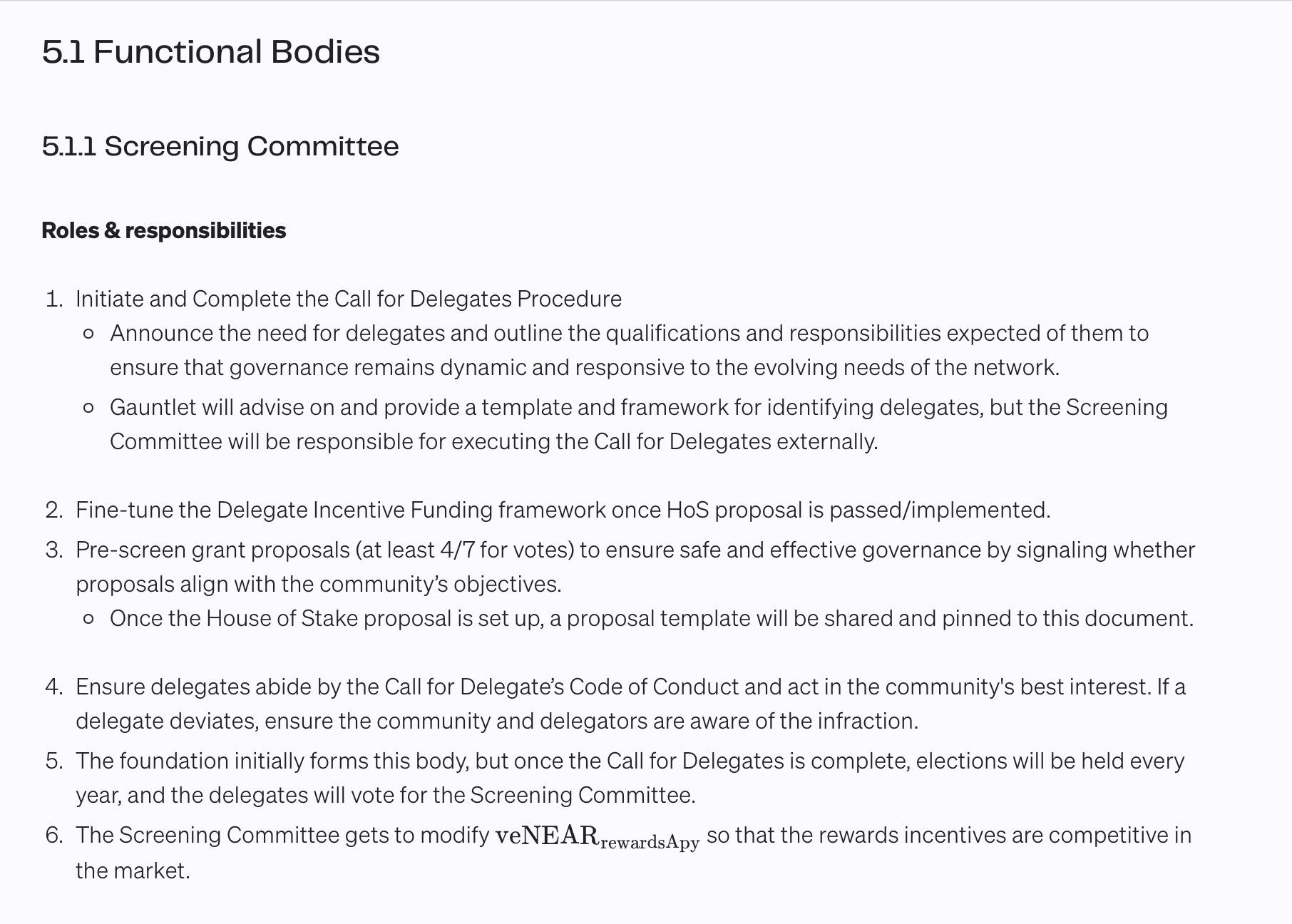
A Screening Committee is proposed, which will initiate the delegate selection processes, pre-screen grant proposals, and ensure continuous evaluation of governance efficacy. The Screening Committee plays a critical role in maintaining dynamic and responsive governance.
Delegate Framework
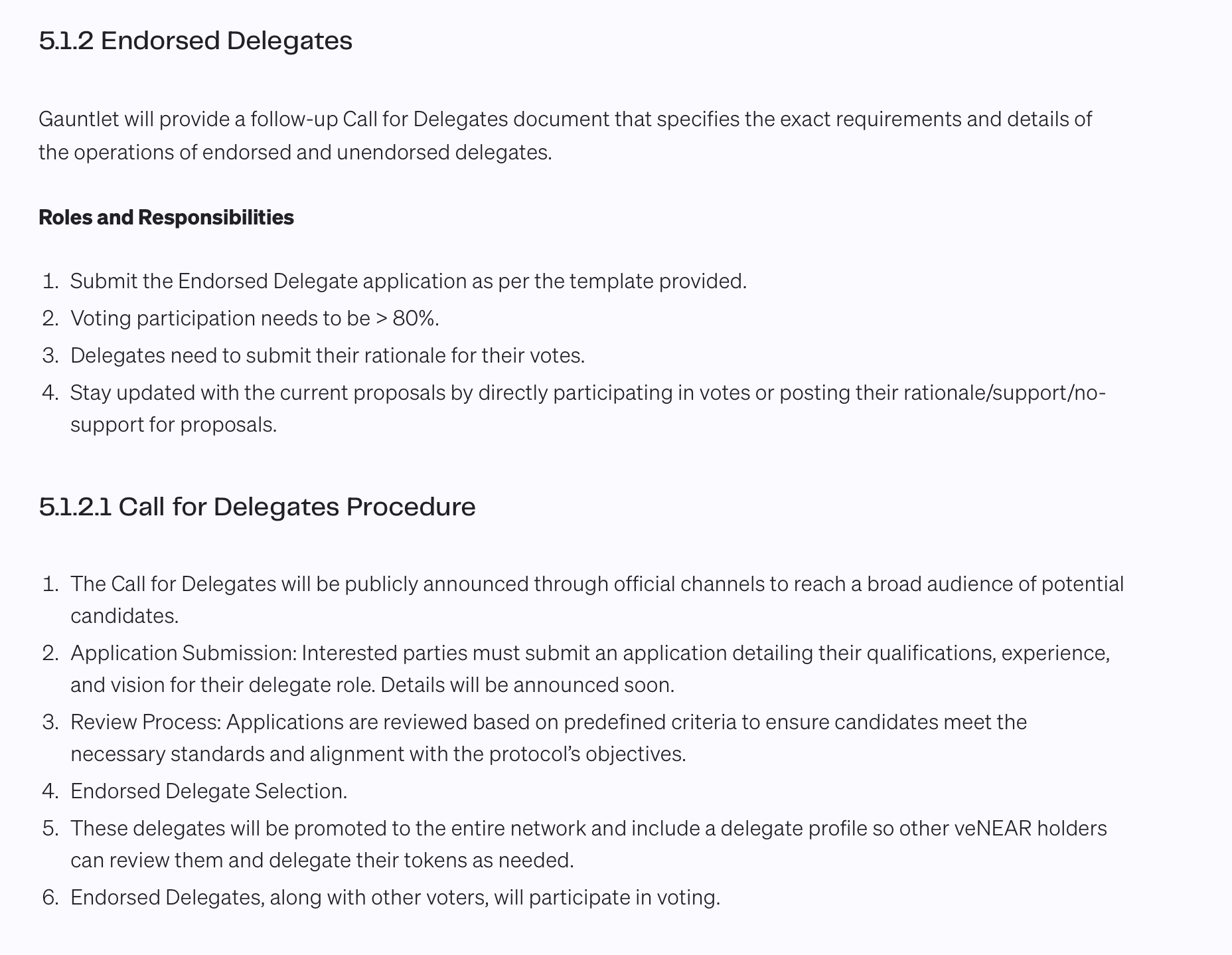
Definitions and roles of Endorsed Delegates are clearly outlined, including their selection process and responsibilities. These delegates are crucial for operational governance and are selected based on their engagement and compliance standards.
Utilization of 0.5% Annual Inflation
A key motivation behind this proposal is to effectively direct and utilize the 0.5% annual inflation rate to fund governance initiatives and incentivize meaningful ecosystem participation.
Path to Decentralization
Steps towards decentralization include expanding delegate membership and periodic reviews by the Screening Committee to adjust strategies based on performance and effectiveness.
Helpful Links:
- agt 13
I’m confused here, so there’s no need to unstake from the current delegator? veNEAR will be given to those currently staking?.. this should be clear, especially on CT… degens barely read anything
- cuongdcdev 10
 agt:
o need to unstake from the current delegator? veNEAR will be given to those currently staking?.. this should be clear, especially on CT… degens barely read anything
nice catch, I’m curious about how veNEAR is minted, also what about users holding LSTs tokens like LiNEAR or stNEAR, how can they vote? do they have to unstake to get NEAR and lock in the voting escrow contract?
- haenko 7
Who will be security consuls? And how to apply?
- Dacha 23
 Gauntlet:
The Screening Committee plays a critical role in maintaining dynamic and responsive governance.
I believe the Screening Committee will encounter similar challenges to those we faced in the NDC: issues around election/appointment processes, conflicts of interest, decision-making protocols, and timeframes. Few people in the ecosystem are genuinely interested in governance and willing to engage deeply and publicly in the process, as evidenced by the current committees and nodes. Therefore, I suggest removing the Screening Committee and not revisiting the idea.
Regarding the Security Council, it should be managed exclusively by NF (like a board with people for example: Illia, Bianca, Abi, Chris, etc.) as the New Governance settlor , with clearly defined responsibilities and actions.
- agt 5
Our validator relies on a unique token emissions model that is heavily dependent on NEAR meme subsidies. Based on our understanding of the proposal, validators without LST compatibility may face significant challenges. We’re eager to clarify how this will affect our specific operations.
- blaze 16
This model hinges on committees and evaluation criteria. It’s unclear how this resolves the inherent gatekeeping challenges and the lack of support for diverse contributions while avoiding the same individuals making all decisions about the ecosystem that do today.
- slimedrgn 16
If I understand this correctly, only LSTs (and non-staked NEAR which doesn’t make any economic sense) will be eligible for veNEAR, and if we want to stake NEAR and convert to veNEAR, it must go through NEAR → LST → veNEAR route. I see 3 problems with this approach:
- LSTs have quite high fees right now, the lost APR is an operational expense (even though voters are the ones who suffer from this), and the amount lost / spent on these fees should be considered if we want veNEAR to stay for years.
- 2 LST projects are a point of failure. What if an LST DAO is attacked and all funds are staked to a validator that has 99% fee? Or if the LST DAO (that consists of LNR and mpDAO holders) collectively decides to increase fees to 99% to buyback LNR and mpDAO. If it takes 3 months to unstake, the whole yield during that time will be lost. In the worst case, the LST DAO can even steal all the staked funds completely, because the LST contract is the one that the actual staked NEAR belongs to. Not to mention that these LST ‘DAOs’ are not as decentralized as many of us imagine. Not everyone is ready to expose themselves to these risks, but there’s no choice if they want a reasonable APR while participating in the governance. Since obviously no one is going to convert NEAR directly into veNEAR without staking, the entire governance framework will be in a very bad state if, for example, metapool.sputnik-dao.near (that needs 2 people to approve a proposal), for some arbitrary reason decides to shut down the operations. And the 3-months unstake period makes it impossible to react quickly to such incidents.
- What’s the point of using LSTs if they’re locked for 3 months? Aren’t LSTs only used because they are supposed to be liquid? If there’s some technical challenge implementing the veNEAR staking without LSTs, why not make a new LST that has 0% fee, can’t be stolen or changed by anyone, and is deployed for each validator automatically, so that the experience is roughly the same as with the native staking that we have today?
I think there should be an option to natively stake NEAR to a validator of your choice, and get veNEAR for that. This will also solve the problem of lower veNEAR yield than if the user just staked NEAR.
Also, regarding the screening committee, we may encounter the same issues as with NDC. But since the number of people involved is not high, it’s easier to notice when the committee members vote based on something other than the facts, so there can be a solution this time. Perhaps, requiring them to stake veNEAR as well, and slashing if the security council finds out that the screening committee misbehaves? That would also imply that 1) the screening committee consists of people who are actually involved in the ecosystem and are capable of making it better, not just an employee who doesn’t have much to lose and has much to gain, 2) they need to submit the rationale for their votes if they reject a proposal during the pre-screening stage, 3) there is a clear set of rules by which a proposal can be rejected during pre-screening, 4) there are incentives for reporting cases when an application was rejected without enough evidence, or for a reason that is not covered in the pre-screening guidelines.
Removing the screening committee completely is also an appealing option, but in that case, we’ll need a replacement that will filter out spam and scam proposals. Not everyone is capable, or has the incentive, to do thorough rug checks and reality checks on every proposal, so the more layers of protection, the better, as long as these layers don’t filter out the legitimate projects.
- Dacha 8
 slimedrgn:
Removing the screening committee completely is also an appealing option, but in that case, we’ll need a replacement that will filter out spam and scam proposa
Yes, I think the House of Staking can make decisions by voting, but even so, the Security Council can veto a House of Staking approval, for example.
My point is to completely remove intermediaries, except for the NF, which provides funding for the initiative.
- agt 4
yes, I couldn’t agree more with your suggestion to allow already natively staked NEAR (especially those in the shitzu.pool.near) to receive veNear.
- kiskesis 17
Dear NEAR Community,
I appreciate the effort and thoughtfulness behind the “House of Stake” proposal. After reviewing it thoroughly, here are my perspectives on its various aspects:
Pluses:
- Utilization of 0.5% Annual Inflation: I strongly support this idea. We discussed it last November at Nearcon, and if the NEAR Foundation agrees, I believe it will be beneficial for everyone.
- Incentivization of Governance Token Holders: This is a commendable approach that will likely increase active participation and commitment from stakeholders.
- Temperature Check: While I appreciate the intention behind this, I have some concerns about its effectiveness given the relatively small size of the NEAR community. Similar initiatives haven’t worked well in other ecosystems like Arbitrum, potentially leading to prolonged processes with minimal benefits.
Minuses:
- Token Locking Mechanism: Creating another venue for token locking may inadvertently drain liquidity from other essential parts of the ecosystem, such as DEXs, lending & borrowing platforms, and NEAR validators. As we have discussed over the past six months, leveraging existing contributions seems more practical. The NDC implemented a system that considers users’ activities across the ecosystem, and it is open-source. Voting power should be based on these existing contributions, with optional enhancements through locking mechanisms if desired. Given NEAR’s current liquidity constraints, creating another locking venue may not be the best approach.
- Committees: The challenge with active contributors remains. The risk is ending up with the same individuals in governance roles, which has been the case for the past five years. To address this, we could consider minimizing the number of committee seats and ensuring frequent rotation. Alternatively, we might eliminate the human factor entirely, relying solely on governance token holders for decisions, with the NEAR Foundation providing an emergency brake.
Proposed Solutions:
- Governance Token/NEAR Holders as Voters: This approach ensures direct community involvement.
- Emergency Brake: This could be managed by the NEAR Foundation or a set of trusted individuals. However, given recent trust issues, transparency and accountability in this mechanism are crucial.
Additional Suggestions:
- AI Integration: Leveraging AI, such as fine-tuning Llama or ChatGPT, for initial checks could streamline the process and eliminate the need for a temperature check, enhancing NEAR’s position as an AI-friendly ecosystem.
- Legal Wrappers: Any committee will require a legal framework to protect participants.
- Benchmark Development: Reports alone are insufficient. We need predefined benchmarks that reflect our primary goals (e.g., user retention, liquidity). Launching governance without these metrics will lead to inefficiencies and misuse of resources. The NDC’s open-source documentation on this topic could be a valuable starting point.
Conclusion:
While the “House of Stake” proposal has many merits, addressing the above concerns and incorporating these suggestions will better align it with NEAR’s long-term objectives. I look forward to seeing how the community evolves this proposal and am ready to contribute to these discussions.
- zavodil 16
I support the decision to implement ve tokenomics, as it has proven to be a good idea. However, I am completely against the proposal to build the entire governance framework around LST providers, who can change fees as they please and update contracts and delegation principles at any time.
To avoid creating threats to the decentralization of the protocol, a new staking contract should be added to the
pool.nearbase instead, which mints veNEAR during staking, and LST tokens should have a decreasing coefficient. - David_NEAR 14
Wonderful, in-depth, proposal. Tonnes to digest.
Aside from the typical objections of:
"doesn’t stake weighted voting just put the governance in the hands of a16z et al
I don’t have anything stark to point out. Voting power correlating with the length of time staked should ensure that those with the most amount of intentional commitment as signaled by time locked will covet an increased share of voting power.
I am pro LRT integration into the framework, as long as considerations can be made to omit the risks that @zavodil and the above have highlighted.
“This model hinges on committees and evaluation criteria. It’s unclear how this resolves the inherent gatekeeping challenges and the lack of support for diverse contributions while avoiding the same individuals making all decisions about the ecosystem that do today.”
Seems like a good opportunity to test out an AI president/committee/etc, or at least prepare for one!
 FWIW - mistakes will be made. Nothing is perfect right outta the gate. Radical experiments make for radical success and, hopefully, we can mitigate the impact of any failures with the appropriate safeguards.
- atrox1382 10
Hi, first of all, happy to read that decentralization remains a priority, I honestly hoped we would be further ahead by now. As interesting as the highs & lows of the NDC have been, I would love to see more of our collective learnings reflected in this proposal. While a tabula rasa approach is valid, we should try our best to learn from those expensive mistakes we’ve made. Moreover the proposal only creates a path towards a very minor form of decentralization (in line with protocol governance), probably completely the opposite of what was the intended result of NDC 2 years ago, (unless the Screening Committee makes certain changes along the way).
A vote-escrowed token is a brilliant idea which has worked in similar situations however as mentioned already by several people, we need to make sure that it does not create an imbalanced playing field for stakers with unintended unfairness. Moreover it creates an additional layer of complexity which in my opinion does not further decentralization of our community.
Switching to stake weighted? I don’t think anyone doubts this to be the correct move, however I would still vouch for certain reputational or quadratic voting factors to be considered within the voting framework.
Screening committee & delegates, I’m a big fan of this approach actually however certain checks & balances are missing in my opinion and could lead to big problems similar to the ones we’ve seen in the past. I would be interested to understand this architecture better as I think it could alleviate some of the concerns I’ve shared above (if executed properly)
As this is a highly complex matter, it would be great in my opinion if a 30 minute workshop could be planned and shared with the wider community.
- crazyrabbitLTC 6
Hello folks! Dennison from Tally.xyz here. New to the forum, but a Nearcat since 2020.

For some quick background, Tally powers the governance of some of the largest protocols in the ethereum space: Arbitrum, ZkSync, Wormhole, and many more. Folks manage over $30b in DAO assets on our platform and have used our tools to transfer more then $600m. We have been intimately involved in the design and implementation of some of the largest DAO’s in the space.
This is a great proposal by Gauntlet, really exciting stuff and aligns with what we’ve been thinking ourself is needed for successful governance.
I would like to formerly ask to be considered as an implementation partner to build out the tooling to support NEAR’s Governance.
We would be very excited to support the NEAR vision for governance.
Exciting stuff!
- Leuts 4
Hello everyone! Anthony from Aragon here. Apologies for coming in like a carrion crow but we are very exited to read and hear about NEAR’s next steps in onchain governance, especially considering it is ve related, something we expertise in!
Aragon has been providing DAO tooling since 2017 and the likes of Lido and Curve use our V1 framework and most recently Polygon announced a few weeks ago they will be using Aragon V2.
What may be most pertinent to the NEAR community is that Aragon has particular expertise in ve builds. Curve is the biggest originator of the veToken setup which is on Aragon and we are working with or advising half a dozen other projects currently on their veBuilds. We are the only DAO service provider with full-stack ownership. We also have a designated team for custom deployments as well.
We’d love to be formally considered to work with NEAR on this build and considered as an implementation partner.
Please don’t hesitate to shoot me a message here or on X (A_Leutenegger).
Thank you so much!
-Anthony - fiatisabubble 12
I haven’t yet been able to unpack all the nuances of this proposal but overall I feel this approach will be more aligned with the goals of the ecosystem.
Whilst the ‘one person one vote’ framework was interesting, it had a major flaw in enabling participants who had no skin in the game. This seems to fix this however it does bring its own set of challenges that should be mitigated wherever possible.
I also share similar concerns to others in this thread highlighting the overdependence on LSTs (non-staked NEAR deposits are at an economic disadvantage). I have however seen discussions for a workaround on X and that should help address them.
With a lot of staked NEAR being locked up for community governance it would also be interesting to see how DeFi primitives can leverage veNEAR in their offerings.
- PGov 7
Excited to see this proposal! We’re interested in the veNEAR concept and the architecture behind locking up tokens for multiple years to get governance power we think at the start will be rather hard to convince. However, once rewards are turned on and we have more use cases for governance, this could be a good example to a lot of future mechanisms. This gamified delegation reminds us a bit of Maker’s new Endgame delegation tokenomics and is something we will be keeping a close eye on in the next few months.
The screening committee will be an interesting concept and we are looking forward to learning more about it. Further committees and working groups on related ideas we’re sure will happen. It would be great to get a timeline on the order of events.
- Niskarsh 5
What is the expected timeline on this? We were planning on creating Snapshot clone for all apps using NEAR to manage their governance, proposals, votes etc. Would this cover that use case?
- alex.shevchenko 16
In general, the proposal is a step in the right direction from my point of view. However, there are several things that I should note (with the references to the full HoS proposal).
- The formula in 4.2.3 might be misleading for people who used to read articles, since lowercase symbols without subscripts are usually denote variables. I suggest to substitute it with $v(t) = v_0 p(t, T_L)$, where $p(t, T_L)$ is a premium function, where $T_L$ is locking time. Premium function is expected to satisfy the following equation $p(T_L, T_L) = 0$. In the first approach $p(t, T_L) = \left(1-\frac{t}{T_L}\right) \left( 1+ 2\frac{T_L}{T_{max}}\right)$, where $T_{max}$ is a maximum lockup of 4 years.
- I really support that veNEAR linearly depends on locked NEAR, so there’s no gaming of the governance system through splitting the lock into smaller chunks or uniting into bigger.
- The second approach (4.2.4.2) with linear increase of the premium is interesting, however, it does not make any sense for the users to unlock within any timeframe except the minimum possible (3 months, see Unlock Duration Specification). The reason is simple: the strategy with a longer unlock would deliver $v(p)$ always lower or equal than the strategy with the shortest possible unlock, taking the same unlock finish date.
- I support the thinking behind 2.4.5 a lot.
- With the budget constraints and proposed solutions, first three make sense in general. I support #1 with slow transition from 10% → 50% over multiple years, which would shift community from passive staking into active governance. #2 would be always negligible (since NEAR is scalable), so I would omit it. I highly support #3, but instead of dropping tokens to veNEAR holders or sharing revenues directly with veNEAR holders, direct these (perhaps, partially) into Community Treasury, managed by veNEAR holders. Thus, the HoS would be mindful of its’ budget.
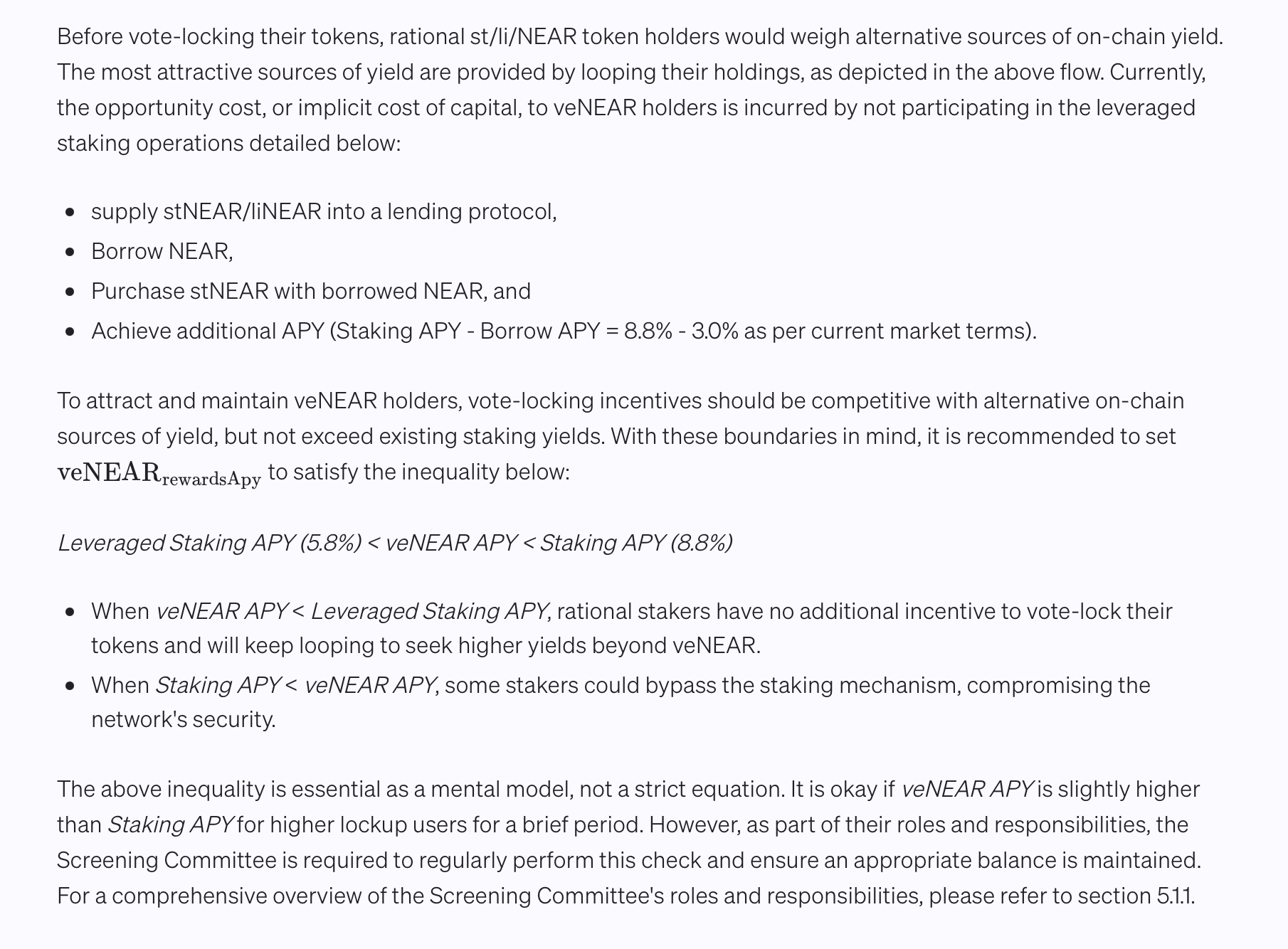
- Dynamic allocation of $veNEAR_{rewardsApy}$ needs to be really analysed; I don’t think we would be able to simply come up with the formulae here. Especially taking into account loops like NEAR->stNEAR->supply 1/2 in borrowing->lend USDT->supply liquidity in USDT<>stNEAR; which may generate higher yields depending on the prices and their actions. I would omit this option for now.
- Sorry, I don’t get the rationale behind creating endorsed delegates body. I believe anyone should be able to delegate to anyone else with an ability of instantaneous removal of delegated veNEAR. In this case a community would find people who think similarly and would ogranise into groups that are led by specific opinion leaders / active governance members. I really believe that people who get delegations should not receive additional remuneration from HoS. I would remove this piece completely, while still putting efforts of HoS into making delegation visible and transparent to everyone (create delegation dashboards, incentivise more participation of smaller opinion leaders, etc.).
- 5.1.4 might be a challenging topic depending on the distribution of delegated veNEAR. I would suggest to keep screening committee composed of the highly trusted individuals for the first year and not to have endorsed delegates as a whole.
- Mayor_of_Pumpopolis 7
How does this Rube Goldberg-esque design introduce accountability for vaporware, grant-n-dash, incoherent projects with no long term vision and malign incentives generally?
Where are the incentives or penalties to prevent further abuse of the grant system? Who should be accountable? Will there be another collection of bureaucrats happily collecting a stipend regardless of outcome?
I suspect the results will be the same until these fundamental questions around malign incentives are addressed.
Illustration by Rube Goldberg - frado 2


How to apply?
I’m reading everything with calm - Gauntlet 21
Thank you very much for all of the feedback and comments on our House of Stake (HoS) proposal. It is great to see this level of attention and care for NEAR governance.
Gauntlet would first like to address the concerns around the existence of any committees within the proposed governance framework. We want to outline from a first-principles approach why committees can be a net positive for governance and then dive into how these committees were structured to solve the problems with the NDC.
We will start by addressing some of the lessons learned from the NDC and how this system attempts to improve NEAR governance. The NDC had a large number of councils and regular elections, which decreased active governance participation and made governance attacks easier. Additionally, the NDC bodies had explicit control over fund allocations. So even when the community became aware of the pain points in the inherent design of the structure, there was a lengthy and expensive process to limit them.
This new framework looks to directly accommodate governance fatigue, which is evidently a significant problem for DAOs and societies at large. Committees can function as a filter for governance to ensure the active delegates are only engaged when it matters most. Second, the most effective governance systems inside and outside of the crypto industry typically utilize both delegate representatives and committees to have experts make decisions, who are nominated at the very least to help aid governance.
There seems to be some confusion about the responsibilities of the two committees our proposal introduces, and we would like to clarify.
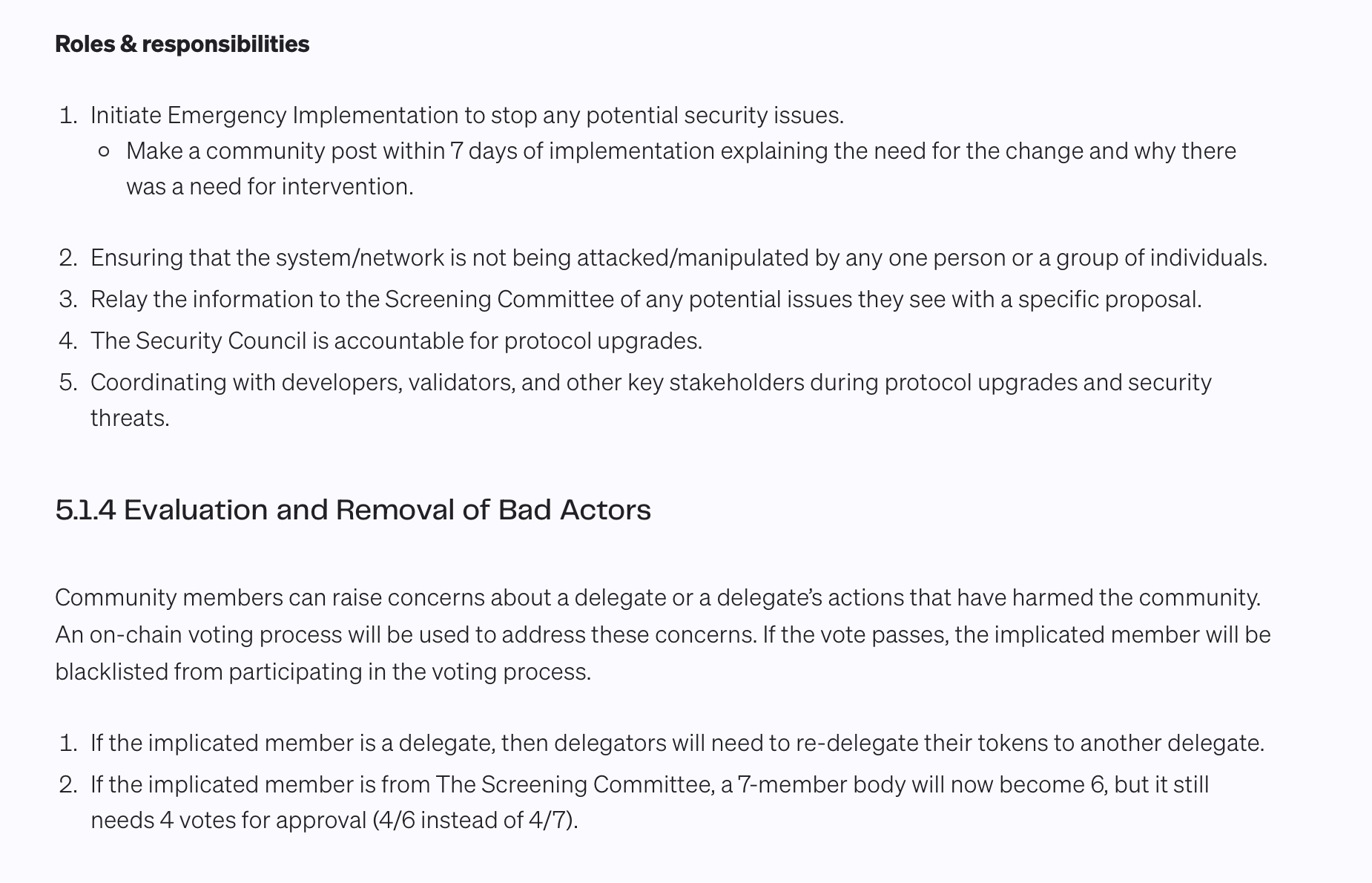
The first committee is a security council comprising the Near Foundation and core protocol experts such as NEAR One, with no elections. This committee can only approve major network upgrades and oversee protocol development and security but will not spend any ecosystem funds.
The second committee is the screening council, which can only increase the quorum and voter approval % required for a proposal to pass. It is important to note that the screening committee cannot allocate any funds for governance and cannot veto any proposals; it just makes it harder for “bad proposals” to pass. This function is critical while bootstrapping a governance ecosystem, making it easier for delegates to avoid governance fatigue and helping the DAO avoid governance attacks while bootstrapping delegations. Again, the role of the screening committee is not to be gatekeepers but to aid in governance and efficient funding, it cannot unilaterally veto any proposal.
In response to some community feedback around ensuring the committees are effective and do not reproduce historical issues, a potential recommendation for improving the screening committee would be to implement a 1-year expiration clause. This would require the DAO at large to vote on renewing or restructuring the committee purely through governance. If the House of Stake DAO believes it is resistant to governance attacks and governance fatigue at that point, it can stop the screening committee and convert it to a standard quorum and a Yes % for proposals.
We also see a future where the community incorporates the use of AI agents in the HoS in the coming months to either screen proposals or act as delegates, which is in line with Illia’s vision of AI-driven governance. We expect to hear more on that very soon. Keen to hear thoughts on this from others.The second main theme of feedback Gauntlet has observed relates to legacy staker compatibility for veNEAR voting. The current update is that Gauntlet and the NEAR community are actively working towards developing an additional mechanism to resolve this concern by allowing legacy stakers to select their validator and receive veNEAR, without requiring them to utilize LSTs or change their chosen validator. As we work to finalize the requirements and details of this mechanism we will provide updates to the the community for further feedback asap.
- luzmargaritas 3
Good decision to seek the best management of the Near DAO and give greater opportunities to the community to participate in Governance

- agt 6
Excellent, looking forward to hearing about legacy stalker’s dilemma. I suspect most of us want to be active in the shaping of Near.
- Zachary 15 Gauntlet:
The first committee is a security council comprising the Near Foundation and core protocol experts such as NEAR One, with no elections.
Introducing any filters only opens Pandora’s box and paves the way for corruption. It seems Gauntlet faced similar issues when trying to set up such committees, didn’t they? Do you want to repeat the same mistakes with Near? Why are you repeating your own errors?
References:
forum. arbitrum.foundation/t/proposal-the-arbitrum-coalition/19145
x. com/defi_made_here/status/1721499800711860452
x. com/permaggg/status/1721791626966634505
x. com/cryptofishx/status/1721516774909259933
Regarding the Security Council, nodes like Near One fails to fulfill its obligations according to the Infra committee’s charter github. com/near/Infrastructure-Working-Group/wiki/Infrastructure-Committee by not providing reports and managing applications.
Expecting active participation from these and other nodes in governance is absurd. Their activities are often 100% financially dependent on Illia and will follow all his directives.
Harder for “Bad Proposals” to Pass
This is completely wrong thinking and will only lead to corruption among a small group of people deciding whether a proposal is good or not. It’s obvious this isn’t Illia’s decision, but rather the decision and desire of those who want to manage the financial flows of the new governance system.
I assure you there won’t be any excessive burden, as even VCs interested in this governance do not actively participate or delegate this role to interns.
- cloudmex-alan 6 slimedrgn:
2 LST projects are a point of failure. What if an LST DAO is attacked and all funds are staked to a validator that has 99% fee? Or if the LST DAO (that consists of LNR and mpDAO holders) collectively decides to increase fees to 99% to buyback LNR and mpDAO. If it takes 3 months to unstake, the whole yield during that time will be lost. In the worst case, the LST DAO can even steal all the staked funds completely, because the LST contract is the one that the actual staked NEAR belongs to. Not to mention that these LST ‘DAOs’ are not as decentralized as many of us imagine. Not everyone is ready to expose themselves to these risks, but there’s no choice if they want a reasonable APR while participating in the governance. Since obviously no one is going to convert NEAR directly into veNEAR without staking, the entire governance framework will be in a very bad state if, for example, metapool.sputnik-dao.near (that needs 2 people to approve a proposal), for some arbitrary reason decides to shut down the operations. And the 3-months unstake period makes it impossible to react quickly to such incidents.
Talking about LS business model, doesn’t make any sense to increase fee to 99%, market standard is 10%, Meta Pool is currently 6%.
Will save time for adding more comments on my personal and Meta Pool’s POV about this governance framework proposed by Gauntlet.
- cloudmex-alan 2
 alex.shevchenko:
I support the thinking behind 2.4.5 a lot.
I don’t see this point on the doc.
- luzmargaritas 2
Hi, do you have an alternative proposal that at least minimizes this “possible corruption of this committee”?

- luzmargaritas 2
Good question it´s an important issue to clarify. And it´s important that all the community read and ask

- luzmargaritas 2
The dynamics of DAOs is a difficult matter to manage, each of them has its own environment and the community participates in a random way. But hey, you learn from experiences.

- LiNEAR 7
As a long term builder of NEAR and some of the earliest contributors, we are very excited to see the House of Stake proposal. We support this initiative and believe that it’s beneficial to the longer term success of NEAR and its ecosystem.
The proposal suggests replacing the current 1-1 voting system with a stake-weighted, lockup voting token veNEAR. This would allow holders of $LiNEAR to convert their tokens to veNEAR, allowing holders to participate in NEAR on-chain governance while simultaneously earning NEAR staking rewards and veNEAR rewards. We definitely are in favor of this approach!
As for the concerns that some of the community members have posted above, we want to mention that LiNEAR has always cared about the decentralization and longer term success of NEAR. We charge minimal fees. While certain validators might produce higher yield to users during specific epochs, over the long run, LiNEAR has provided higher yet stable yield. Our automatic validator selection algorithm allows the users’ NEAR to be distributed across 200+ nodes, constantly monitoring the performance of the validators, and makes decision to stake and unstake as needed, guaranteeing a good yield for the users over a long period of time while also promoting the decentralization of NEAR.
LiNEAR has received over 27 million NEAR and has been up and running for 2 years without any issues. The code has been audited by both Blocksec and Hacken.
In addition, LiNEAR is also working on creating LRT of NEAR tokens. We want to propose to include restaked NEAR as a voting token.
- satojandro 12
Thank you for this proposal!
I am very excited to see a professional, well thought out proposal, so fast after the sunsetting of NDC (and the resulting burnout in community governance it left in most of us.)
Here is a detailed breakdown:
Acknowledgments
I believe that anyone contributing feedback to governance should acknowledge the following:
- Conflict of Interest: I was a member of the Transparency Commission within the previous NDC structure. I was very vocal about the shortcomings of that structure before, during and after its implementation and I saw first hand from within the many ways in which it was exploited and how it failed.
- Conflict of Interests (Others) Other people participating in this thread were also part of NDC, either at the pre-conception stage or as elected members. Some were oblivious to the obvious and defended it til the end, some were grossly negligent or outright corrupt, the rest tried their best to make it work and are also well versed into the ecosystem dynamics and challenges. The outcome is the same and one must understand where the outcome is coming from as they now try to shape new forms of governance.
As far as acknowledgments go, I am very happy to see Gauntlet acknowledging the NDC shortcomings. We must learn form past experiments in order to progress.
Challenges of NDC Framework
The proposal has a very brief and eloquently put summary of some of the shortcomings of NDC. I’d like to add a little extra flavour which I believe is necessary to truly appreciate the proposed structure:
-
The NDC was unaligned by design. Early drafts were permeated with UBI and other forms of social utopianism which aimed to use NEAR treasury for great things, except actually help NEAR ecosystem grow. It is hard to believe I was involved in very intense power struggles to include NEAR ALIGNMENT into the Charters of some DAOs. Deliberate steps were taken to onboard people only for the purposes of voting to the extent that a real ‘election issue’ was voters having so little involvement with NEAR they didn’t even have enough to cover gas fees to vote (and txs on NEAR are cheap asf).
-
Lack of Merit or Authority: we had a Transparency Commission with people who did not have any background in dispute resolution and that even when explained basic legal concepts and processes decided to use their power to override common sense and advice (incl. from Foundation, Trustees, etc.). A house of merit where members with less merit and more free time overloaded and undermined more senior members, which grew quickly frustrated and stopped engaging.
-
Faux screening: the NDC did have some screening, implementing basic ‘OG’ status to be able to run. This was an acknowledgement as to the need for some standards, but as the rest of the framework, it was very poorly implemented, keeping an extremely low bar. Justifications ranged at time from lack of time for a more complex technical implementation to ‘fairness’ concerns. Even if both were valid at the time, this seems like a relevant precedent in the consideration of current committees.
Functional Bodies
Screening Committee
I 100% support the implementation of a Screening Committee. While it is true that the committee will only be as good as the people that sit in it, it is also true that there are people who have built one of the most advanced blockchains out there (technical, operational accomplishments) and that unburdened by group think and mobs masquerading as ‘community’, have been able to procure this proposal.
I trust the NEAR Foundation, under Illia’s leadership, and other early core contributors and founders, to use their best judgment and either be in screening committee directly or appoint people who they deem will be able to perform these duties as laid out in proposed gov framework.
Once again, a lot of us have PTSD from the NDC. But we must use the NDC as an example of what does not work, move past it, and implement a proper Screening Committee to ensure we never have such challenges again.
Beware of those who call for the elimination of checks and balances such as Screening Committees…
Endorsed Delegates
I am eagerly looking forward for more information being provided regarding endorsed delegates. In particular, I would like to know:
- Application Template: what information will be required of Delegates to be provided?
In the past we struggled with NDC elected members:
- Presenting pro-active disclosures of conflict of interest
- Adhering to basic conflict of interest procedures (like voting on your own proposals)
- Passing KYC
- Complying with basic KYC processes (incl. taking deliberate measures to bypass KYC requirements)
- Identifying and acknowledging people’s experience, subject matter expertise, interests.
I am open to working with the team looking into the application template to ensure we strike the right balance between privacy and due diligence.
- Delegates need to submit their rationale for their votes
This is perhaps the most important thing in the entire proposal. While I have personally always provided LENGHTY explanations to my decision from MDAO to Transparency Commission (if you are super bored go check out all my Marketing DAO decision dating back to 2021). Sadly, I was one of the few. Attempts to ask others to do the same were ignored, or outright opposed. (incl. making the rationale public).
Here I am interested in:
-
The systems built to enable these deliberations and final decision to be made. Specifically, I’d love to see an AI interface that can serve as a ‘Case Manager’, assisting delegates work their way through pending proposal, documenting all their reasoning, translating content to/from the language that would allow delegates to perform their best work, among other potential use cases.
-
What happens if delegates fail to submit their reasoning?
In general, I believe that this framework where: a) there is a higher bar for delegates to join b) there are clear expectations on performance (beyond the pathetically mediocre standard adopted by NDC of simply showing up to meetings even without uttering a word), and perhaps most importantly, it allows community to delegate tokens to their preferred Delegate ensuring all communities are represented.
Security Council
I believe the Security Council body needs some revision. My main concern is that it is being tasked with two very different sets of responsibilities. At first, it would appear as through Security Council is a technical body in charge of security breaches, protocol upgrades, etc. But then they are also granted dispute resolution powers that need to be thought out carefully:
- What would be the process for ‘Community Members’ to raise concerns about a delegate?
- What is the definition of ‘harming the community’? As it stands, it is extremely open ended.
- Clarify who participates in the on-chain vote? Is it only Security Council members that vote or is the removal also open to all stake-weighted participants?
- Review and state explicitly the reasoning for maintaining the Quorum for the Screening Committee the same, even if the number reduces in size. (This was also a heavily contentious issue in NDC, albeit by design to kill a body if it became inoperable)
I already experienced through the short-lived Transparency Commission how anon ‘community members’ targeted sitting members of NDC with poorly drafted, baseless claims that were extremely time consuming to address.
As it stands, the highly technical group of people that would be well suited for dealing with core infrastructure security and upgrades, et al. are probably THE WORST suited people to deal with community claims and dispute resolution (very public facing, social skills, legal reasoning).
Use of NEAR, stNEAR, Linear
I’ve been reading the comments from several community members and the update from Gauntlet regarding allowing locking NEAR for veNEAR directly with validators.
- It is important to note that these concerns and suggestions are coming from OG community members who are also running validators. Long term commitment and quality. However, I do not think we can make the same assertion about every validator on the network, specially four years into the future.
- I believe that the risk of any given validator going offline (leaving the active validator set) is significantly higher than the risk of two OG, NEAR-native liquid staking solutions somehow stopping operations.
- As I understand it; if a user locks stNEAR or Linear for four years to receive veNEAR. And one or more validators go offline, Meta Pool and Linear are still able to withdraw assets from validator (non-custodial) and redistribute.
- The risk of an individual validator going permanently offline is the most severe one. We also need to consider the risks of a validator having very poor performance (and users being locked with them for four years), or, most concerningly, a validator raising the fees significantly after securing a lot of veNEAR delegation.
- Once again, the risk of any individual validator abusing fees due to lockups is significantly higher than the risk of our only two OG, NEAR native operators (who both have fees on NEAR that are considerably Lower than standard LST fees elsewhere.
Ultimately, we have to decide whether we want a system that places the onus of choosing a good long term validator on the user (assuming that is possible to do so). I would do an actual consultation of stakers, not current validator operators, and present them with both alternatives and both set of risks. Would you rather lock an LST, and them automatically delegate your NEAR over the lockup period to best performing validators, or to trust ONE validator to be there long term and not change fees.
Codify expectations with LSTs
I have a strong preference for LSTs. However, in the interest of addressing the valid concerns raised, I propose the following:
- Enable more LSTs to join the proposed governance framework over time. This would ensure that the landscape stays competitive over time. (i.e. is X operator joins NEAR 18 months after governance framework goes live, the contract can be upgraded accordingly to allows their LST to be locked for veNEAR).
- Set a maximum fee from LSTs in order to be eligible for Governance Framework. In the same way that LSTs currently require individual validators to set their fees at 10% or lower in order to allocate delegation to them, the governance framework can set a maximum amount of fee that LSTs are allowed to implement in order to be part of framework. Rather than imposing limitations on LST providers, the idea is to provide long term reassurance that fees won’t exceed (whatever the highest acceptable threshold is for the industry).
- LSTs to create ways to allow stakers who migrate in order to participate in governance to signal which validator they want their stake to be delegated to. Currently Meta Pool allocates a % of all their stake to validators that their community votes for (with their token). I believe a similar, simpler model can be implemented where, if someone locks stNEAR or Linear, they also get to tell the LST provider where to delegate the equivalent amount of NEAR (everything else remains the same, if validator goes offline or performs poorly, the delegation can be reassigned to other operators).
At the moment, a TINY amount of NEAR is liquid staked. And, to be brutally honest, a significant amount of it comes from NEAR Foundation in efforts to decentralise the network and support small operators. I would personally welcome community governance as an opportunity to increase the share of LSTs and in turn, spread out the NEAR more widely. However, I would also support people being able to choose their validator via LSTs.
Incentives to veNEAR Holders
Allowing users to stake NEAR directly with validators would also require us to review the Incentives to veNEAR holders.
- The incentives for veNEAR have been calculated based on the opportunity cost of LSTs
- If a user stakes NEAR directly with a validator and then locks the stake to obtain veNEAR, there is no opportunity cost.
- Interestingly, the proposal also acknowledges the risk of veNEAR APY being higher than staking, if too many people deposit ‘naked NEAR’ for governance then the network security may suffer if there aren’t enough stakers. In this case, allowing for direct delegation to validators and locking would actually mitigate this risk. (Would it replace ‘naked NEAR locking’? Or we just have the additional option?)
- With the estimates provided, with a meagre 10m NEAR locked for governance, we would require 580,000 NEAR for veNEAR APY. This is over 10% of the 0.5% inflation rewards allocated to Treasury (~5m per year). I believe 10m is a low estimate considering the 500m+ currently staked, which means cost of running program could easily exceed the amount of funds allocated to it.
- Does it make sense to offer veNEAR rewards to people who stake directly with validators and do not incur any opportunity cost? Obviously not, but then we are facing a new set of issues around potential ‘discrimination’.
As shown in the table above, as the total NEAR locked in veNEAR contracts increase, the minimum required annual NEAR rewards paid to veNEAR holders will also increase to maintain parity with other on-chain sources of yield. It is important to note that as veNEAR gets fully adopted, budget constraints will be a challenge the community must address in the future. As the veNEAR supply grows, the required annual spend to fund veNEAR rewards will also increase.
Incentives for Delegates
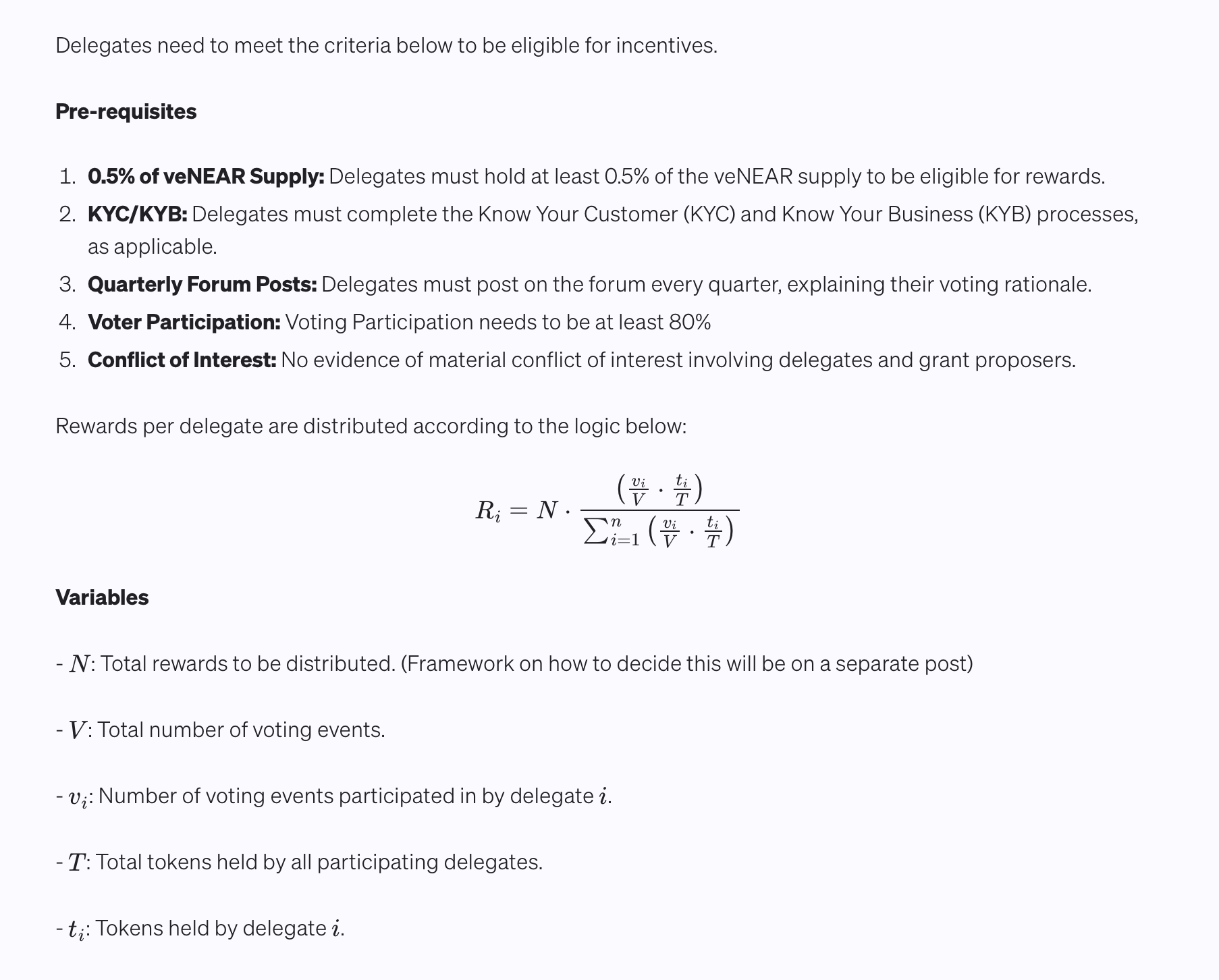
In general, I like setting a minimum % of delegation for Delegates to be eligible for incentives. I also like that it is based on participation, which perhaps could be more explicit in it requiring Delegates to always share their reasoning. I do have some questions;
- Who determines the total amount of rewards to be distributed to Delegates?
- Is there any modelling or examples from other ecosystems with a similar framework where we can see the distribution of delegation across Delegates?
2.1 Assuming a standard 80/20 distribution, I am worried that determining the Total Amount of Delegation to be distributed to Delegates will be very hard as, assuming they all have roughly the same participation (Voting), 20% of delegates are likely to receive 80% of rewards (upper echelon may seem to be earning A LOT, while the rest and lower echelons may seem insufficient). I understand the market forces in people determining who they want to delegate to (no issue with that). My issue is in reverse engineering the total size of the pool based on what any given individual receives and the perceived notion of ‘fairness’). - To tackle this I would consider having predictable formulas to set delegate rewards (before Delegates are appointed and delegation distributed to them).
3.1 This could include setting a fixes % of the total funds available to Delegates.
3.2 Calculating how much would be the bare minimum for a delegate with 0.5% of delegation and 80% voting participation, then calculating the rest from there.
3.3. Open to suggestions.
Conclusion
I really like the proposal. There are some areas to clarify and improve upon. Grateful to have the opportunity to comment on it as a general member of the community.
[If you read this far. Thank you. Satoshi would be proud. LFG]
- danielle 6
The new governance mechanism give power to NEAR holders, and also motivate Defi projects in the same ecosystem like Meta Pool & Linear Protocol by utilizing LSTs. More token weights, more veNEAR for voting. It makes sense.
- ttbqb1st 2
This proposal brings a lot of exciting benefits to holders.This is really a big step of NEAR protocol
- luzmargaritas 4
 satojandro:
Incentives to veNEAR Holders
Thank you for taking the time to do this analysis that serves the entire community. It remains to look for answers to provide alternatives and ensure that there are no gaps in information that is relevant to the entire NEAR Community.
- Vladislas 2
Hello,these fallen ones are just another failed experiment with the same old parameters. Why don’t a16z and Electric Capital just chip in a million Near each and set up their own management?
- luzmargaritas 1
It seems that the comment was not finished, that’s how it is. It would be good to finish the proposal.

- cloudmex-alan 7
Based on Meta Pool’s governance experience, it has been observed that rewarding only active voters is crucial for maintaining a robust and engaged community, due that participation is key.
This approach ensures that rewards are distributed to those who actively participate and contribute to the decision-making process, thereby fostering a more dynamic and committed governance environment. Applying this principle to the new House of Stake will incentivize active participation and ensure that rewards are allocated to those who are genuinely involved in shaping the ecosystem’s future.
This strategy not only encourages greater voter turnout but also enhances the quality of governance by ensuring that only engaged and informed participants are rewarded.
Other spin-offs around this can also be explored.

- luciotato 6
a few comments:
-
at this moment, the sputnik meta-pool council must be involved in setting protocol fees, so even if the DAO is attacked, it does not translate into the risk of setting fees to 99%. But you have a good point, so we will also propose a 10% cap by contract code to remove that risks.
-
The mpDAO or LNR holders setting fees to 99% is not a plausible scenario. It does not make economical sense because it will mean the destruction of the LST protocol, in exchange of 3 months of staking rewards. Let’s refrain from posting scenarios where the consequence is a destruction of the protocol, let’s start from the base that POS works because the players have skin in the game and they don’t want to destroy their own protocols.
-
Regarding assigning all stake to a 99% fee validator, right now by contract code no validator can receive more than 49.99% of the total stake managed by the meta-pool smart contract. (49% is still high, we will propose to the DAO to setting the cap at 5%). Even if by some attack a validator is assigned 49.99%, the stake movement is not immediate. Under normal conditions a 49% assignment will require 8 to 10 months to become effective stake, and even in the worst case scenario of somehow full control by some attacker, moving stake requires 4 epochs, and by contract code you can not move stake if the users require unstaking, so again, worst case scenario means the destruction of meta-pool protocol but no risk for the NEAR protocol itself or risk for the underlying user’s NEAR (they will have enough time by contract to unstake and recover their NEAR)
-
metapool.sputnik-dao needs 2 people to approve a proposal, that’s another good point and even if we have been operating since NEAR’s day one without any incident, that can be improved by moving metapool.sputnik-dao to a 3 of 5, or 4 of 7 council. Point taken. Will be improved.
-
“why not make a new LST that has 0% fee”?, because part of the advantage of LSTs is that we actively monitor validators to balance increasing the Nakamoto coefficient with obtaining a good yield for the users. You need to pay people for their services. You need to pay for monitoring. You need to pay for maintenance. You need to pay for validation.
But having an LST contract that is non-upgradeable and with a fixed fee to cover operations is not a bad idea and the meta pool team is keen build that as public goods.
The idea is to code and deploy a third LST, a Neutral LST, non-upgradeable and with a fixed fee. Let’s call the token NLST.
-
If you stake there you can use the NLST to vote to which validator your NEAR will be staked (we already do something similar here: https://www.metapool.app/stakevote/?network=near )
-
The key problem here is validator monitoring, that must be done off-chain for now. This can be solved at first via feeding the NLST contract with our own validator monitoring, just to avoid high-fee validators or offline ones, and in the near future (pun intended), as a V2, that could be solved by an AVS on a NEAR restaking platform. In any case you need protocol fees either to pay for the maintenance, the monitoring or to pay for the AVS service. TANSTAAFL
-
- luciotato 5
The question is: “what happens if the validator goes offline?” People are stuck for 3 months or more with an off-line validator, and that also reduces the censorship-resistance of the entire NEAR protocol.
I made another proposal for neutral LST here: Neutral LST
I believe it is better to have a solution at the smart-contract level and not tied to the infra.
- slimedrgn 4
Regarding “what happens if the validator goes offline?”, it looks like a question with 2 choices - LSTs or no LSTs. Both choices have some tradeoffs. With questions like this, it’s important to think outside the box, not limiting the choices by what is already built. I think there could be a better way of locked staking - for example, using “Staking Vault” NFTs / accounts. Each user has their own Vault NFT under
*.venear-staking-vault.nearname, this NFT holds the stake, the same way as LSTs work now. This NFT will be locked in veNEAR contract, and you can’t withdraw NEAR while the NFT is locked, but you can unstake from one validator (with the normal unstaking delay of 5 epochs) and delegate to another validator in “remote control” mode while the NFT is still locked. When it’s unlocked, the voter can withdraw NEAR from this NFT. This approach solves the problem of validators going offline / setting 99% fee, since people can just unstake and delegate to another validator in ~3 days, as they do now. It gives voters the flexibility of moving their delegation to another validator while it’s still locked and can’t be withdrawn for 3 months, until the veNEAR contract returns the Staking Vault NFT to the voter. It would have no additional fees, wouldn’t need a DAO or an algorithm to disperse the stake to 200+ validators, wouldn’t have an organization that can potentially steal the money. The staker is in charge of monitoring their validators, everything will be the same as it is now with native staking (please don’t start calling it “legacy staking”). - Mayor_of_Pumpopolis 8
There’s nothing wrong with top-down planning, but it needs to be done competently. If we need to accept faux decentralization to deliver on buzzword bingo, it doesn’t change the need for competence.
The problem with previous grants wasn’t in a lack of decentralization, low volume of votes or community engagement. These are all meaningless metrics. The problem was a lack of competence. Projects were funded which never delivered. The core team heavily funded and promoted things which nobody needed or asked for.
Who were the proposed customers for “The BOS”? Did no one ask this before embarking on that years long journey to nowhere?
Vaporware projects were promoted on official channels by paid social media staff. This sucked air out of the ecosystem for legitimate projects and builders who have delivered working projects. Grand narratives with no profit motive or envisioned customers similarly deplete the ecosystem.
These strategies offered short-term hype at best. In the medium to long term, users and developers lose faith due to mismanaged expectations. There is a reason why other ecosystems have attracted robust, organic growth while NEAR’s superior tech takes a backseat.
What is being proposed here is even more vote-yourself-grants, with extra steps. Many of the original grants selected by insiders before the NDC were not executed competently. Why should this process, which appears to be a synthesis of both approaches be different? Obscuring the problem doesn’t change the core issue.
Problems will continue until there is a legitimate system of market incentives which penalize failures. Long term performance must be rewarded and incentivized.
- Hershel 3
 Crypto_woody:
how much did you get paid for this framework?
Less than NF COO receives monthly https:// pikespeak.ai/wallet-explorer/cjpd.near/history and withdraws on Binance
- agt 3
Competently and consistently
- luzmargaritas 3
Agree with the suggestion of AI use for the “temperature check” also with establish metrics to evaluate the change process
- cloudmex-alan 4
- Keyrock 3
Thanks to the Gauntlet team for drafting this proposal and to the community for their valuable feedback and engagement. Based on the extensive discussion and feedback regarding the latter section of the proposal, which focuses on Governance Architecture, we have decided to focus on the proposed Tokenomics. Following are our thoughts on the suggested Ve-tokenomics, specifically the two proposed approaches.
Approach 1: Fixed Lock
-
Due to altcoin volatility, many users are adverse to exposing themselves to liquidity and time-duration risks by locking up their tokens. Most DAOs already struggle with governance participation, and this lockup requirement might act as a barrier to entry for users wanting to participate in governance due to the minimum lockup period of 3 months required to obtain veNEAR.
-
Retail and smaller holders may be asymmetrically affected by this risk as they have the least incentive to lock and participate in governance. This may lead them to become underrepresented in the DAO.
-
To incentivize locking tokens, veNEAR holders will earn rewards. As mentioned in 4.2.5.1, to make veNEAR competitive against on-chain alternatives, these rewards are set to 5.8% APY. The NEAR rewards will be distributed to NEAR holders based on their pro-rata share of the veNEAR supply. However, due to lockup periods affecting a user’s veNEAR amount, the APY a user earns depends on both a user’s self-chosen lock-up period and the average lock-up period of the total veNEAR supply. Take the case that 100m NEAR has been locked as veNEAR with an average time of 2 years. As a result, 580k NEAR is distributed among 200m veNEAR. A user’s APY can vary based on their lock period, as seen in Table 1.
Lock-up Period VeNEAR Effective APY 3 months 1.125 3.26% 1 year 1.5 4.35% 2 years 2 5.80% 4 years 3 8.70% -
Due to the variable rate of APY, the target APY rate only ensures that APY is competitive for users whose veNEAR lockup period is equivalent to the average lockup of all veNEAR. Additionally, locking tokens for long durations encompasses large amounts of time and liquidity risk, which should be considered when benchmarking APY against on-chain strategies where the token remains liquid.
-
Based on the above, we suggest changing the target yield rate such that even the bottom 10% of users based on lock-up period still earn 5.8%. This ensures short-term locks are competitive with on-chain strategies and longer locks are rewarded in proportion to the risk taken.
-
It is mentioned in 4.2.5 that the target rate should remain below 8.8% - equivalent to the NEAR staking rate. However, as LSTs can be deposited for veNEAR to accrue both staking and NEAR rewards, there is sufficient economic incentive to stake NEAR regardless of veNEAR’s maximum APY.
Approach 2: Rolling Lock
- The Rolling Lock approach lets users accumulate veNEAR voting power linearly over time. Users can enter a queue and receive boosts based on the time staked. As vePower increases, economic rewards increase, creating an incentive for users to keep their NEAR tokens locked for longer periods.
- We believe that users should be rewarded in proportion to the economic value they bring. While users who lock veNEAR are aligned with and benefit the protocol, we have concerns about whether the rolling lock approach incentivizes governance participation or merely rewards users without requiring active involvement.
- This may be seen as a free yield opportunity by farmers, and large amounts of NEAR emissions may be required to reach the target rate APY. Since all these costs are paid by the DAO, it is inefficient to pay APY if most users are passive and unproductive farmers.
Based on the above, we have created an iterative version of the Rolling Lock model. Instead of a user’s veNEAR accruing based on time, it accrues based on the user’s governance participation. This aims to align incentives by rewarding those who are active in participation. Secondly, we believe this will eliminate free riders and reduce overall costs to the DAO since the intention is to maintain a 5.8% reward rate.
Suggested Approach 3: Vote-based Rolling Lock
-
Similar to the Rolling Lock, users lock their NEAR or lstNEAR for veNEAR. This lock has no pre-specified time period and has a 3-month unlock period. 1 NEAR locked is 1 veNEAR.
-
A user will accrue veNEAR power as their voting participation increases. Voting participation is the percentage of voting in the last 50 governance proposals. The maximum boost a user can get is 2 additional veNEAR for each NEAR deposited (resulting in a total of 3 veNEAR/NEAR).
-
The formula for a user’s veNEAR is:
veNEAR = NEAR deposited + (Voting participation in last 50 proposals × 2 × NEAR deposited)
A user’s boost is the maximum boost multiplied by their voting percentage. A user with 100% participation will have 3 veNEAR, while a user with 50% participation will have 2 veNEAR.
-
As increasing voting participation requires proposals to vote on, accruing veNEAR is also time-based. However, in this approach, the rewards are limited to those actively participating, incentivizing participation and reducing costs to the DAO.
We believe this approach aims to align economic rewards with active governance participation, reduce barriers to entry, and lower costs to the DAO. By promoting active governance participation, it seeks to ensure a more sustainable incentive system for veNEAR holders.
-
- claudioac 3
Thank you Gauntlet team for sharing the proposal for HoS.
Hello Nearians! As you know at Meta Pool DAO we have been developing and working in on-chain governance for our LST platform since 2021 and more actively since 2022. Links to our latest Meta Pool DAO Grants Round N.7
We are keen to support this initiative and would like to add some comments to it.
@alex.shevchenko and @zavodil have some great points of view and would recommend that your team review their points of view.
- Fixed Lock NEAR to get veNEAR, will show the real commitment to individuals and organizations that want to be part of the NEAR governance.
- As to allocating the rewards for veNEAR holders, I would suggest that HoS only awards it to those that are actively voting. We are already doing this for our own governance at Meta Pool DAO. Lower participation but true believers in governance are involved.
- Screening Committee, start with a short list of individuals. NF/Pagoda/NEAROne should be 50% and then another 50% of core projects contributing to the ecosystem. Less is more in regards to this group. Allow the committee to vote on the first proposals to get the ball rolling.
- Delegates, again less is more. There will not be a “perfect” delegate(s), experience in specific areas should be mandatory and clear track record of executing plus delivering is a must.
LST´s
My point of view will be biased, since I am part of the Meta Pool DAO. @luciotato post addresses some of the concerns brought by the community.Again, we have always put community front and center in our DAO, here is the BOS component for our Meta Pool Improvement Proposals, enabling on-chain discussions which I encourage folks to use and participate in our DAO. We want to make the necessary adjustments that will enable our LST to comply with the requirements from the community. So stNEAR can contribute to the growth of the NEAR Protocol network. Not just by enabling decentralization through our Meta Vote platform, but also through direct governance participation.
The NEAR ecosystem has our commitment to shape this proposal to the values of what everyone here has contributed to build during all these years. Some of us since mainnet launch and others through out the different cycles.
We want NEAR Protocol to flourish and I want to help this proposal deliver value for all the ecosystem participants.
- claudioac 3
Active governance is key. If you vote you earn rewards as easy as that!
- claudioac 4
I agree that funding projects for BOS was very experimental. We also built a couple of components that focused on our audiences. Like our Meta Pool Improvement Proposals, it was a bet that the NEAR Protocol core team built and did not find Product-Market-Fit for mass adoption, time to move on.
This is part of where NEAR was back then and now we see a shift towards AI. This is all tech that some of us will use and others wont. I think everyone has learned and as an ecosystem we are doing our best to keep delivering value with the technology that the core team is building. Some of it might be hits and other misses, we should not get discouraged. Lets keep buidling, I appreciate the concerns you have expressed.
As for this proposal, we need to focus on transparency and enable contributors to the ecosystem to participate.
- Nader.frax 5
We at Frax Finance are excited to see the Gauntlet “House of Stake” proposal for the NEAR Ecosystem. This comprehensive governance framework aligns well with our vision of transparency, accountability, and sustainable growth. The Frax community is enthusiastic about the potential of this proposal to enhance governance and drive meaningful participation within the NEAR ecosystem.
Additionally, we are particularly interested in the integration of frxNEAR in the coming months as another liquid staking token (LST) within the vote-escrow governance framework. This inclusion will further strengthen the synergy between NEAR and Frax, promoting more robust DeFi interactions and expanding opportunities for both ecosystems.
We fully endorse this proposal and look forward to the positive impact it will bring.
- Ozymandius 5
Tuning in here after seeing the post and the initial response.
-
I am very glad to see governance moving forward with NEAR. It has been a missing piece of the ecosystem that needs to be addressed so that the annual inflation can be used effectively and there are more ways to get involved outside of the small inner orbit of OGs.
-
The mechanics of the design look sound, and at the very least will make sure that the NEAR token holders are encouraged to look into the ecosystem at how ecosystem rewards are being utilized. Ideally there is a balance of accountability and participation from this.
-
On this proposal vs. NDC and the past: I would encourage everyone to embrace this experiment with their best foot forward. The question here is if we want governance on NEAR this cycle, or to kick the can (again) - that should largely incentivize everyone to help communicate and participate in this proposal so we can finally grow $NEAR as an ecosystem.
Personally, I think Gauntlet will be able to deliver. The real question is if the NEAR community is ready to actively engage (so we don’t have a Compound like attack). I think now is a good time to begin.
-
- sean 3
I am excited to see the next evolution of NEAR governance but have some hesitations with this current proposal. I dislike the proposed long lockup periods for veNEAR, which range from 3 months to 3 years. Such extended lockups pose significant opportunity costs and risks, particularly favoring large holders or organizations who can afford to lock tokens for extended periods. I view NEAR’s current 3-day unlock period is a competitive advantage, and changing tokenomics to support veNEAR could undermine this. I’d like to see shorter lock ups on the lower and upper bounds for veNEAR.
The proposed delegate requirements, including holding 0.5% of veNEAR supply, KYC processes, and high voter participation thresholds, seems restrictive on who will want to be a delegate.
Utilizing the 0.5% annual inflation for governance is a positive step, but the token locking mechanism may inadvertently drain liquidity from other parts of the ecosystem.
- 404Gov 2
404 DAO is excited to see this proposal by Gauntlet. We appreciate the intentionality of the proposed governance framework which aims to increase NEAR token holder alignment and promote ecosystem growth. Our experience working with Gauntlet in other DAOs has been positive, and we look forward to continuing to work with them, as well as with the broader NEAR ecosystem.
- Gauntlet 4
Thank you, again, for all the great community feedback. Including some responses below:
Delegate Applications
The proposed Endorsed Delegate application process will be essential to the success of House of Stake governance. It is designed to allow delegates to express their experience and authority on matters pertinent to HOS governance, promote transparency and disclosure of COI, and enforce relevant compliance standards. These applications will include requirements and segments such as:
- Historic engagement in the Near ecosystem and protocol.
- Alignment with the Near ecosystem.
- Conflicts of interest.
- Historic and target voting participation.
- A delegate Code of Conduct, including expectations regarding integrity, transparency, accountability, and active participation.
To maintain endorsed delegate status, they will also be required to meet the following standards:
- Voting participation needs to be > 80%.
- Submit their rationale for their votes.
Endorsed Delegates set the tone of the governance forum, and they steer the proposals in the right direction by giving their guidance & feedback in an objective manner
Delegate Engagement
The delegation will remain decentralized, allowing delegates to both receive and grant delegation permissionlessly via the on-chain governance system. The standard of communication is a requirement of Endorsed Delegates; the community will have the power to actively monitor and ensure that non-communicative or negligent delegates are revoked of their Endorsed Delegate status by making a proposal to remove a delegate from the forum. It’s important to note that this role exists to ensure participation, not delegate opinion (to which they are entitled as delegates of the protocol)
As per delegate removal, the structure here is designed to execute delegate removal in instances of harm to the community. Where stake-weighted voting should theoretically help address incentive alignment toward bad actors gaining outsized power, the Screening Committee is independent of the Security Council and will serve as a last-resort defense against bad actors of higher severity, including the potential of malicious collusion or governance attacks. We believe that the Committee will be appropriately positioned to execute blacklisting in extreme cases.
Preventing Fatigue
The presence of the Screening Committee has an added benefit in its ability to fight voter fatigue. So they can screen the first level of spam/fraudulent proposals. With the spam/fraud filtered by the Screening Committee, Delegates can focus on the important proposals & spend their time on proposals that have the potential to contribute significantly to the NEAR ecosystem.
Concerns re: Whales and Collusion
House of Stake is designed to help deter governance attacks in two manners:
-
Presence of Screening Committee: When an attack occurs, the Screening Committee acts as a first line of defense. They can make it significantly harder for malicious proposals to pass by requiring a 75% approval (rather than a 51% approval) for their ratification.
-
Security Council as Emergency Backstop: If both the Screening Committee and the delegate system approve a compromised proposal, the Security Council can upgrade the protocol to include protective measures, stop the proposal, and block the attack.
We want to reiterate that the Screening Committee can only increase/decrease the quorum. A Screening Committee cannot veto any proposals; it just makes it harder for “bad proposals” to pass
Delegate Incentives
Once the proposed “Call for Delegates” and the initial tranche of Endorsed Delegates have been approved, Gauntlet will propose comprehensive delegate incentives and a compensation plan. We will certainly consider these (and other) community comments and feedback. The delegate compensation plan will be transparent, with a Total Reward amount to be voted on and approved by the community. The Gauntlet applied research team continues optimizing this formula and conducting independent research and academic review (i.e. research paper here).
Incentives to veNEAR Holders
The 580,000 NEAR here refers only to the first phase of incentives, which will roll out veNEAR holders targeting 10 million NEAR locked-in veNEAR Contracts. As the total NEAR locked in veNEAR contracts increase, the minimum required annual NEAR rewards paid to veNEAR holders will also increase. As discussed in section 4.2.5.1, Gauntlet will be available to fine-tune this and give a deep dive on each presented solution once the proposal is accepted & veNEAR is live.
Regarding LSTs, work is ongoing to make veNEAR compatible with non-LSTs, and we will have further updates on this shortly.
Regarding locking mechanisms, the rate of increase in veNEAR Premium is linear in nature for both Rolling Lock & Fixed Lock. So, the rate of increase for 1 veNEAR per epoch is the same for every user. The difference comes from the amount of time locked up by a user. The higher the lock-up period, the higher the premium a user will be able to receive on veNEAR. It is important to note that veNEAR can have a max premium of 200%, which happens at 4 years
Legacy Stakers and LSTs
We want to ensure the community that we’ve heard and are actively responding to feedback concerning the development of tooling that allows legacy stakes to select their validator and receive veNEAR without requiring them to utilize LSTs or change their chosen validator. The Gauntlet and Near Foundation will continue to update the community as progress continues.
Lastly, many community concerns regarding fatigue, governance design, and delegate expectations can and will continue to be adapted as the DAO evolves. It’s important to remember that this proposal lays a strong foundation for the House of Stake, but the future of near governance is intended to evolve along with its community, protocol ecosystem, and technical development.
Next Steps:
With the 2 week period of feedback coming to an end, Gauntlet will work with the Near Foundation and community to provide the details of the mechanism update to enable legacy stakers to receive veNEAR, and move forward with the proposal.
- Gauntlet 3
-
Re point 1: Thank you for pointing this out! This has been updated in our blog post
-
Re point 3: You are correct; we have revised this in our article, which says that the unlock duration for Rolling Lock would be 3 months by default.
-
Re point 6: Agreed. We proposed four solutions to scaling the veNEAR rewards, some of which use components from other successful projects that our team has analyzed. We are open to diving deeper into any of these options or reviewing options proposed by the community.
-
- claudioac 5
Putting NEAR token holders front and center is key in the proposal, allowing them to generate more value for the ecosystem and also at the individual level.
You have the full support of the Meta Pool DAO as long as this is the key driver for the HoS!
- luzmargaritas 3
Meta Pool has always supported the strengthening of the NEAR protocol with initiatives that ensure that the community participates actively and fairly. These are not simple issues, but this new form of governance aims to achieve that.
- luzmargaritas 4
Indeed, Meta Pool has a history of incorporating actions that have managed to put the community at the forefront of each project it undertakes. This is its distinctive value

- cloudmex-alan 2
Nice work done by @Gauntlet team!
I’ll suggest to keep community close and centered on this conversation. NEAR Governance is still a alpha-beta testing process where surely there will be iterations around it.
- Ref_Finance 5
We believe that the details of the mechanism and the thresholds, especially regarding the utilization of ecosystem entities and protocols, must be shared with the community to ensure there are no ‘loopholes’ that could be exploited.
- Allstake_fi 2
Super psyched to see this proposal!
Allstake is an omnichain restaking and shared security protocol. The core infrastructure, Allstake Hub, is built on NEAR Protocol; it manages all the Actively Validated Services (AVS) and operators, and tracks all deposit, delegation, and withdrawal states of restakers. Chain Signature’s cross-chain interoperability capabilities allow users to natively restake a wide range of assets (LSTs, LRTs, LP tokens, stablecoins, etc.) on multiple chains including NEAR, Solana, Bitcoin, Ethereum, Ton, and more.
As the leading staking protocol built on NEAR, we hope that restaked $NEAR can also participate in vote-lock. One way is to directly allow minting of $veNEAR during restaking. Another way is to support the use of NEAR LRTs (liquid restaking tokens) for vote-lock.
We believe that the NEAR ecosystem in the future will produce a number of AVS (Actively Validated Services). The profits generated by these AVS could be directed to veNEAR holders, which would greatly increase the capital efficiency of NEAR, providing increased yield to NEAR stakers. This could potentially further increase the amount of NEAR tokens staked and locked for governance.
- pivortex 2
Overall I support this proposal and I’m excited to see what happens. It’s great to see that the gauntlet team and actively looking and responding to feedback.
Here are some comments I would like to make:
- I do not support option 3 of the proposed budget solutions, 4.2.5.1, the others are fine / good.
- The role of the delegates is confusing to me, instead of voting directly the average token holder will delegate there voting power to a delegate, or can they vote for themselves?
- I share concerns around the LST mechanism. Further liquid staking providers should be able to be added in the future and people should be again to gain voting power by staking with validators directly.
- I interact with DeFi and apps with one account and hold tokens in another using a ledger. I would want to keep my voting tokens secure in my ledger but do not want to connect my ledger to any application. Any solution to this?
- Will all proposals go through this process even for proposals that look for support of say $2000? Or is it more like we vote to allocate $100,000 to whatever committee and area with these appointees.
- 5.1.2.1 part 3 “protocols objectives”, what does this mean and who sets the objectives? For example a candidate states they do not want to persue the AI path, will they be rejected? Also who is reviewing these applications, the screening committee? But I thought the screening committee were voted in by the delegates?
- It is important that screening committee members / delegates should be properly incentivised.
- I would be curious to hear from the foundation how much funding will be allocated for HoS to distribute over time
- Whilst the token itself may not be able to be transfered from account to account, accounts themselves can be reasonably easily traded so I’m curious to see how the economy for buy and selling voting NEAR evolves.
- I don’t think stake weighted voting is 100% the right mechanism as those who hold and lock the most tokens aren’t necessarily those who contribute or know the most about the ecosystem, I think commitees, focussing on a specific domain, with those who are known to have contributed and know a lot is the way to go. like the infra committee, but this didn’t go too well with NDC as many committee members did not acutally know much and were subject to other motives. But I think this is worth a shot and let’s see how it goes!
Thanks
- fastnear 11
FASTNEAR is working on the implementation of the House of Stake proposal by Gauntlet.
Here is summary explaining how the legacy staking will work under the veNEAR system.NEAR staking in veNEAR
TL;DR: You can confidently participate in the veNEAR system while maintaining full control of your assets. Your NEAR tokens will be held in a personal lockup contract that you control, allowing you to stake with your chosen validator and receive voting power. You’ll keep earning staking rewards and can withdraw them at any time. The 3-month lock period for veNEAR voting rights ensures the voters hold NEAR for at least 3 months after voting.
Overview
Legacy stakers will be able delegate their stake to the same staking pools:
- Deployment of a Lockup Contract:
- For each user, a unique lockup contract will be deployed under the veNEAR system.
- This lockup contract will be controlled by the user only and will hold their staked NEAR.
- Staking Process:
- Users can stake their NEAR tokens to a validator of their choice through their lockup contract.
- The lockup contract allows staking to one validator at a time.
- Maintaining Control:
- The lockup contract ensures that users keep control of their assets.
- The veNEAR contract can track these assets but cannot manipulate or block access to them, even after veNEAR contract upgrades.
- Staking Actions:
- Users can perform actions like deposit, withdrawal, stake, and unstake directly on their lockup contract.
- These actions don’t depend on the veNEAR contract.
- Voting Power:
- The NEAR tokens in the lockup contract contribute to the user’s voting power (veNEAR).
- The veNEAR contract tracks this voting power.
- Changing Validators:
- If a user wants to change validators, they can unstake their NEAR from the current validator, wait for the required epochs, withdraw from the previous validator, and then stake to another validator (all within the same lockup contract).
- Lock period:
- To receive veNEAR, a user should lock their NEAR in the lockup contract for the duration of 3 months (according to 4.2.4.2).
- When a user wants to withdraw their locked NEAR, they start the unlocking process from the lockup contract, which will last for 3 months. During this period they can keep staking (earning the staking rewards), but can’t vote using their veNEAR.
- After the 3 months of unlocking period users can withdraw NEAR from the lockup contract.
- Rewards:
- Staking rewards are owned by the lockup contract, benefiting the user. Staking rewards are credited directly to lock-up contracts, ensuring that all staking rewards reach the end user.
- Users will have an option to withdraw staking rewards without having to initiate the unlocking process.
This system allows legacy stakers to continue staking with their chosen validators while participating in the new veNEAR system for voting and governance. The lockup contract acts as a bridge between the existing staking mechanism and the new veNEAR-based voting system.
- agt 2
Only suggestion would be that for those staking with shitzu.pool.near get preferential treatment
- vandal 3
Just a couple of questions for clarity.
If a user is already staking, either directly to a validator or through liquid staking (Metapool, Linear) and those LSTs are in Allstake, do they need to unstake in order to participate in the veNear program for voting?
Thanks!
- Olgatech 1
Hi everyone!
The proposal seems very interesting to me, especially because it includes innovative solutions. I’m excited about the ecosystem and would like to get more involved. Could you let me know what the requirements are to become a delegate?
I appreciate any additional information you can provide in advance.
Thank you! - Yunuskasim 3
Hi @Gauntlet ,
We haven’t heard from you in a while, what are the next steps, do you have a timeline?
- Yunuskasim 2
latest update from @Gauntlet :
x.com
Gauntlet (@gauntlet_xyz) on X
Important Timeline Update for the @NEARProtocol community on the House of Stake implementation. As mentioned previously, @fast_near is developing the contract code. Our roadmap timeline is as follows: • End of November: Contract complete code freeze + Call for delegates • - luzmargaritas 1
The community
 will be waiting for updates to the Road Map
 in this implementation that is expected to innovate the NEAR ecosystem